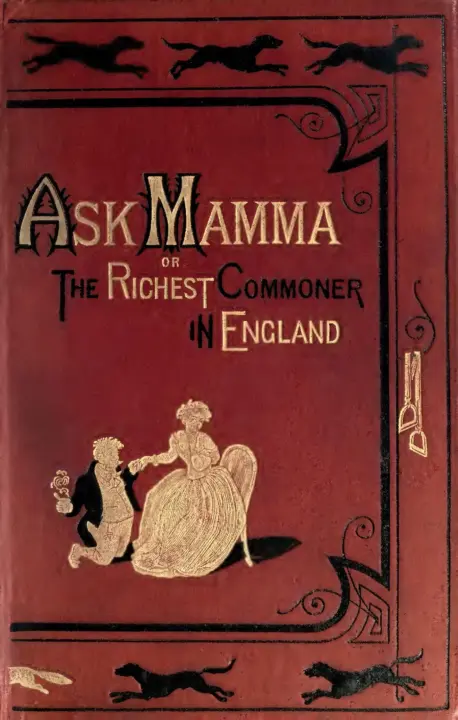
“Ask Mamma”; or, The Richest Commoner In England
Robert Smith Surtees
THE CLASSIC COLLECTION · 1852
"Mr. Sponge's Sporting Tour" by Robert Smith Surtees is a humorous novel written in the mid-19th century. The story centers around the comically ambiguous character of Mr. Sponge, a man navigating the world of hunting and high society with dubious motives, particularly in his pursuits of fortune. Through the lens of Mr. Sponge's absurdities and the sporting culture of his time, the book offers an entertaining critique of social pretensions and the sporting class. The opening of the novel introduces Mr. Soapey Sponge as he strolls along Oxford Street, characterized by an air of self-importance and a keen interest in horses and the equestrian lifestyle. As he wanders through the bustling streets of London, it becomes evident that his existence is largely devoted to horse trading and fortune-hunting, though he is not very successful in either. In an amusingly self-aware tone, the author sets the stage for Sponge's adventures and misadventures in the sporting world, complete with a motley cast of characters that will likely accompany him as the tale unfolds. The narrative suggests that Sponge's ambitions will lead him into both absurd and enlightening situations as he engages with fellow enthusiasts and seekers of wealth.
Introduction adapted from the source catalogue; source summaries may be automatically generated.
Free to read · English · 190,649 words · No account needed
MAKE TIME FOR A GOOD BOOK
On by default. Untick to stop anonymous reading totals. Each page counts after 10 seconds in view. How this works.
Anonymous counting is on unless you have switched it off.
'Poorly is he?' replied Mr. Sponge; 'sorry to hear that--what's the matter
with him?'
'Bad bilious attack, I think,' replied Plummey--'very subject to them, at this time of year particklarly; was laid up, at least confined to his room, three weeks last year of a similar attack.'
'Indeed!' replied Mr. Sponge, not relishing the information.
'Then I must say you'll dine here?' said the butler.
'Yes; I must have my dinner, of course,' replied Mr. Sponge. 'I'm not ill, you know. No occasion to make a great spread for me, you know; but still I must have some victuals, you know.'
'Certainly, sir, certainly,' replied Mr. Plummey.
'I couldn't think of leaving Mr. Puffington when he's poorly,' observed Mr. Sponge, half to himself and half to the butler.
'Oh, master--that's to say, Mr. Puffington--always does best when left alone,' observed Mr. Plummey, catching at the sentence: 'indeed the medical men recommend perfect quiet and moderate living as the best thing.'
'Do they?' replied Sponge, taking out another cigar. Mr. Plummey then withdrew, and presently went upstairs to report progress, or rather want of progress, to the gentleman whom he sometimes condescended to call 'master.'
Mr. Puffington had been taking another spell at the paper, and we need hardly say that the more he read of the run the less he liked it.
'Ah, that's Mr. Sponge's handiwork,' observed Plummey, as with a sneer of disgust Mr. Puffington threw the paper from him as Plummey entered the room.
'How do you know?' asked Mr. Puffington.
'Saw it, sir--saw it in the letter-bag going to the post.'
'Indeed!' replied Mr. Puffington.
'Mr. Spraggon and he did it after they came in from hunting.'
'I thought as much,' replied Mr. Puffington, in disgust.
Mr. Plummey then related how unsuccessful had been his attempts to get rid of the now most unwelcome guest. Mr. Puffington listened with attention, determined to get rid of him somehow or other. Plummey was instructed to ply Sponge well with hints, all of which, however, Mr. Sponge skilfully parried. So, at last, Mr. Puffington scrawled a miserable-looking note, explaining how very ill he was, how he regretted being deprived of Mr. Sponge's agreeable society, but hoping that it would suit Mr. Sponge to return as soon as he was better and pay the remainder of his visit--a pretty intelligible notice to quit, and one which even the cool Mr. Sponge was rather at a loss how to parry.
Your reading position is saved on this browser. Take it to another device with a library code. Reading pages adapt to text, rather than matching a printed edition.
BEHIND THE BOOK
This eBook is for the use of anyone anywhere in the United States and most other parts of the world at no cost and with almost no restrictions whatsoever. You may copy it, give it away or re-use it under the terms of the Project Gutenberg License included with this eBook or online at www.gutenberg.org. If you are not located in the United States, you will have to check the laws of the country where you are located before using this eBook. Read the source licence.
The original source file, including credits and licence, is retained by this library. Request an original-format copy at no charge. Please include the book title and Project Gutenberg identifier #16957.
KEEP YOUR CURIOSITY GOING
Coulson Kernahan

Maurice Baring
Frances Wright
Cécile Tormay

Frederic Jesup Stimson

W. H. P. (William Henry Pope) Jarvis