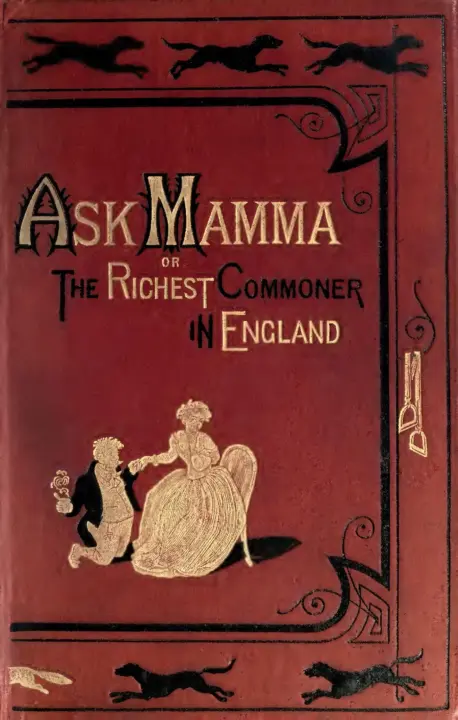
“Ask Mamma”; or, The Richest Commoner In England
Robert Smith Surtees
THE CLASSIC COLLECTION · 1852
"Mr. Sponge's Sporting Tour" by Robert Smith Surtees is a humorous novel written in the mid-19th century. The story centers around the comically ambiguous character of Mr. Sponge, a man navigating the world of hunting and high society with dubious motives, particularly in his pursuits of fortune. Through the lens of Mr. Sponge's absurdities and the sporting culture of his time, the book offers an entertaining critique of social pretensions and the sporting class. The opening of the novel introduces Mr. Soapey Sponge as he strolls along Oxford Street, characterized by an air of self-importance and a keen interest in horses and the equestrian lifestyle. As he wanders through the bustling streets of London, it becomes evident that his existence is largely devoted to horse trading and fortune-hunting, though he is not very successful in either. In an amusingly self-aware tone, the author sets the stage for Sponge's adventures and misadventures in the sporting world, complete with a motley cast of characters that will likely accompany him as the tale unfolds. The narrative suggests that Sponge's ambitions will lead him into both absurd and enlightening situations as he engages with fellow enthusiasts and seekers of wealth.
Introduction adapted from the source catalogue; source summaries may be automatically generated.
Free to read · English · 190,649 words · No account needed
MAKE TIME FOR A GOOD BOOK
On by default. Untick to stop anonymous reading totals. Each page counts after 10 seconds in view. How this works.
Anonymous counting is on unless you have switched it off.
We fear our fair friends will expect something gay from the above heading--lamps and flambeaux outside, fiddlers, feathers, and flirters in. Nothing of the sort, fair ladies--nothing of the sort. Lord Scamperdale 'at home' simply means that his lordship was not out hunting, that he had got his dirty boots and breeches off, and dry tweeds and tartans on.
Lord Scamperdale was the eighth earl; and, according to the usual alternating course of great English families--one generation living and the next starving--it was his lordship's turn to live; but the seventh earl having been rather unreasonable in the length of his lease, the present earl, who during the lifetime of his father was Lord Hardup, had contracted such parsimonious habits, that when he came into possession he could not shake them off; and but for the fortunate friendship of Abraham Brown, the village blacksmith, who had given his young idea a sporting turn, entering him with ferrets and rabbits, and so training him on with terriers and rat-catching, badger-baiting and otter-hunting, up to the noble sport of fox-hunting itself, in all probability his lordship would have been a regular miser. As it was, he did not spend a halfpenny upon anything but hunting; and his hunting, though well, was still economically done, costing him some couple of thousand a year, to which, for the sake of euphony, Jack used to add an extra five hundred; 'two thousand five under'd a year, five-and-twenty under'd a year,' sounding better, as Jack thought, and more imposing, than a couple of thousand, or two thousand, a year. There were few days on which Jack didn't inform the field what the hounds cost his lordship, or rather what they didn't cost him.
Woodmansterne, his lordship's principal residence, was a fine place. It stood in an undulating park of 800 acres, with its church, and its lakes, and its heronry, and its decoy, and its racecourse, and its varied grasses of the choicest kinds, for feeding the numerous herds of deer, so well known at Temple Bar and Charing Cross as the Woodmansterne venison. The house was a modern edifice, built by the sixth earl, who, having been a 'liver,' had run himself aground by his enormous outlay on this Italian structure, which was just finished when he died. The fourth earl, who, we should have stated, was a 'liver' too, was a man of vertu--a great traveller and collector of coins, pictures, statues, marbles, and curiosities generally--things that are very dear to buy, but oftentimes extremely cheap when sold; and, having collected a vast quantity from all parts of the world (no easy feat in those days), he made them heirlooms, and departed this life, leaving the next earl the pleasure of contemplating them. The fifth earl having duly starved through life, then made way for the sixth; who, finding such a quantity of valuables stowed away, as he thought, in rather a confined way, sent to London for a first-rate architect. Sir Thomas Squareall (who always posted with four horses), who forthwith pulled down the old brick-and-stone Elizabethan mansion, and built the present splendid Italian structure, of the finest polished stone, at an expense of--furniture and all--say 120,000l.; Sir Thomas's estimates being 30,000l. The seventh earl of course they starved; and the present lord, at the age of forty-three, found himself in possession of house, and coins, and curiosities; and, best of all, of some 90,000l. in the funds, which had quietly rolled up during the latter part of his venerable parent's existence. His lordship then took counsel with himself--first, whether he should marry or remain single; secondly, whether he should live or starve. Having considered the subject with all the attention a limited allowance of brains permitted, he came to the resolution that the second proposition depended a good deal upon the first; 'for,' said he to himself, 'if I marry, my lady, perhaps, may make me live; and therefore,' said he, 'perhaps I'd better remain single.' At all events, he came to the determination not to marry in a hurry; and until he did, he felt there was no occasion for him to inconvenience himself by living. So he had the house put away in brown holland, the carpets rolled up, the pictures covered, the statues shrouded in muslin, the cabinets of curiosities locked, the plate secured, the china closeted, and everything arranged with the greatest care against the time, which he put before him in the distance like a target, when he should marry and begin to live.
Your reading position is saved on this browser. Take it to another device with a library code. Reading pages adapt to text, rather than matching a printed edition.
BEHIND THE BOOK
This eBook is for the use of anyone anywhere in the United States and most other parts of the world at no cost and with almost no restrictions whatsoever. You may copy it, give it away or re-use it under the terms of the Project Gutenberg License included with this eBook or online at www.gutenberg.org. If you are not located in the United States, you will have to check the laws of the country where you are located before using this eBook. Read the source licence.
The original source file, including credits and licence, is retained by this library. Request an original-format copy at no charge. Please include the book title and Project Gutenberg identifier #16957.
KEEP YOUR CURIOSITY GOING
Coulson Kernahan

Maurice Baring
Frances Wright
Cécile Tormay

Frederic Jesup Stimson

W. H. P. (William Henry Pope) Jarvis