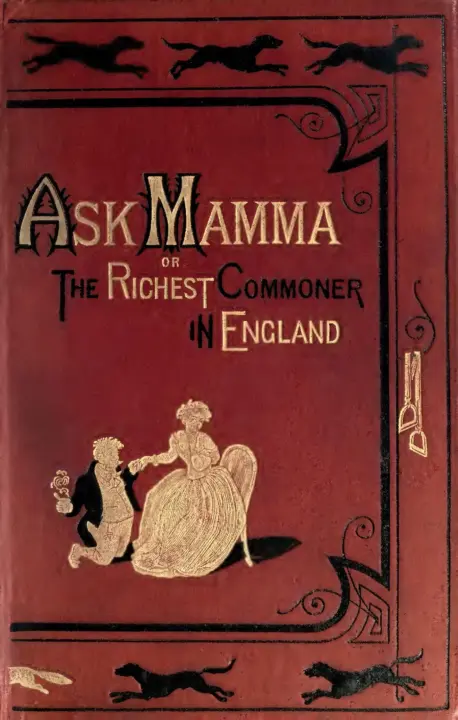
“Ask Mamma”; or, The Richest Commoner In England
Robert Smith Surtees
THE CLASSIC COLLECTION · 1852
"Mr. Sponge's Sporting Tour" by Robert Smith Surtees is a humorous novel written in the mid-19th century. The story centers around the comically ambiguous character of Mr. Sponge, a man navigating the world of hunting and high society with dubious motives, particularly in his pursuits of fortune. Through the lens of Mr. Sponge's absurdities and the sporting culture of his time, the book offers an entertaining critique of social pretensions and the sporting class. The opening of the novel introduces Mr. Soapey Sponge as he strolls along Oxford Street, characterized by an air of self-importance and a keen interest in horses and the equestrian lifestyle. As he wanders through the bustling streets of London, it becomes evident that his existence is largely devoted to horse trading and fortune-hunting, though he is not very successful in either. In an amusingly self-aware tone, the author sets the stage for Sponge's adventures and misadventures in the sporting world, complete with a motley cast of characters that will likely accompany him as the tale unfolds. The narrative suggests that Sponge's ambitions will lead him into both absurd and enlightening situations as he engages with fellow enthusiasts and seekers of wealth.
Introduction adapted from the source catalogue; source summaries may be automatically generated.
Free to read · English · 190,649 words · No account needed
MAKE TIME FOR A GOOD BOOK
On by default. Untick to stop anonymous reading totals. Each page counts after 10 seconds in view. How this works.
Anonymous counting is on unless you have switched it off.
Nothing bespeaks the character of a dealer's trade more than the servants and hangers-on of the establishment. The civiler in manner, and the better they are 'put on,' the higher the standing of the master, and the better the stamp of the horses.
Those about Mr. Buckram's were of a very shady order. Dirty-shirted, sloggering, baggy-breeched, slangey-gaitered fellows, with the word 'gin' indelibly imprinted on their faces. Peter Leather, the head man, was one of the fallen angels of servitude. He had once driven a duke--the Duke of Dazzleton--having nothing whatever to do but dress himself and climb into his well-indented richly fringed throne, with a helper at each horse's head to 'let go' at a nod from his broad laced three-cornered hat. Then having got in his cargo (or rubbish, as he used to call them), he would start off at a pace that was truly terrific, cutting out this vehicle, shooting past that, all but grazing a third, anathematizing the 'buses, and abusing the draymen. We don't know how he might be with the queen, but he certainly drove as though he thought nobody had any business in the street while the Duchess of Dazzleton wanted it. The duchess liked going fast, and Peter accommodated her. The duke jobbed his horses and didn't care about pace, and so things might have gone on very comfortably, if Peter one afternoon hadn't run his pole into the panel of a very plain but very neat yellow barouche, passing the end of New Bond Street, which having nothing but a simple crest--a stag's head on the panel--made him think it belonged to some bulky cit, taking the air with his rib, but who, unfortunately, turned out to be no less a person than Sir Giles Nabem, Knight, the great police magistrate, upon one of whose myrmidons in plain clothes, who came to the rescue, Peter committed a most violent assault, for which unlucky casualty his worship furnished him with rotatory occupation for his fat calves in the 'H. of C.,' as the clerk shortly designated the House of Correction. Thither Peter went, and in lieu of his lace-bedaubed coat, gold-gartered plushes, stockings, and buckled shoes, he was dressed up in a suit of tight-fitting yellow and black-striped worsteds, that gave him the appearance of a wasp without wings. Peter Leather then tumbled regularly down the staircase of servitude, the greatness of his fall being occasionally broken by landing in some inferior place. From the Duke of Dazzleton's, or rather from the tread-mill, he went to the Marquis of Mammon, whom he very soon left because he wouldn't wear a second-hand wig. From the marquis he got hired to the great Irish Earl of Coarsegab, who expected him to wash the carriage, wait at table, and do other incidentals never contemplated by a London coachman. Peter threw this place up with indignation on being told to take the letters to the post. He then lived on his 'means' for a while, a thing that is much finer in theory than in practice, and having about exhausted his substance and placed the bulk of his apparel in safe keeping, he condescended to take a place as job coachman in a livery-stable--a 'horses let by the hour, day, or month' one, in which he enacted as many characters, at least made as many different appearances, as the late Mr. Mathews used to do in his celebrated 'At Homes.' One day Peter would be seen ducking under the mews' entrance in one of those greasy, painfully well-brushed hats, the certain precursors of soiled linen and seedy, most seedy-covered buttoned coats, that would puzzle a conjuror to say whether they were black, or grey, or olive, or invisible green turned visible brown. Then another day he might be seen in old Mrs. Gadabout's sky-blue livery, with a tarnished, gold-laced hat, nodding over his nose; and on a third he would shine forth in Mrs. Major-General Flareup's cockaded one, with a worsted shoulder-knot, and a much over-daubed light drab livery coat, with crimson inexpressibles, so tight as to astonish a beholder how he ever got into them. Humiliation, however, has its limits as well as other things; and Peter having been invited to descend from his box--alas! a regular country patent leather one, and invest himself in a Quaker-collared blue coat, with a red vest, and a pair of blue trousers with a broad red stripe down the sides, to drive the Honourable old Miss Wrinkleton, of Harley Street, to Court in a 'one oss pianoforte-case,' as he called a Clarence, he could stand it no longer, and, chucking the nether garments into the fire, he rushed frantically up the area-steps, mounted his box, and quilted the old crocodile of a horse all the way home, accompanying each cut with an imprecation such as 'me make a guy of myself!' (whip) 'me put on sich things!' (whip, whip) 'me drive down Sin Jimses-street!' (whip, whip, whip), 'I'd see her ---- fust!' (whip, whip, whip), cutting at the old horse just as if he was laying it into Miss Wrinkleton, so that by the time he got home he had established a considerable lather on the old nag, which his master resenting a row ensued, the sequel of which may readily be imagined. After assisting Mrs. Clearstarch, the Kilburn laundress, in getting in and taking out her washing, for a few weeks, chance at last landed him at Mr. Benjamin Buckram's, from whence he is now about to be removed to become our hero Mr. Sponge's Sancho Panza, in his fox-hunting, fortune-hunting career, and disseminate in remote parts his doctrines of the real honour and dignity of servitude. Now to the inspection.
Your reading position is saved on this browser. Take it to another device with a library code. Reading pages adapt to text, rather than matching a printed edition.
BEHIND THE BOOK
This eBook is for the use of anyone anywhere in the United States and most other parts of the world at no cost and with almost no restrictions whatsoever. You may copy it, give it away or re-use it under the terms of the Project Gutenberg License included with this eBook or online at www.gutenberg.org. If you are not located in the United States, you will have to check the laws of the country where you are located before using this eBook. Read the source licence.
The original source file, including credits and licence, is retained by this library. Request an original-format copy at no charge. Please include the book title and Project Gutenberg identifier #16957.
KEEP YOUR CURIOSITY GOING
Coulson Kernahan

Maurice Baring
Frances Wright
Cécile Tormay

Frederic Jesup Stimson

W. H. P. (William Henry Pope) Jarvis