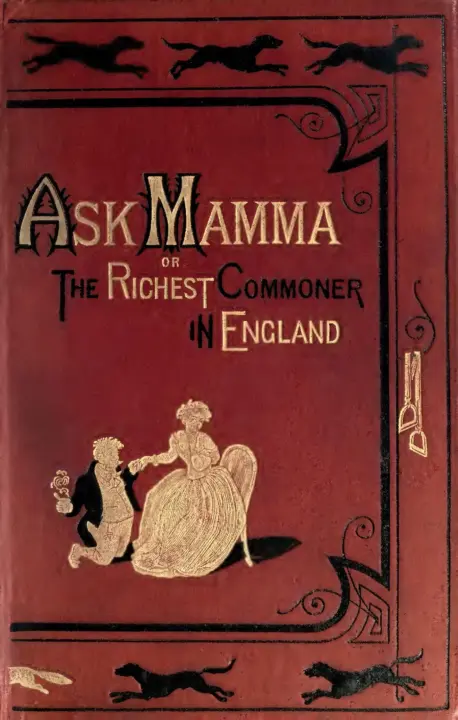
“Ask Mamma”; or, The Richest Commoner In England
Robert Smith Surtees
THE CLASSIC COLLECTION · 1852
"Mr. Sponge's Sporting Tour" by Robert Smith Surtees is a humorous novel written in the mid-19th century. The story centers around the comically ambiguous character of Mr. Sponge, a man navigating the world of hunting and high society with dubious motives, particularly in his pursuits of fortune. Through the lens of Mr. Sponge's absurdities and the sporting culture of his time, the book offers an entertaining critique of social pretensions and the sporting class. The opening of the novel introduces Mr. Soapey Sponge as he strolls along Oxford Street, characterized by an air of self-importance and a keen interest in horses and the equestrian lifestyle. As he wanders through the bustling streets of London, it becomes evident that his existence is largely devoted to horse trading and fortune-hunting, though he is not very successful in either. In an amusingly self-aware tone, the author sets the stage for Sponge's adventures and misadventures in the sporting world, complete with a motley cast of characters that will likely accompany him as the tale unfolds. The narrative suggests that Sponge's ambitions will lead him into both absurd and enlightening situations as he engages with fellow enthusiasts and seekers of wealth.
Introduction adapted from the source catalogue; source summaries may be automatically generated.
Free to read · English · 190,649 words · No account needed
MAKE TIME FOR A GOOD BOOK
On by default. Untick to stop anonymous reading totals. Each page counts after 10 seconds in view. How this works.
Anonymous counting is on unless you have switched it off.
Canter, canter, canter, went Jawleyford, with an arm akimbo, head well up, legs well down, toes well pointed, as if he were going to a race, where his work would end on arriving, instead of to a fox-hunt, where it would only begin.
'You are rather hard on the old nag, aren't you?' at length asked Sponge, as, having cleared the rushy, swampy park, they came upon the macadamized turnpike, and Jawleyford selected the middle of it as the scene of his further progression.
'Oh no!' replied Jawleyford, tit-tup-ing along with a loose rein, as if he was on the soundest, freshest-legged horse in the world; 'oh no! my horses are used to it.' 'Well, but if you mean to hunt him,' observed Sponge, 'he'll be blown before he gets to cover.'
'Get him in wind, my dear fellow,' replied Jawleyford, 'get him in wind,' touching the horse with the spur as he spoke.
'Faith, but if he was as well on his legs as he is in his wind, he'd not be amiss,' rejoined Sponge.
So they cantered and trotted, and trotted and cantered away, Sponge thinking he could afford pace as well as Jawleyford. Indeed, a horse has only to become a hack, to be able to do double the work he was ever supposed to be capable of.
But to the meet.
Scrambleford Green was a small straggling village on the top of a somewhat high hill, that divided the vale in which Jawleyford Court was situated from the more fertile one of Farthinghoe, in which Lord Scamperdale lived.
It was one of those out-of-the-way places at which the meet of the hounds, and a love feast or fair, consisting of two fiddlers (one for each public-house), a few unlicensed packmen, three or four gingerbread stalls, a drove of cows and some sheep, form the great events of the year among a people who are thoroughly happy and contented with that amount of gaiety. Think of that, you 'used up' young gentlemen of twenty, who have exhausted the pleasures of the world! The hounds did not come to Scrambleford Green often, for it was not a favourite meet; and when they did come, Frosty and the men generally had them pretty much to themselves. This day, however, was the exception; and Old Tom Yarnley, whom age had bent nearly double, and who hobbled along on two sticks, declared that never in the course of his recollection, a period extending over the best part of a century, had he seen such a 'sight of red coats' as mustered that morning at Scrambleford Green. It seemed as if there had been a sudden rising of sportsmen. What brought them all out? What brought Mr. Puffington, the master of the Hanby hounds, out? What brought Blossomnose again? What Mr. Wake, Mr. Fossick, Mr. Fyle, who had all been out the day before? Reader, the news had spread throughout the country that there was a great writer down; and they wanted to see what he would say of them--they had come to sit for their portraits, in fact. There was a great gathering, at least for the Flat Hat Hunt, who seldom mustered above a dozen. Tom Washball came, in a fine new coat and new flat-fliped hat with a broad binding; also Mr. Sparks, of Spark Hall; Major Mark; Mr. Archer, of Cheam Lodge; Mr. Reeves, of Coxwell Green; Mr. Bliss, of Boltonshaw; Mr. Joyce, of Ebstone; Dr. Capon, of Calcot; Mr. Dribble, of Hook; Mr. Slade, of Three-Burrow Hill; and several others. Great was the astonishment of each as the other cast up.
Your reading position is saved on this browser. Take it to another device with a library code. Reading pages adapt to text, rather than matching a printed edition.
BEHIND THE BOOK
This eBook is for the use of anyone anywhere in the United States and most other parts of the world at no cost and with almost no restrictions whatsoever. You may copy it, give it away or re-use it under the terms of the Project Gutenberg License included with this eBook or online at www.gutenberg.org. If you are not located in the United States, you will have to check the laws of the country where you are located before using this eBook. Read the source licence.
The original source file, including credits and licence, is retained by this library. Request an original-format copy at no charge. Please include the book title and Project Gutenberg identifier #16957.
KEEP YOUR CURIOSITY GOING
Coulson Kernahan

Maurice Baring
Frances Wright
Cécile Tormay

Frederic Jesup Stimson

W. H. P. (William Henry Pope) Jarvis