THE CLASSIC COLLECTION✦Women’s Wild Oats: Essays on the Re-fixing of Moral StandardsCLASSIC FREE BOOKS
Women’s Wild Oats: Essays on the Re-fixing of Moral Standards
C. Gasquoine (Catherine Gasquoine) Hartley
THE CLASSIC COLLECTION · 1917
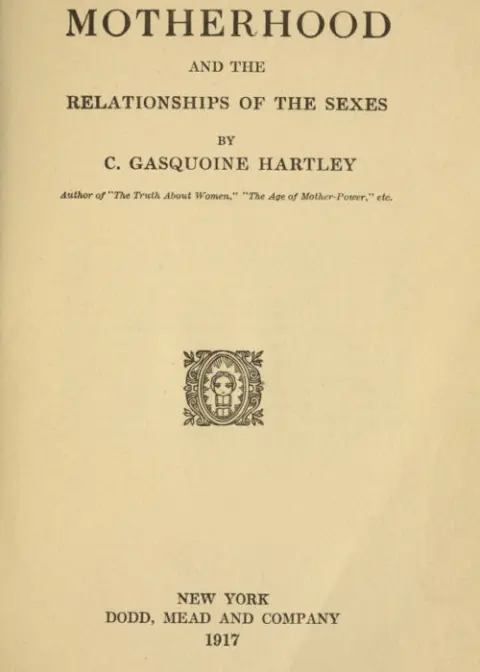
"Motherhood and the Relationships of the Sexes" by C. Gasquoine Hartley is a socio-philosophical examination written in the early 20th century. The book discusses the concept of motherhood, the evolving roles of women, and the relationships between the sexes in the context of societal changes brought about by the Great European War. Hartley's writing suggests a deep exploration of the maternal instinct and its implications on race and civilization, emphasizing the critical role of mothers in shaping future generations. The opening of the work reflects on the historical context of women’s rights leading up to the war and examines how the conflict profoundly shifted women's positions and their struggle for political recognition. Hartley argues that women’s fight for liberation had intensified emotions that led to a reactionary state, suggesting that the war forcefully highlighted the need for women to embrace their maternal instincts and responsibilities. She presents a dual perspective on motherhood, viewing it as both a natural instinct and a social obligation that requires renewed focus and respect, especially in light of the pressing issues of child welfare and maternal health that emerged during the war years.
Introduction adapted from the source catalogue; source summaries may be automatically generated.
Free to read · English · 106,750 words · No account needed
MAKE TIME FOR A GOOD BOOK
On by default. Untick to stop anonymous reading totals. Each page counts after 10 seconds in view. How this works.
Anonymous counting is on unless you have switched it off.
[53] Mitchell, Childhood of Animals, pp. 170-171.
[54] Espinas, Soc. Animales, pp. 120 et seq. The reader should consult this work on the three stages of domestic societies: “the society conjugal, the society maternal, and the society paternal.”
[55] Letourneau, Evolution of Marriage, p. 327.
[56] In this connection see The Truth about Woman pp. 110-111.
[57] Darwin, Descent of Man, p. 443.
[58] Espinas, Soc. Animales. See the introductory and concluding chapters of this admirable book.
[59] Havelock Ellis, Psychology of Sex, vol. vi. p. 422.
[60] J. C. Houtzeau, Facultés mentales des animaux, vol. ii. p. 394. This work should be consulted, in particular, for the comparison it gives of the mental faculties of the animals with those of man.
[61] Darwin, Descent of Man, p. 399.
[62] Letourneau, Evolution of Marriage, p. 33. See also The Truth about Woman, p. 109 and The Position of Woman in Primitive Society.
[63] Mitchell, Childhood of Animals, p. 171 et seq.; p. 176.
[64] English title, The Position of Woman in Primitive Society: A Study
of Matriarchy.
[65] I am not giving any references in support of the statements made in this chapter. The reader is referred to The Age of Mother-Power.
[66] The Age of Mother-Power.
[67] I would wish to say here that I did not consider this question sufficiently when I wrote The Age of Mother-Power. I was, perhaps, carried away by the advantages to women of the maternal system of reckoning descent. Such a system could be preserved only under the conditions of the communal clan. This necessitated the absorption of the individual family, which must consist of father, mother and children. I hold this to be a greater evil than the wrongs—great as those wrongs undoubtedly were—that came in family relationships with the re-establishment of the patriarchal home.
[68] The reader is referred to a new book on feminism that has come into my hands while reading the proofs of this chapter, Towards a Sane Feminism, by Wilma Meikle. The book is instructive as expressing the views of the younger suffragists. Note especially the three chapters, “Simplifying Sex Problems,” “How to be Moral though Married,” and “Between the Home and the Labour Market.” One short sentence I quote which clearly shows the opinions held by the writer, “The truth is that Motherhood is one of the most casual of all relationships and one of the shortest-lived.” Any comment from me on this smart folly is unnecessary.
[69] The quotation is taken from the well-known book of Mrs. Perkins Gilman, who gave the earliest expression to this false view of what is good for the child.
[70] Years of Childhood, by Serge Aksakoff, trans. by J. D. Duff.
[71] See note on p. 155.
Your reading position is saved on this browser. Take it to another device with a library code. Reading pages adapt to text, rather than matching a printed edition.
BEHIND THE BOOK
This eBook is for the use of anyone anywhere in the United States and most other parts of the world at no cost and with almost no restrictions whatsoever. You may copy it, give it away or re-use it under the terms of the Project Gutenberg License included with this eBook or online at www.gutenberg.org. If you are not located in the United States, you will have to check the laws of the country where you are located before using this eBook. Read the source licence.
The original source file, including credits and licence, is retained by this library. Request an original-format copy at no charge. Please include the book title and Project Gutenberg identifier #57575.
KEEP YOUR CURIOSITY GOING

David Patterson (Spirit) Hatch
Cécile Tormay

Moritz Busch
Coulson Kernahan
John L. Ransom

Ralph Waldo Emerson