THE CLASSIC COLLECTION✦Women’s Wild Oats: Essays on the Re-fixing of Moral StandardsCLASSIC FREE BOOKS
Women’s Wild Oats: Essays on the Re-fixing of Moral Standards
C. Gasquoine (Catherine Gasquoine) Hartley
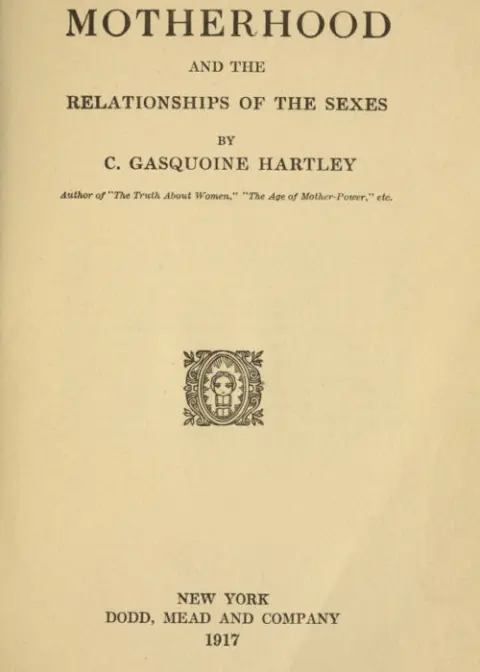
THE CLASSIC COLLECTION · 1917
"Motherhood and the Relationships of the Sexes" by C. Gasquoine Hartley is a socio-philosophical examination written in the early 20th century. The book discusses the concept of motherhood, the evolving roles of women, and the relationships between the sexes in the context of societal changes brought about by the Great European War. Hartley's writing suggests a deep exploration of the maternal instinct and its implications on race and civilization, emphasizing the critical role of mothers in shaping future generations. The opening of the work reflects on the historical context of women’s rights leading up to the war and examines how the conflict profoundly shifted women's positions and their struggle for political recognition. Hartley argues that women’s fight for liberation had intensified emotions that led to a reactionary state, suggesting that the war forcefully highlighted the need for women to embrace their maternal instincts and responsibilities. She presents a dual perspective on motherhood, viewing it as both a natural instinct and a social obligation that requires renewed focus and respect, especially in light of the pressing issues of child welfare and maternal health that emerged during the war years.
Introduction adapted from the source catalogue; source summaries may be automatically generated.
Free to read · English · 106,750 words · No account needed
MAKE TIME FOR A GOOD BOOK
On by default. Untick to stop anonymous reading totals. Each page counts after 10 seconds in view. How this works.
Anonymous counting is on unless you have switched it off.
[72] These were the numbers given in the debate in Parliament, April 4, 1916, at the time of writing this chapter. They will be much, much larger before my book is finished and published.
[73] For a full description of these early experiments in communal dwellings see The Age of Mother-Power, pp. 48, 103-131, 151.
[74] See p. 112.
[75] See p. 119.
[76] See The Age of Mother-Power, pp. 127, 173, 178, 177-180.
[77] See Iwan Bloch, Sexual History of our Times, p. 196, who quotes
from Josef Kohler.
[78] See pp. 229-254.
[79] The reader is referred to the chapter on “Divorce” in The Truth about Woman, pp. 352-359. I may, perhaps, also state my intention of devoting my next book entirely to the urgent question of Divorce Reform. For this reason I have said very little about the subject in this work.
[80] See pp. 229-254.
[81] See p. 347.
[82] The reader is referred to the chapter on “Reproductive Differences” in an instructive little book, Preparation for Marriage, by Walter Heape.
[83] See p. 339.
[84] See The Truth about Woman, pp. 326-328. Also article in the English Review, September 1913, republished as a small book in America under the title Women and Morality.
[85] The Truth about Woman, p. 191.
[86] See p. 51.
[87] This estimate of the number of Women War Workers is given by Sir Leo
Chiozza Money.
[88] See p. 155.
[89] Sir Leo Chiozza Money, in an article in Tit Bits (October 21, 1916), “Women’s Share in Winning the War,” says, “Assuming peace to come by the end of 1917, the country will probably contain about two millions more women than men of marriageable age.”
[90] I am here in agreement with Mr. H. G. Wells’ forecast, “What is Coming?” See his essay on Women and the War, already referred to, p. 167.
[91] On this question see The Truth about Woman, pp. 372, 373. An article by Mr. W. L. George, “Women after the War,” appeared in the English Review of December 1. Mr. George gives some very interesting statistics as to the disproportion between the numbers of the two sexes, treating the question from a very new point of view. He shows that the number of unmarried men in England and Wales at the last census so greatly outnumbered the extra women that there were “nearly three men for every superfluous woman!”
[92] I related this incident first in The Truth about Woman, p. 347.
[93] Very interesting statistics in this connection are given in an admirable monograph by Dr. Max Marcuse, Uneheliche Mütter (Berlin, 1907, vol. xxvii. of the Documents of Great Towns, edited by Hans Ostwald).
Marriages Illegitimate births
per 1000. per 1000.
1876 8.5 8.6
1877 8.0 8.7
1878 7.7 8.7
1879 7.5 8.8
Taken from Jahrbuch für das deutsche Reich. This table clearly shows a steady increase in the illegitimate birth-rate in direct proportion to the decline in the number of marriages.
Your reading position is saved on this browser. Take it to another device with a library code. Reading pages adapt to text, rather than matching a printed edition.
BEHIND THE BOOK
This eBook is for the use of anyone anywhere in the United States and most other parts of the world at no cost and with almost no restrictions whatsoever. You may copy it, give it away or re-use it under the terms of the Project Gutenberg License included with this eBook or online at www.gutenberg.org. If you are not located in the United States, you will have to check the laws of the country where you are located before using this eBook. Read the source licence.
The original source file, including credits and licence, is retained by this library. Request an original-format copy at no charge. Please include the book title and Project Gutenberg identifier #57575.
KEEP YOUR CURIOSITY GOING

David Patterson (Spirit) Hatch
Cécile Tormay

Moritz Busch
Coulson Kernahan
John L. Ransom

Ralph Waldo Emerson