THE CLASSIC COLLECTION✦Women’s Wild Oats: Essays on the Re-fixing of Moral StandardsCLASSIC FREE BOOKS
Women’s Wild Oats: Essays on the Re-fixing of Moral Standards
C. Gasquoine (Catherine Gasquoine) Hartley
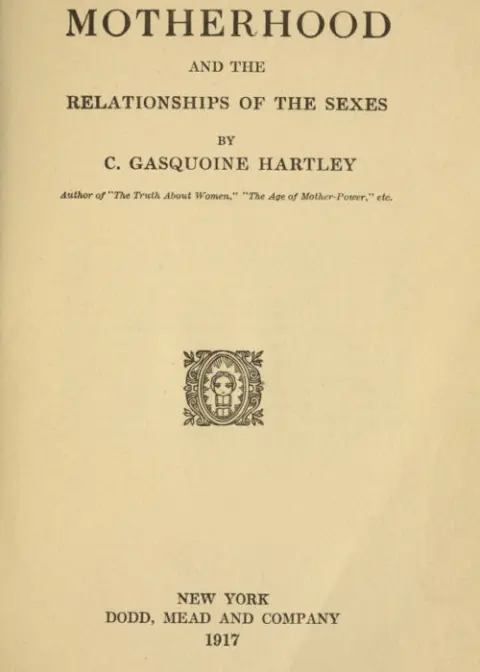
THE CLASSIC COLLECTION · 1917
"Motherhood and the Relationships of the Sexes" by C. Gasquoine Hartley is a socio-philosophical examination written in the early 20th century. The book discusses the concept of motherhood, the evolving roles of women, and the relationships between the sexes in the context of societal changes brought about by the Great European War. Hartley's writing suggests a deep exploration of the maternal instinct and its implications on race and civilization, emphasizing the critical role of mothers in shaping future generations. The opening of the work reflects on the historical context of women’s rights leading up to the war and examines how the conflict profoundly shifted women's positions and their struggle for political recognition. Hartley argues that women’s fight for liberation had intensified emotions that led to a reactionary state, suggesting that the war forcefully highlighted the need for women to embrace their maternal instincts and responsibilities. She presents a dual perspective on motherhood, viewing it as both a natural instinct and a social obligation that requires renewed focus and respect, especially in light of the pressing issues of child welfare and maternal health that emerged during the war years.
Introduction adapted from the source catalogue; source summaries may be automatically generated.
Free to read · English · 106,750 words · No account needed
MAKE TIME FOR A GOOD BOOK
On by default. Untick to stop anonymous reading totals. Each page counts after 10 seconds in view. How this works.
Anonymous counting is on unless you have switched it off.
[29] Pycraft, ibid., p. 218. The story of this excellent father and also several of the other cases given are taken from Yarrell, Brit. Fishes, 2nd edit., ii. p. 436.
[30] J. Lewis Bonhote, British Birds, pp. 314-315. See also The Truth about Woman, pp. 107, 249, 265.
[31] P. Chalmers-Mitchell, Childhood of Animals, pp. 70, 109, 157.
[32] Several examples are mentioned in Darwinism, p. 281. Wallace, however, brings them forward in quite a different connection to prove his theory of the protective duller colours of the female birds.
[33] P. 136 et seq.
[34] See p. 221, which is evidence that, perhaps, may be held to give
some corroboration.
[35] An interesting account of the family qualities of birds is given by Espinas in Des Sociétés Animales, pp. 234-292.
[36] P. C. Mitchell, Childhood of Animals, pp. 157, 158. See also about the ostrich, The Truth about Woman, p. 94.
[37] This is done to my knowledge by the male wood-pigeon, missel-thrush, blue-martin, buzzard, stone curlew, curlew, dottrel, sand-piper, common gull, black-coated gull, kittiwake, razorbill, puffin, stormy petrel, great blue heron and black vulture. There are probably good fathers among other species whose names I have missed.
[38] Pycraft, Infancy of Animals, p. 62.
[39] Pycraft, Infancy of Animals, pp. 77-78.
[40] Mitchell, Childhood of Animals, pp. 160-162. Pycraft, Infancy of Animals, pp. 63, 68, 70, 71, 75, 76.
[41] The scene was witnessed by Miss Turner. I take my account from Mr. Pycraft, who quotes from Miss Turner.
[42] Mr. Eliot Howard calls attention to this remarkable conduct in his fascinating book on the British Warblers.
[43] Mitchell, Childhood of Animals, pp. 149-150, 159.
[44] For a much fuller account of these bad fathers among birds see The Truth about Woman, pp. 90, 104-111, where explanation is attempted. See also The Position of Woman in Primitive Society (American title, The Age of Mother-Power), p. 63.
[45] J. G. Millais, Natural History of British Ducks, p. 8.
[46] The habits of the penguins were first noted by the late Dr. Ed. A. Wilson, the distinguished naturalist of the Discovery Expedition, and on his death his work was ably carried on by the Staff Surgeon, Murray Levick. He has come nearer to the life of the penguin than any other discoverer. See Natural History of the Adélie Penguins. Also article in The New Statesman, April 17, 1915.
[47] The lowliest living mammals, the duck-billed mole and the anteater of Australia, still lay eggs, which they retain within their bodies until nearly ready to hatch.
[48] This case is recorded by Mr. Chalmers Mitchell in The Childhood of Animals, the fascinating book from which I have gained so much assistance.
[49] See The Truth about Woman, pp. 102-114, also The Position of Woman in Primitive Society, the theme of which book follows and develops this theory.
[50] Mitchell, Childhood of Animals, p. 225.
[51] Mitchell, Childhood of Animals, pp. 164, 166, 225.
[52] Letourneau, The Evolution of Marriage, p. 32.
Your reading position is saved on this browser. Take it to another device with a library code. Reading pages adapt to text, rather than matching a printed edition.
BEHIND THE BOOK
This eBook is for the use of anyone anywhere in the United States and most other parts of the world at no cost and with almost no restrictions whatsoever. You may copy it, give it away or re-use it under the terms of the Project Gutenberg License included with this eBook or online at www.gutenberg.org. If you are not located in the United States, you will have to check the laws of the country where you are located before using this eBook. Read the source licence.
The original source file, including credits and licence, is retained by this library. Request an original-format copy at no charge. Please include the book title and Project Gutenberg identifier #57575.
KEEP YOUR CURIOSITY GOING

David Patterson (Spirit) Hatch
Cécile Tormay

Moritz Busch
Coulson Kernahan
John L. Ransom

Ralph Waldo Emerson