THE CLASSIC COLLECTION✦Women’s Wild Oats: Essays on the Re-fixing of Moral StandardsCLASSIC FREE BOOKS
Women’s Wild Oats: Essays on the Re-fixing of Moral Standards
C. Gasquoine (Catherine Gasquoine) Hartley
THE CLASSIC COLLECTION · 1917
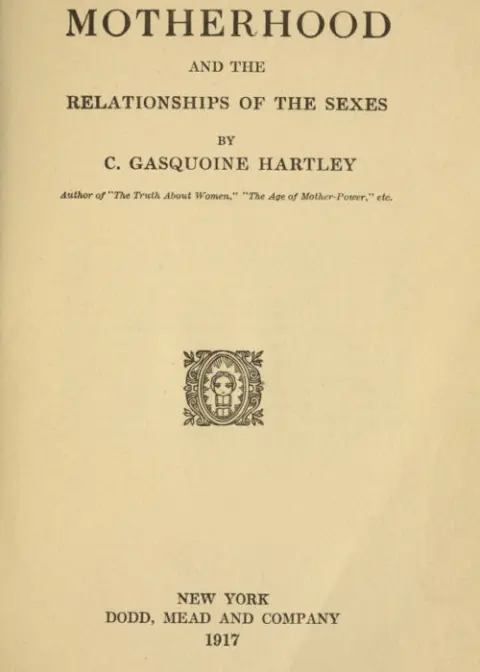
"Motherhood and the Relationships of the Sexes" by C. Gasquoine Hartley is a socio-philosophical examination written in the early 20th century. The book discusses the concept of motherhood, the evolving roles of women, and the relationships between the sexes in the context of societal changes brought about by the Great European War. Hartley's writing suggests a deep exploration of the maternal instinct and its implications on race and civilization, emphasizing the critical role of mothers in shaping future generations. The opening of the work reflects on the historical context of women’s rights leading up to the war and examines how the conflict profoundly shifted women's positions and their struggle for political recognition. Hartley argues that women’s fight for liberation had intensified emotions that led to a reactionary state, suggesting that the war forcefully highlighted the need for women to embrace their maternal instincts and responsibilities. She presents a dual perspective on motherhood, viewing it as both a natural instinct and a social obligation that requires renewed focus and respect, especially in light of the pressing issues of child welfare and maternal health that emerged during the war years.
Introduction adapted from the source catalogue; source summaries may be automatically generated.
Free to read · English · 106,750 words · No account needed
MAKE TIME FOR A GOOD BOOK
On by default. Untick to stop anonymous reading totals. Each page counts after 10 seconds in view. How this works.
Anonymous counting is on unless you have switched it off.
[12] These cases are taken from Pycraft, The Infancy of Animals, and the different works of Fabre, Social Life in the Insect World, The Life and Love of the Insect, Insect Life, etc.
[13] See article by J. Arthur Thomson in The New Statesman, November
1915.
[14] Not all the scarabees live to see the adult growth of their children. This is done, as Fabre’s observations have established by the Spanish Copris and some related dung-beetles, which are unique among non-social insects, inasmuch as the mother survives to see the emergence and complete metamorphosis of the family for whom she and her husband have so unremittingly toiled.
[15] In this connection the reader is recommended to consult C. Lloyd-Morgan’s works, in particular Animal Life and Intelligence. See also the interesting remarks on “De L’Amour Maternal,” in Sociétés Animales, by Alfred Espinas, pp. 172-180.
[16] See Espinas, Des Sociétés Animales, especially Chapter V, “Société domestique paternelle,” pp. 236 et seq.
[17] These cases, as well as many others in this and in the next chapter, are taken from Pycraft’s Infancy of Animals. I would wish to record my indebtedness to this fascinating book. To prevent continuous reference notes, wherever it is not otherwise stated, the reader will know the cases I quote have been taken from Mr. Pycraft’s book.
[18] The reader is referred to a small book by St. George Mivart, The
Common Frog.
[19] I quote from Mr. Pycraft’s account of this incident, Infancy of
Animals, p. 193.
[20] Pycraft gives a short account of their habits, ibid., pp. 200-206.
[21] Problems of Sex, by J. A. Thomson and Prof. Geddes, p. 20.
[22] Pycraft, The Infancy of Animals, pp. 215-216; G. J. Romanes, Animal Intelligence, pp. 243-245, 246-247; J. A. Thomson and Prof. Geddes, Problems of Sex, p. 20.
[23] Animal Intelligence, p. 242.
[24] Pycraft. These cases, with those that follow, are again taken from The Infancy of Animals, pp. 217-219.
[25] Animal Intelligence, p. 242.
[26] Romanes refers to Silliman’s American Journal, February 1872.
[27] These cases would seem to contradict the statement made on p. 82 that small families occur when the young are protected by the parents. I cannot explain this exception. But what I have stated about the dependence of the birth rate on the amount of parental care is commonly true. In this connection I would quote Mr. Pycraft (Infancy of Animals, p. 214): “A careful survey of the facts shows us that the production of large numbers of eggs and young produces the same result as obtained where but few eggs are laid, and are either carefully guarded by the parents or are specially protected by some other means.”
[28] Quoted by St. George Mivart.
Your reading position is saved on this browser. Take it to another device with a library code. Reading pages adapt to text, rather than matching a printed edition.
BEHIND THE BOOK
This eBook is for the use of anyone anywhere in the United States and most other parts of the world at no cost and with almost no restrictions whatsoever. You may copy it, give it away or re-use it under the terms of the Project Gutenberg License included with this eBook or online at www.gutenberg.org. If you are not located in the United States, you will have to check the laws of the country where you are located before using this eBook. Read the source licence.
The original source file, including credits and licence, is retained by this library. Request an original-format copy at no charge. Please include the book title and Project Gutenberg identifier #57575.
KEEP YOUR CURIOSITY GOING

David Patterson (Spirit) Hatch
Cécile Tormay

Moritz Busch
Coulson Kernahan
John L. Ransom

Ralph Waldo Emerson