THE CLASSIC COLLECTION✦Women’s Wild Oats: Essays on the Re-fixing of Moral StandardsCLASSIC FREE BOOKS
Women’s Wild Oats: Essays on the Re-fixing of Moral Standards
C. Gasquoine (Catherine Gasquoine) Hartley
THE CLASSIC COLLECTION · 1917
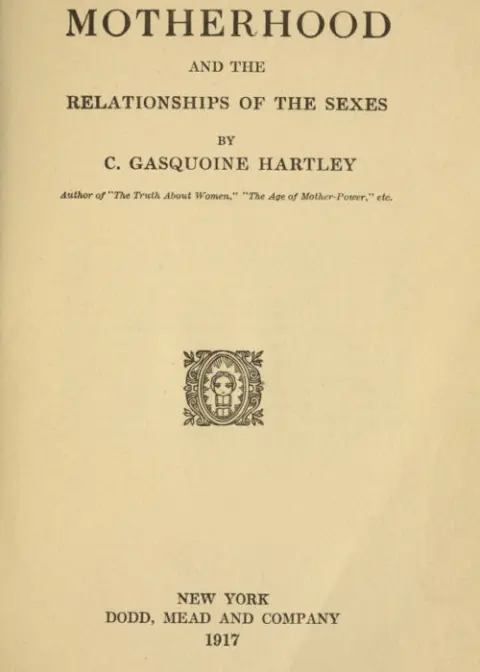
"Motherhood and the Relationships of the Sexes" by C. Gasquoine Hartley is a socio-philosophical examination written in the early 20th century. The book discusses the concept of motherhood, the evolving roles of women, and the relationships between the sexes in the context of societal changes brought about by the Great European War. Hartley's writing suggests a deep exploration of the maternal instinct and its implications on race and civilization, emphasizing the critical role of mothers in shaping future generations. The opening of the work reflects on the historical context of women’s rights leading up to the war and examines how the conflict profoundly shifted women's positions and their struggle for political recognition. Hartley argues that women’s fight for liberation had intensified emotions that led to a reactionary state, suggesting that the war forcefully highlighted the need for women to embrace their maternal instincts and responsibilities. She presents a dual perspective on motherhood, viewing it as both a natural instinct and a social obligation that requires renewed focus and respect, especially in light of the pressing issues of child welfare and maternal health that emerged during the war years.
Introduction adapted from the source catalogue; source summaries may be automatically generated.
Free to read · English · 106,750 words · No account needed
MAKE TIME FOR A GOOD BOOK
On by default. Untick to stop anonymous reading totals. Each page counts after 10 seconds in view. How this works.
Anonymous counting is on unless you have switched it off.
I shall be called old-fashioned. Yet, perhaps, after all, I see further, deeper, and more surely than those who call me so.
The union of the man and the woman cleaving to each other can be the wonder of life. Marriage should be a blessing of the senses, a kindling of the spirit, a mutual surrender, and a new creation.
Creation is not accomplished; it is continuous and unceasing, and in its work every living thing has its share, destroying and creating.
What is it that I desire? What is it that I expect? What is the change of whose coming I feel as assured as of the rising of to-morrow’s sun?
I look for a regeneration of woman’s instincts through consciousness. She, who has conquered the world, will then renounce the world. The old corruption will be swept away. Woman is the keeper of redemption; it is her work to lead man back to the gate of his being.
We are waiting in pain for the new liberation. Love alters everything, it melts the whole world and makes it afresh. Love is the sun of our spirits and the wind.
Is there, indeed, this glad hope of things changing? Changing? They have got to change. The weeds of our mistakes have so grown up that they are choking us. Yes, whether from inside or from out, I do not know yet, but there is change and awakening coming. Motherhood will triumph. Life is going to be made new before long.
[1] The Position of Women in Primitive Society.
[2] See note at the end of the chapter.
[3] The number recorded as killed up to November 9, 1914, was 109,723.
[4] H. G. Wells, Mankind in the Making, p. 88.
[5] The towns with the highest percentages are as follow: Morley 31, Chadderton 32, Bacup 38, Stockton 34, Liverpool 38, Salford 32, Stockport 39, Mansfield 49.
[6] These quotations are taken from the Report of the Board of
Education, p. 70.
[7] Night work in the textile trades was prohibited for women by the factory legislation of 1844. The custom disappeared gradually in Great Britain and other countries. Then it was finally banished by international agreement from twelve European countries at the International Conference of Bonn, 1906.
[8] The three systems of employment adopted are as follows—
One shift of 13-14 hours (the overtime system);
Two shifts of 12 hours;
Three shifts of 8 hours.
The report strongly recommends the universal adoption of the 8-hour shift
system.
[9] See The Truth about Woman (pp. 247-270), where this difference between the sexes is treated from a different point of view.
[10] “The Insects’ Homer,” by Maurice Maeterlinck, Fortnightly Review,
October 1912.
[11] Fabre, “The Leaf Cutters,” English Review, March 1915.
Your reading position is saved on this browser. Take it to another device with a library code. Reading pages adapt to text, rather than matching a printed edition.
BEHIND THE BOOK
This eBook is for the use of anyone anywhere in the United States and most other parts of the world at no cost and with almost no restrictions whatsoever. You may copy it, give it away or re-use it under the terms of the Project Gutenberg License included with this eBook or online at www.gutenberg.org. If you are not located in the United States, you will have to check the laws of the country where you are located before using this eBook. Read the source licence.
The original source file, including credits and licence, is retained by this library. Request an original-format copy at no charge. Please include the book title and Project Gutenberg identifier #57575.
KEEP YOUR CURIOSITY GOING

David Patterson (Spirit) Hatch
Cécile Tormay

Moritz Busch
Coulson Kernahan
John L. Ransom

Ralph Waldo Emerson