THE CLASSIC COLLECTION✦The Disappearing EyeCLASSIC FREE BOOKS
The Disappearing Eye
Fergus Hume
THE CLASSIC COLLECTION · 1880
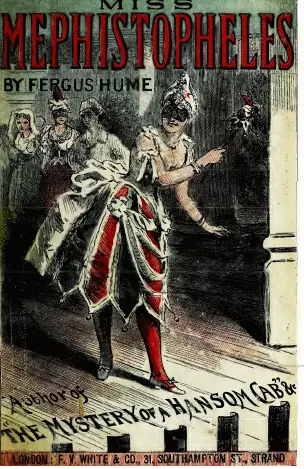
"Miss Mephistopheles: A Novel" by Fergus Hume is a fictional work written in the late 19th century. The story unfolds in Melbourne, Australia, featuring characters like Keith Stewart, a young man with literary aspirations, and Ezra Lazarus, a journalist. Their lives intersect with the complexities of the theatre scene and a woman known as "Caprice," who is both a celebrated actress and the mother of a child saved from danger by Keith. The opening of the novel introduces a dreary, rainy evening in Melbourne, emphasizing the discomfort felt by the characters but juxtaposing it with vibrant discussions between them. The beginning focuses on Keith and Ezra as they share insights into their ambitions and the women in their lives—particularly Caprice. The narrative presents their contrasting backgrounds: Keith's struggles and romantic ideals versus Ezra's more grounded perspective. As the two men contemplate their lives, a dramatic moment unfolds when Keith heroically saves a child, a pivotal event that brings him into the orbit of Caprice. This scene sets the stage for the exploration of themes like ambition, love, and the darker corners of society that the characters navigate.
Introduction adapted from the source catalogue; source summaries may be automatically generated.
Free to read · English · 63,753 words · No account needed
MAKE TIME FOR A GOOD BOOK
On by default. Untick to stop anonymous reading totals. Each page counts after 10 seconds in view. How this works.
Anonymous counting is on unless you have switched it off.
"I hope it will end in Keith's being released," said Eugénie, looking at Ezra with intense anxiety.
That gentleman took out the letter, and glancing at it for a moment, gave vent to an ejaculation of disgust.
"What's the matter?" asked Eugénie and Naball together.
"The letter is in cypher," said Lazarus, tossing it over to the detective. "I don't think we'll be able to read it."
"Oh, we'll have a try," said Naball, quickly spreading oat the letter. "Let's have a look at it."
The letter was as follows:--
"Dsidanmo seaf utnes teh ssteon ryiks sgenlil gto teher tdhnoaus sgennid it lses teher hduenrd bneiertns."
"What the deuce does it mean?" asked Naball in a puzzled tone.
"It's a cypher, evidently, of which my father alone possesses the key," said Ezra. "I'll have a look among his papers, and if I find it, it will soon make sense of this jumble of words."
"It's like a Chinese puzzle," observed Naball, glancing at it. "I never could find out these things."
"Let me look," said Eugénie, taking the letter. "I used to be rather
good at puzzles."
"We'll find this one out," said Naball significantly, "and you'll do
some good for Stewart."
"You think it's about Caprice's diamonds?" she asked.
"I think it's about Caprice's diamonds," he replied.
"I think the words have been written backwards," said Ezra, looking
over her shoulder.
Eugénie shook her head.
"I don't think so," she replied, scanning the letter closely. "If so, the word 'it' would have been written 'ti.'"
"Try a word of three letters, if there's one," suggested Naball, "and you can see how the letters are placed."
"Here's one spelt 'g-t-o.' What word can be made out of that."
"Got," said Ezra eagerly.
"Well, if so, in the cypher it reads, the first letter 'g,' the last, letter 't,' and the middle letter at the end."
"What do you think of that?" asked Naball bluntly.
"That the sender of this has taken the first and last letters of a word, and written them in rotation."
"I don't understand," said Naball in a puzzled tone.
"I think I do," said Eugénie quickly. "Let us take another word, and instead of guessing it, try my idea, Here is a word, 'teher.' Now, Mr. Naball, take a sheet of paper and write down what I say."
Naball got some paper and a pencil.
"Now," said Eugénie, "this word 'teher.' The first letter is 't,' now the second letter, which, I think, is the end one of the proper word, is 'e'--place that at the end."
Naball wrote "t--e."
Your reading position is saved on this browser. Take it to another device with a library code. Reading pages adapt to text, rather than matching a printed edition.
Fergus Hume

Fergus Hume

Fergus Hume
Fergus Hume
BEHIND THE BOOK
This eBook is for the use of anyone anywhere in the United States and most other parts of the world at no cost and with almost no restrictions whatsoever. You may copy it, give it away or re-use it under the terms of the Project Gutenberg License included with this eBook or online at www.gutenberg.org. If you are not located in the United States, you will have to check the laws of the country where you are located before using this eBook. Read the source licence.
The original source file, including credits and licence, is retained by this library. Request an original-format copy at no charge. Please include the book title and Project Gutenberg identifier #55378.
KEEP YOUR CURIOSITY GOING
Coulson Kernahan

Maurice Baring
Frances Wright
Cécile Tormay

Frederic Jesup Stimson

W. H. P. (William Henry Pope) Jarvis