THE CLASSIC COLLECTION✦The Disappearing EyeCLASSIC FREE BOOKS
The Disappearing Eye
Fergus Hume
THE CLASSIC COLLECTION · 1880
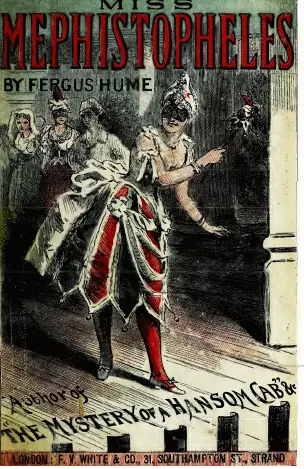
"Miss Mephistopheles: A Novel" by Fergus Hume is a fictional work written in the late 19th century. The story unfolds in Melbourne, Australia, featuring characters like Keith Stewart, a young man with literary aspirations, and Ezra Lazarus, a journalist. Their lives intersect with the complexities of the theatre scene and a woman known as "Caprice," who is both a celebrated actress and the mother of a child saved from danger by Keith. The opening of the novel introduces a dreary, rainy evening in Melbourne, emphasizing the discomfort felt by the characters but juxtaposing it with vibrant discussions between them. The beginning focuses on Keith and Ezra as they share insights into their ambitions and the women in their lives—particularly Caprice. The narrative presents their contrasting backgrounds: Keith's struggles and romantic ideals versus Ezra's more grounded perspective. As the two men contemplate their lives, a dramatic moment unfolds when Keith heroically saves a child, a pivotal event that brings him into the orbit of Caprice. This scene sets the stage for the exploration of themes like ambition, love, and the darker corners of society that the characters navigate.
Introduction adapted from the source catalogue; source summaries may be automatically generated.
Free to read · English · 63,753 words · No account needed
MAKE TIME FOR A GOOD BOOK
On by default. Untick to stop anonymous reading totals. Each page counts after 10 seconds in view. How this works.
Anonymous counting is on unless you have switched it off.
"Well, you see," he murmured apologetically, "Mr. Stewart wanted to know a good 'un to back for the Cup, so I was afraid of the old 'un hearing, and as there wasn't no paper, I wrote on the back of one of 'em, 'Back Flat-Iron.'"
"In pencil?"
"No, in ink. Mr. Stewart, he laughs and nods, then puts the notes in the cash box, and puts 'em in the safe."
"That's all right," said Naball, dismissing him; "you can go."
Isaiah put on his hat, put his hands in his pockets, and departed, whistling a tune. When the door closed on him, Naball turned to his two companions with an exulting light in his eyes.
"What do you think now, Mr. Naball?" asked Eugénie.
"Think. I think as I've done all along," he replied. "Caprice stole those jewels herself, and sold them to old Lazarus."
"But what's that got to do with the death of my father?" asked Ezra.
"Perhaps nothing--perhaps a lot," said the detective. "I don't know but that boy's evidence has given me a clue. Suppose--I'm only supposing, mind you--Caprice stole her own diamonds, with Villiers as an accomplice. Suppose she took them to old Lazarus and sold 'em. Suppose Villiers, thinking the old man has them in his safe, goes to rob him, and commits the murder to do so. Suppose all that--I should think there would be a very pretty case against Villiers."
"Yes; but Keith's knife?" said Eugénie.
"Ah, now you have me," answered Naball, puzzled. "I don't know, unless Villiers managed to get it while Stewart was fighting with him on that night, and covered it in blood in order to throw suspicion on him."
"All your ideas are theoretical," said Ezra drily. "Perhaps Caprice never stole her own jewels, or sold them to my father."
"Yes, she did, I'll swear," retorted Naball decisively. "Why wouldn't she prosecute? why did I find Villiers with one of the jewels? You bet, she stole them for some freak, and I daresay Villiers committed the murder to get them back."
"I don't think my father would have kept such valuable jewels as that
about the premises."
"No; he'd put 'em in the bank."
"No, he wouldn't," retorted Ezra; "he sent all his jewels to Amsterdam. And here," holding up a letter, "is an envelope with the Dutch postmark."
"By Jove!" ejaculated Naball, under his breath, "what a queer thing if
it should turn out to be those diamonds of Caprice's. Open the
letter."
"Suppose it does turn out to be the diamonds," said Ezra, slowly
tearing the envelope.
"Well"--Naball drew a long breath--"it will be the beginning of the
end."
Your reading position is saved on this browser. Take it to another device with a library code. Reading pages adapt to text, rather than matching a printed edition.
Fergus Hume

Fergus Hume

Fergus Hume
Fergus Hume
BEHIND THE BOOK
This eBook is for the use of anyone anywhere in the United States and most other parts of the world at no cost and with almost no restrictions whatsoever. You may copy it, give it away or re-use it under the terms of the Project Gutenberg License included with this eBook or online at www.gutenberg.org. If you are not located in the United States, you will have to check the laws of the country where you are located before using this eBook. Read the source licence.
The original source file, including credits and licence, is retained by this library. Request an original-format copy at no charge. Please include the book title and Project Gutenberg identifier #55378.
KEEP YOUR CURIOSITY GOING
Coulson Kernahan

Maurice Baring
Frances Wright
Cécile Tormay

Frederic Jesup Stimson

W. H. P. (William Henry Pope) Jarvis