THE CLASSIC COLLECTION✦The Disappearing EyeCLASSIC FREE BOOKS
The Disappearing Eye
Fergus Hume
THE CLASSIC COLLECTION · 1880
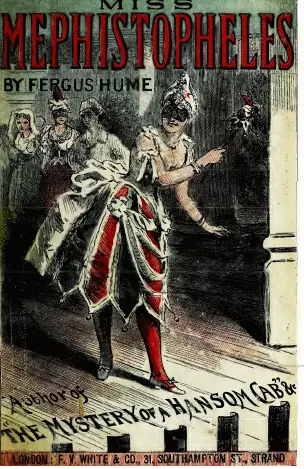
"Miss Mephistopheles: A Novel" by Fergus Hume is a fictional work written in the late 19th century. The story unfolds in Melbourne, Australia, featuring characters like Keith Stewart, a young man with literary aspirations, and Ezra Lazarus, a journalist. Their lives intersect with the complexities of the theatre scene and a woman known as "Caprice," who is both a celebrated actress and the mother of a child saved from danger by Keith. The opening of the novel introduces a dreary, rainy evening in Melbourne, emphasizing the discomfort felt by the characters but juxtaposing it with vibrant discussions between them. The beginning focuses on Keith and Ezra as they share insights into their ambitions and the women in their lives—particularly Caprice. The narrative presents their contrasting backgrounds: Keith's struggles and romantic ideals versus Ezra's more grounded perspective. As the two men contemplate their lives, a dramatic moment unfolds when Keith heroically saves a child, a pivotal event that brings him into the orbit of Caprice. This scene sets the stage for the exploration of themes like ambition, love, and the darker corners of society that the characters navigate.
Introduction adapted from the source catalogue; source summaries may be automatically generated.
Free to read · English · 63,753 words · No account needed
MAKE TIME FOR A GOOD BOOK
On by default. Untick to stop anonymous reading totals. Each page counts after 10 seconds in view. How this works.
Anonymous counting is on unless you have switched it off.
When the messenger had been despatched, Naball drew his seat up to the table, and began to make some notes, after which he turned to Eugénie.
"I was firmly convinced of Stewart's guilt," he said quietly; "but what you have told me throws a new light on the subject. I said you could not do that--I beg your pardon--you can."
Eugénie bowed her head in acknowledgment of the apology, and asked him a question in a hesitating manner.
"You don't think Caprice is guilty?"
"I think nothing at present," he replied evasively; "not even that Stewart is innocent. When I see the boy, I'll tell you what I think."
They talked on together for a few minutes, and then there came a knock at the door. In reply to Ezra's permission to enter, the door opened, and Isaiah appeared on the threshold, holding some papers in his hand.
"Oh, you've come," said Ezra, as the boy shut the door after him.
"Yes; did you want me?" demanded Isaiah in a jerky manner, "'cos I
never knowed you did."
"Didn't you meet a messenger?" asked Naball, turning his head round.
Isaiah deposited the papers he carried on Ezra's desk, and shook his
head.
"No, I never met any one, I didn't," he answered. "Mr. Ezra asked me
to bring all letters that came to the old 'un, so as these came, I
did."
"That's right," said Lazarus, looking through the letters. "By-the-way, Isaiah, this gentleman wants to ask you a few questions."
"What, Mr. Naball?" said Isaiah in alarm. "Oh, sir, I never had
nothing to do with it."
Naball smiled.
"No! no! that's all right," he said good-naturedly. "It would take a bigger man than a sprat like you to commit such a crime; but, tell me, do you know Caprice?"
Isaiah leered significantly.
"I've seen her on the stage, that's all."
"Never off?"
"Drivin' about the streets."
"Anywhere else?"
Isaiah glanced uneasily at Ezra, who laughed.
"Go on, Isaiah; it's all right."
"Well, I've seen her at the old 'un's place."
"Oh, indeed," said Naball quickly. "Often?"
"Yes--lots of times--at night--came to do business, I s'pose."
"When did you see her last?"
"Oh, not for a long time," replied Isaiah; "but do you remember the week them diamonds were stolen?"
"Yes, yes," said Naball eagerly.
Isaiah nodded.
"Well, she came to see the old 'un, then."
Naball suppressed his exultation with difficulty, and asked Isaiah
another question.
"I say--those bank-notes that were stolen--"
"I never stole 'em."
"No one said you did," retorted Naball tartly; "but you wrote something on the back of one of 'em."
Isaiah turned scarlet, and shifted from one leg to the other.
Your reading position is saved on this browser. Take it to another device with a library code. Reading pages adapt to text, rather than matching a printed edition.
Fergus Hume

Fergus Hume

Fergus Hume
Fergus Hume
BEHIND THE BOOK
This eBook is for the use of anyone anywhere in the United States and most other parts of the world at no cost and with almost no restrictions whatsoever. You may copy it, give it away or re-use it under the terms of the Project Gutenberg License included with this eBook or online at www.gutenberg.org. If you are not located in the United States, you will have to check the laws of the country where you are located before using this eBook. Read the source licence.
The original source file, including credits and licence, is retained by this library. Request an original-format copy at no charge. Please include the book title and Project Gutenberg identifier #55378.
KEEP YOUR CURIOSITY GOING
Coulson Kernahan

Maurice Baring
Frances Wright
Cécile Tormay

Frederic Jesup Stimson

W. H. P. (William Henry Pope) Jarvis