THE CLASSIC COLLECTION✦Letters to Persons Who Are Engaged in Domestic ServiceCLASSIC FREE BOOKS
Letters to Persons Who Are Engaged in Domestic Service
Catharine Esther Beecher
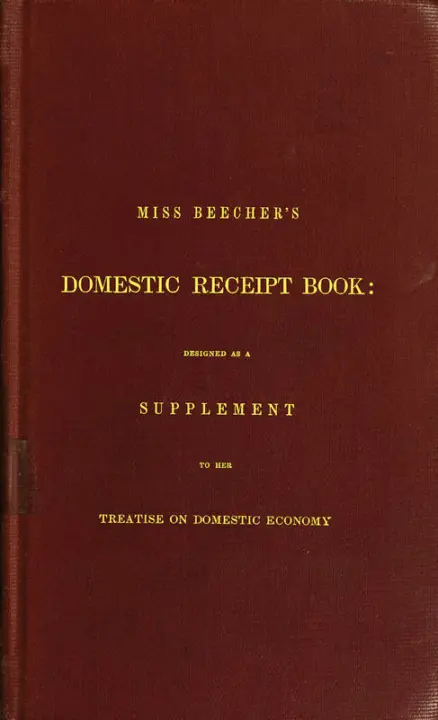
THE CLASSIC COLLECTION · 1846
"Miss Beecher's Domestic Receipt Book" by Catharine Esther Beecher is a practical guide on domestic management, particularly focusing on cooking and household management, written in the mid-19th century. The book serves as a comprehensive resource for young housekeepers, offering a wide range of tested recipes and tips for efficient meal preparation and healthy dietary choices. It aims to empower women by providing them with the knowledge necessary to create both everyday meals and elegant dishes for entertaining. The opening of the book lays out its objectives, emphasizing the importance of original, well-tested recipes suitable for various occasions and the necessity of clear instructions for everyday kitchen tasks. Beecher highlights the significance of healthful eating and proper food selection, supported by contributions from experienced housekeepers across the country. The initial chapters provide a robust framework for selecting nutritious food and drinks, aiming to establish foundational knowledge that housekeepers can apply in their daily lives, ensuring they can create wholesome meals while cultivating an understanding of the science behind food preparation.
Introduction adapted from the source catalogue; source summaries may be automatically generated.
Free to read · English · 92,424 words · No account needed
MAKE TIME FOR A GOOD BOOK
On by default. Untick to stop anonymous reading totals. Each page counts after 10 seconds in view. How this works.
Anonymous counting is on unless you have switched it off.
Weights and Measures.
It is a good plan to have a particular measure cup kept for the purpose, and after once weighing all those receipts that are given by weight, to measure the quantity by this cup, and then write the measures in your receipt book, and keep the cup only for this purpose. The following is some guide in judging of the relative proportion between measures and weights.
A quart of flour, or of sifted loaf sugar, or of softened butter, each weigh about a pound. The flour, if sifted, must be heaped.
A pint equals eight ounces.
A half a pint equals four ounces.
One gill equals two ounces.
Half a gill equals one ounce.
A quart of brown sugar, or of Indian meal, equals a pound and two
ounces of the same.
One great spoonful of flour, loaf sugar, or of melted butter, equals a quarter of an ounce of the same. It should be a little heaped.
Four spoonfuls equal an ounce, or half a gill.
Eight spoonfuls equal one gill.
Sixteen spoonfuls equal half a pint.
Spoons differ so much in size that this is an uncertain guide.
A medium-sized teaspoon holds sixty drops of water.
Ten eggs usually weigh a pound.
Four gills make a pint.
Two pints make a quart.
Four quarts make a gallon.
Eight quarts make a peck.
Four pecks make a bushel.
Avoirdupois Weight.
Sixteen drachms make an ounce.
Sixteen ounces make a pound.
Twenty-eight pounds make a quarter.
Four quarters make a hundred.
Twenty hundred make a ton.
Apothecaries’ Weight.
Twenty grains make a scruple.
Three scruples make a drachm.
Eight drachms make an ounce.
Twelve ounces make a pound.
On Purchasing Wood.
Wood that is straight and solid makes more in a load, and is the most
profitable.
A cord of small crooked sticks does not contain half the wood there is
in a load of solid logs.
The best wood for fires is the hickory, hard maple, white ash, black birch, yellow birch, beech, yellow oak, and locust. The best are placed first.
The following are inferior in quality. Elm, soft maple, white birch,
pepperage, and pine.
The following are not fit to burn, either because they snap, or will not burn. Chestnut, butternut, cedar, sassafras, red oak, and buckeye.
Any person can learn to distinguish each kind by a little attention and
instruction.
Wood is bought by measurement. A cord of wood is 8 feet long, 4 feet
wide, and 4 feet high.
Your reading position is saved on this browser. Take it to another device with a library code. Reading pages adapt to text, rather than matching a printed edition.
Catharine Esther Beecher

Catharine Esther Beecher
Catharine Esther Beecher

Catharine Esther Beecher
BEHIND THE BOOK
This eBook is for the use of anyone anywhere in the United States and most other parts of the world at no cost and with almost no restrictions whatsoever. You may copy it, give it away or re-use it under the terms of the Project Gutenberg License included with this eBook or online at www.gutenberg.org. If you are not located in the United States, you will have to check the laws of the country where you are located before using this eBook. Read the source licence.
The original source file, including credits and licence, is retained by this library. Request an original-format copy at no charge. Please include the book title and Project Gutenberg identifier #54965.
KEEP YOUR CURIOSITY GOING

Charles G. (Charles Griffith) Ross
Hannah Webster Foster

Emily Lawless
Edwin Hamlin Carr

Charles De Lano Hine
Andrew Ure