THE CLASSIC COLLECTION✦Letters to Persons Who Are Engaged in Domestic ServiceCLASSIC FREE BOOKS
Letters to Persons Who Are Engaged in Domestic Service
Catharine Esther Beecher
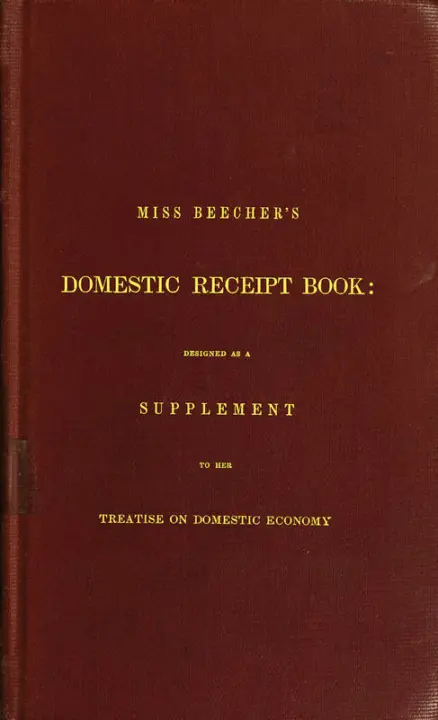
THE CLASSIC COLLECTION · 1846
"Miss Beecher's Domestic Receipt Book" by Catharine Esther Beecher is a practical guide on domestic management, particularly focusing on cooking and household management, written in the mid-19th century. The book serves as a comprehensive resource for young housekeepers, offering a wide range of tested recipes and tips for efficient meal preparation and healthy dietary choices. It aims to empower women by providing them with the knowledge necessary to create both everyday meals and elegant dishes for entertaining. The opening of the book lays out its objectives, emphasizing the importance of original, well-tested recipes suitable for various occasions and the necessity of clear instructions for everyday kitchen tasks. Beecher highlights the significance of healthful eating and proper food selection, supported by contributions from experienced housekeepers across the country. The initial chapters provide a robust framework for selecting nutritious food and drinks, aiming to establish foundational knowledge that housekeepers can apply in their daily lives, ensuring they can create wholesome meals while cultivating an understanding of the science behind food preparation.
Introduction adapted from the source catalogue; source summaries may be automatically generated.
Free to read · English · 92,424 words · No account needed
MAKE TIME FOR A GOOD BOOK
On by default. Untick to stop anonymous reading totals. Each page counts after 10 seconds in view. How this works.
Anonymous counting is on unless you have switched it off.
General Directions for Griddle and other Breakfast Cakes.
The best method of greasing a griddle is, to take a bit of salt pork, and rub over with a fork. This prevents adhesion, and yet does not allow the fat to soak into what is to be cooked.
In putting cakes on to griddles, be careful to form them a regular round shape, and put on only one at each dip, and so as not to spill between the cakes.
In frying mush, cold rice slices, and hominy cakes, cut them half an inch thick, and fry in fresh lard, with enough to brown them handsomely. Make the slices smooth and regular.
Buckwheat Cakes wet with Water.
Take a quart of buckwheat flour, and nearly an even tablespoonful of salt. Stir in warm water, till it is the consistency of thin batter. Beat it thoroughly. Add two tablespoonfuls of yeast, if distillery, or twice as much if home-brewed.
Set the batter where it will be a little warm through the night. Some persons never stir them after they have risen, but take them out carefully with a large spoon.
Add a teaspoonful of pearlash in the morning, if they are sour. Sift it over the surface, and stir it well.
Some persons like to add one or two tablespoonfuls of molasses, to give them a brown color, and more sweetness of taste.
Extempore Buckwheat Cakes.
Three pints of buckwheat.
One teaspoonful carbonate of soda, dissolved in water enough to make a batter, and when mixed, add a teaspoonful of tartaric acid, dissolved in a few spoonfuls of hot water. Mix it in, and bake immediately.
Use salt pork to grease the griddle.
Buckwheat Cakes wet with Milk.
One quart of flour, and in winter stir in lukewarm milk, till it is a thin batter, and beat it thoroughly, adding nearly an even tablespoonful of salt.
Add a small tea-cup of Indian meal, two tablespoonfuls of distillery yeast, or a good deal more if home-brewed; say half a tea-cup full. Set it where it will keep warm all night, and in the morning add a teaspoonful of saleratus, sifted over the top, and well stirred in. If sour, add more saleratus. This is the best kind of buckwheat cakes.
Griddle Cakes of Unbolted Wheat.
A quart of unbolted wheat, and a teaspoonful of salt. Wet it up with water, or sweet milk, in which is dissolved a teaspoonful of saleratus. Add three spoonfuls of molasses. Some raise this with yeast, and leave out the saleratus. Sour milk and saleratus are not as good for unbolted as for fine flour.
These are better and more healthful cakes than buckwheat.
Your reading position is saved on this browser. Take it to another device with a library code. Reading pages adapt to text, rather than matching a printed edition.
Catharine Esther Beecher

Catharine Esther Beecher
Catharine Esther Beecher

Catharine Esther Beecher
BEHIND THE BOOK
This eBook is for the use of anyone anywhere in the United States and most other parts of the world at no cost and with almost no restrictions whatsoever. You may copy it, give it away or re-use it under the terms of the Project Gutenberg License included with this eBook or online at www.gutenberg.org. If you are not located in the United States, you will have to check the laws of the country where you are located before using this eBook. Read the source licence.
The original source file, including credits and licence, is retained by this library. Request an original-format copy at no charge. Please include the book title and Project Gutenberg identifier #54965.
KEEP YOUR CURIOSITY GOING

Charles G. (Charles Griffith) Ross
Hannah Webster Foster

Emily Lawless
Edwin Hamlin Carr

Charles De Lano Hine
Andrew Ure