READ · DISCOVER · ENJOYClassic literature · Always free
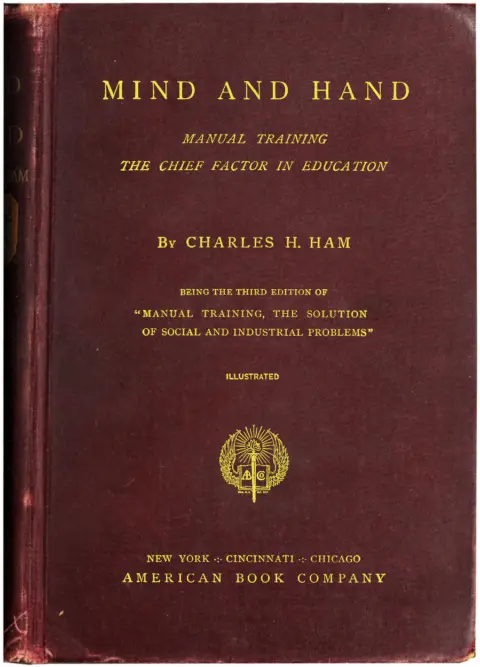
Mind and Hand: Manual Training the Chief Factor in Education — digital edition cover

THE CLASSIC COLLECTION · 1886

Mind and Hand: Manual Training the Chief Factor in Education

"Mind and Hand: Manual Training the Chief Factor in Education" by Charles H. Ham is an educational treatise written in the late 19th century. The book advocates for an educational reform that emphasizes the integration of manual training with intellectual development, positioning these skills as fundamental to a well-rounded education. Ham argues that the combination of mind and hands-on experience creates a more effective learning environment, fostering not only intellectual growth but also moral and practical skills in students. The beginning of the text discusses Ham's vision of the "Ideal School," a transformative educational institution that prioritizes practical training and labor alongside traditional learning. Describing the school as a place that dignifies labor and combines knowledge with hands-on work, he draws inspiration from historical educational theorists. He emphasizes the significance of tools as critical instruments in education, lamenting their absence in conventional schools, and challenges the status quo of education that often neglects practical skills. In his view, true education goes beyond theory to actively engage students in the physical world, blending learning with creativity and practical applications.

Introduction adapted from the source catalogue; source summaries may be automatically generated.

Start reading ↓

Free to read · English · 138,003 words · No account needed

MAKE TIME FOR A GOOD BOOK

Mind and Hand: Manual Training the Chief Factor in Education

On by default. Untick to stop anonymous reading totals. Each page counts after 10 seconds in view. How this works.

Anonymous counting is on unless you have switched it off.

Mind and Hand: Manual Training the Chief Factor in Education

Steam is on, and the students standing at the lathes are impatient to begin. It is not a lesson in the ordinary sense. Each student works independently of special direction, for each is engaged in making a machine--the graduating project. The instructor is at hand, not to dictate but to advise, if requested. From his fund of experience as the elder scholar he will answer questions propounded by his younger fellow-students. In front of the students, parts of the working drawings may be seen. It is plain that there is to be variety in the exhibit of “projects.” There are several steam-engines, differing in model; there is a steam-pump, a punching machine, a lathe, an electric machine, and a steam-hammer.

At a sign work commences--a dozen varieties of work, emitting a dozen tones of buzzing and whizzing. The instructor’s face lights up with a pleased expression as he notes the progress of the work. There is no sign of hesitation in the class; no questions are asked; the students seem to be driving straight to the mark. The instructor’s heart swells with pride; he can trust “his boys!” He has been regarding them with an expression of affection, but now his eyes wander--they have a far-away look. He no longer sees the students, he is looking beyond them. He drops into a reclining attitude, sighs, falls into a reverie, and dreams. In his dream he sees naked savages, emerging from caves, armed with clubs, pursuing animals. These are succeeded by men bearing rude stone implements--axes and hammers--and these in turn by men armed with bows and arrows, but half-clothed with skins of beasts, and crouching and shivering beneath the shelter of the branches of a tree pulled downward and secured by clods of earth. This picture disappears, and is replaced by a pastoral scene--a vast plain covered with flocks and herds. In the foreground stands the shepherd, and in the distance his tent, consisting of skins of beasts stretched on poles, and in the tent door a woman sits pounding a fleece into felt. The shepherd, his flocks and herds, his tent, and the woman in the tent door, vanish like the mists of morning, and where the shepherd was, the husbandman is seen harvesting the golden grain; and in the shadow of the cottage which has replaced the tent a woman is grinding corn. The scene again changes--the plain has become the site of a great city. The city is protected by thick, high walls, surmounted with frowning battlements. Sentinels pace back and forth along the parapet. Huge helmets protect their heads, and their bodies are clothed in armor. Quivers full of bronze-tipped arrows depend from their shoulders; in their hands they carry long bows, and the clank, clank of their broad, two-edged, bronze swords breaks the dull, monotonous routine of their march. A brazen gate swings back noiselessly on brazen hinges, and, bowing to the sentinel, the dreamer as noiselessly glides into the city. Suddenly he feels the hot breath of the foundery furnace-fire, and is blinded by a glare of red light. Shading his eyes he sees dusky forms hurrying to and fro with ladles full of molten metal. Turning away he hears the heavy stroke of the sledge, and looking, beholds a dusty, smoky smithy. The stalwart smith drops the sledge at his side, rests one foot on the anvil-block, and wipes the sweat from his brow; the helper thrusts the cooling metal into the coals, bends to the bellows, and the forge-fire sings. At the sound of a bell the dreamer starts, the old Assyrian city falls into ruins, the ruins crumble into dust, and on this dust another city rises, flourishes, falls, and piles the dust of its ruins. Over a waste of years--twenty centuries--the dreamer’s thought flashes, and he stands in the presence of the Alexandrian mechanic-philosopher. He sees Hero in the public street, gazing abstractedly at his condensed-air fountain, and follows him into his shop or laboratory, and observes him curiously as he toys with the model of a queer little steam-engine. “This is the Iron Age, but in its infancy,” he exclaims under his breath, as his eyes wander from a fine Damascus blade hanging against the wall to some poor hand-tools lying on the working-bench. “I will speak to this old man,” he continues, “and ask him to step into my Machine-tool Laboratory, and see my boys make steam-engines; it will be a revelation to him. Come, old friend--there--look!” And the dreamer looks. Does he see double? The laboratory is unchanged; steam is still on; the whir of machinery and the buzzing sound of steam-driven tools salute the ear, and the students are all busy at their benches finishing parts of “projects” and adjusting them in their places, But there are twenty-four other men--shades of men--in the laboratory. Most of them are old; some are in working clothes, others in full dress, wearing ribbons and orders of merit. Over each student one of these shades bends with an air of absorbing attention. The dreamer recognizes Papin, Fulton, Watt, and Stephenson shadowing the students engaged in the construction of engines. They beckon Hero, and he joins the group, threading his way timidly between the lines of lathes, and looking askance at the rapidly revolving wheels and flying belts. Over the shoulders of other students are seen the faces of Maudslay, Bramah, Clement, Roberts, Whitney, Nasmyth, Huntsman, Cort, Murray, Dudley, Yarranton, Roebuck, and Whitworth, besides several unfamiliar faces. Suddenly they all gather about a nearly completed project--a stationary engine. They witness the forcing home of the last screw; they see the miniature machine made fast to the bench. Steam is let into the cylinders. The student’s flushed face is in sharp contrast with the colorless faces of the group of old men by whom he is surrounded. The piston-rod moves languidly--the machine trembles as if awaking from slumber, the shaft oscillates slowly, then faster, then regularly, like a strong pulse-beat. The project is a success--the first one completed! The student’s face turns pale--as pale as the white faces of the old men at his side. They open their lips as if to cheer him, but no sound escapes them. He breathes quick--almost gasps; his heart beats loudly; he tries to shout but cannot utter a word. At last he claps his hands! The instructor starts from his chair, rubs his eyes, and stares round the laboratory. All the students are there, gathered in a group about the finished “project,” but the ghostly shades of the old inventors have vanished like the unsubstantial fabric of a vision.

Your reading position is saved on this browser. Take it to another device with a library code. Reading pages adapt to text, rather than matching a printed edition.

BEHIND THE WORDS

About Charles H. (Charles Henry) Ham

Charles H. (Charles Henry) Ham (1831–1902). Explore Mind and Hand: Manual Training the Chief Factor in Education in this collection. These books span literature & collections.

Explore this author’s books →

THE READERS’ VERDICT

How did this story stay with you?

Not rated yet
Your rating for Mind and Hand: Manual Training the Chief Factor in Education

Be the first to share your verdict.

One rating per browser, which you can change or remove. A necessary browser identifier remembers your vote. How ratings work

A GOOD STORY DESERVES COMPANY

Pass this book along.

A great read is even better when it’s shared.

SEND A LITTLE INSPIRATION

Share this book

BEHIND THE BOOK

Edition & source details.

Title
Mind and Hand: Manual Training the Chief Factor in Education
Author
Charles H. (Charles Henry) Ham
Publication year
1886
Digital edition publisher
Project Gutenberg
Gutenberg release date
2021-12-29
Language
English
Source edition imprint
$aUnited States :$bAmerican Book Company ,$c1900.
Source identifier
Project Gutenberg #67039
Contributors
No additional named contributors in source metadata

Public-domain source & licence

This eBook is for the use of anyone anywhere in the United States and most other parts of the world at no cost and with almost no restrictions whatsoever. You may copy it, give it away or re-use it under the terms of the Project Gutenberg License included with this eBook or online at www.gutenberg.org. If you are not located in the United States, you will have to check the laws of the country where you are located before using this eBook. Read the source licence.

Full source licence and obtaining an original copy

The original source file, including credits and licence, is retained by this library. Request an original-format copy at no charge. Please include the book title and Project Gutenberg identifier #67039.

the full Project Gutenberg License must appear
prominently whenever any copy of a Project Gutenberg work (any work
on which the phrase “Project Gutenberg” appears, or with which the
phrase “Project Gutenberg” is associated) is accessed, displayed,
performed, viewed, copied or distributed:

This eBook is for the use of anyone anywhere in the United States and most
other parts of the world at no cost and with almost no restrictions
whatsoever. You may copy it, give it away or re-use it under the terms
of the Project Gutenberg™ License included with this eBook or online
at www.gutenberg.org. If you
are not located in the United States, you will have to check the laws
of the country where you are located before using this eBook.

1.E.2. If an individual Project Gutenberg electronic work is
derived from texts not protected by U.S. copyright law (does not
contain a notice indicating that it is posted with permission of the
copyright holder), the work can be copied and distributed to anyone in
the United States without paying any fees or charges. If you are
redistributing or providing access to a work with the phrase “Project
Gutenberg” associated with or appearing on the work, you must comply
either with the requirements of paragraphs 1.E.1 through 1.E.7 or
obtain permission for the use of the work and the Project Gutenberg
trademark as set forth in paragraphs 1.E.8 or 1.E.9.

1.E.3. If an individual Project Gutenberg electronic work is posted
with the permission of the copyright holder, your use and distribution
must comply with both paragraphs 1.E.1 through 1.E.7 and any
additional terms imposed by the copyright holder. Additional terms
will be linked to the Project Gutenberg License for all works
posted with the permission of the copyright holder found at the
beginning of this work.

1.E.4. Do not unlink or detach or remove the full Project Gutenberg
License terms from this work, or any files containing a part of this
work or any other work associated with Project Gutenberg.

1.E.5. Do not copy, display, perform, distribute or redistribute this
electronic work, or any part of this electronic work, without
prominently displaying the sentence set forth in paragraph 1.E.1 with
active links or immediate access to the full terms of the Project
Gutenberg License.

1.E.6. You may convert to and distribute this work in any binary,
compressed, marked up, nonproprietary or proprietary form, including
any word processing or hypertext form. However, if you provide access
to or distribute copies of a Project Gutenberg work in a format
other than “Plain Vanilla ASCII” or other format used in the official
version posted on the official Project Gutenberg website
(www.gutenberg.org), you must, at no additional cost, fee or expense
to the user, provide a copy, a means of exporting a copy, or a means
of obtaining a copy upon request, of the work in its original “Plain
Vanilla ASCII” or other form. Any alternate format must include the
full Project Gutenberg License as specified in paragraph 1.E.1.

1.E.7. Do not charge a fee for access to, viewing, displaying,
performing, copying or distributing any Project Gutenberg works
unless you comply with paragraph 1.E.8 or 1.E.9.

1.E.8. You may charge a reasonable fee for copies of or providing
access to or distributing Project Gutenberg electronic works
provided that:

• You pay a royalty fee of 20% of the gross profits you derive from
the use of Project Gutenberg works calculated using the method
you already use to calculate your applicable taxes. The fee is owed
to the owner of the Project Gutenberg trademark, but he has
agreed to donate royalties under this paragraph to the Project
Gutenberg Literary Archive Foundation. Royalty payments must be paid
within 60 days following each date on which you prepare (or are
legally required to prepare) your periodic tax returns. Royalty
payments should be clearly marked as such and sent to the Project
Gutenberg Literary Archive Foundation at the address specified in
Section 4, “Information about donations to the Project Gutenberg
Literary Archive Foundation.”

• You provide a full refund of any money paid by a user who notifies
you in writing (or by e-mail) within 30 days of receipt that s/he
does not agree to the terms of the full Project Gutenberg™
License. You must require such a user to return or destroy all
copies of the works possessed in a physical medium and discontinue
all use of and all access to other copies of Project Gutenberg™
works.

• You provide, in accordance with paragraph 1.F.3, a full refund of
any money paid for a work or a replacement copy, if a defect in the
electronic work is discovered and reported to you within 90 days of
receipt of the work.

• You comply with all other terms of this agreement for free
distribution of Project Gutenberg™ works.


1.E.9. If you wish to charge a fee or distribute a Project
Gutenberg™ electronic work or group of works on different terms than
are set forth in this agreement, you must obtain permission in writing
from the Project Gutenberg Literary Archive Foundation, the manager of
the Project Gutenberg™ trademark. Contact the Foundation as set
forth in Section 3 below.

1.F.

1.F.1. Project Gutenberg volunteers and employees expend considerable
effort to identify, do copyright research on, transcribe and proofread
works not protected by U.S. copyright law in creating the Project
Gutenberg™ collection. Despite these efforts, Project Gutenberg™
electronic works, and the medium on which they may be stored, may
contain “Defects,” such as, but not limited to, incomplete, inaccurate
or corrupt data, transcription errors, a copyright or other
intellectual property infringement, a defective or damaged disk or
other medium, a computer virus, or computer codes that damage or
cannot be read by your equipment.

1.F.2. LIMITED WARRANTY, DISCLAIMER OF DAMAGES - Except for the “Right
of Replacement or Refund” described in paragraph 1.F.3, the Project
Gutenberg Literary Archive Foundation, the owner of the Project
Gutenberg™ trademark, and any other party distributing a Project
Gutenberg™ electronic work under this agreement, disclaim all
liability to you for damages, costs and expenses, including legal
fees. YOU AGREE THAT YOU HAVE NO REMEDIES FOR NEGLIGENCE, STRICT
LIABILITY, BREACH OF WARRANTY OR BREACH OF CONTRACT EXCEPT THOSE
PROVIDED IN PARAGRAPH 1.F.3. YOU AGREE THAT THE FOUNDATION, THE
TRADEMARK OWNER, AND ANY DISTRIBUTOR UNDER THIS AGREEMENT WILL NOT BE
LIABLE TO YOU FOR ACTUAL, DIRECT, INDIRECT, CONSEQUENTIAL, PUNITIVE OR
INCIDENTAL DAMAGES EVEN IF YOU GIVE NOTICE OF THE POSSIBILITY OF SUCH
DAMAGE.

1.F.3. LIMITED RIGHT OF REPLACEMENT OR REFUND - If you discover a
defect in this electronic work within 90 days of receiving it, you can
receive a refund of the money (if any) you paid for it by sending a
written explanation to the person you received the work from. If you
received the work on a physical medium, you must return the medium
with your written explanation. The person or entity that provided you
with the defective work may elect to provide a replacement copy in
lieu of a refund. If you received the work electronically, the person
or entity providing it to you may choose to give you a second
opportunity to receive the work electronically in lieu of a refund. If
the second copy is also defective, you may demand a refund in writing
without further opportunities to fix the problem.

1.F.4. Except for the limited right of replacement or refund set forth
in paragraph 1.F.3, this work is provided to you ‘AS-IS’, WITH NO
OTHER WARRANTIES OF ANY KIND, EXPRESS OR IMPLIED, INCLUDING BUT NOT
LIMITED TO WARRANTIES OF MERCHANTABILITY OR FITNESS FOR ANY PURPOSE.

1.F.5. Some states do not allow disclaimers of certain implied
warranties or the exclusion or limitation of certain types of
damages. If any disclaimer or limitation set forth in this agreement
violates the law of the state applicable to this agreement, the
agreement shall be interpreted to make the maximum disclaimer or
limitation permitted by the applicable state law. The invalidity or
unenforceability of any provision of this agreement shall not void the
remaining provisions.

1.F.6. INDEMNITY - You agree to indemnify and hold the Foundation, the
trademark owner, any agent or employee of the Foundation, anyone
providing copies of Project Gutenberg™ electronic works in
accordance with this agreement, and any volunteers associated with the
production, promotion and distribution of Project Gutenberg™
electronic works, harmless from all liability, costs and expenses,
including legal fees, that arise directly or indirectly from any of
the following which you do or cause to occur: (a) distribution of this
or any Project Gutenberg work, (b) alteration, modification, or
additions or deletions to any Project Gutenberg work, and (c) any
Defect you cause.

Section 2. Information about the Mission of Project Gutenberg

Project Gutenberg is synonymous with the free distribution of
electronic works in formats readable by the widest variety of
computers including obsolete, old, middle-aged and new computers. It
exists because of the efforts of hundreds of volunteers and donations
from people in all walks of life.

Volunteers and financial support to provide volunteers with the
assistance they need are critical to reaching Project Gutenberg’s
goals and ensuring that the Project Gutenberg collection will
remain freely available for generations to come. In 2001, the Project
Gutenberg Literary Archive Foundation was created to provide a secure
and permanent future for Project Gutenberg and future
generations. To learn more about the Project Gutenberg Literary
Archive Foundation and how your efforts and donations can help, see
Sections 3 and 4 and the Foundation information page at www.gutenberg.org.

Section 3. Information about the Project Gutenberg Literary Archive Foundation

The Project Gutenberg Literary Archive Foundation is a non-profit
501(c)(3) educational corporation organized under the laws of the
state of Mississippi and granted tax exempt status by the Internal
Revenue Service. The Foundation’s EIN or federal tax identification
number is 64-6221541. Contributions to the Project Gutenberg Literary
Archive Foundation are tax deductible to the full extent permitted by
U.S. federal laws and your state’s laws.

The Foundation’s business office is located at 41 Watchung Plaza #516,
Montclair NJ 07042, USA, +1 (862) 621-9288. Email contact links and up
to date contact information can be found at the Foundation’s website
and official page at www.gutenberg.org/contact

Section 4. Information about Donations to the Project Gutenberg
Literary Archive Foundation

Project Gutenberg™ depends upon and cannot survive without widespread
public support and donations to carry out its mission of
increasing the number of public domain and licensed works that can be
freely distributed in machine-readable form accessible by the widest
array of equipment including outdated equipment. Many small donations
($1 to $5,000) are particularly important to maintaining tax exempt
status with the IRS.

The Foundation is committed to complying with the laws regulating
charities and charitable donations in all 50 states of the United
States. Compliance requirements are not uniform and it takes a
considerable effort, much paperwork and many fees to meet and keep up
with these requirements. We do not solicit donations in locations
where we have not received written confirmation of compliance. To SEND
DONATIONS or determine the status of compliance for any particular state
visit www.gutenberg.org/donate.

While we cannot and do not solicit contributions from states where we
have not met the solicitation requirements, we know of no prohibition
against accepting unsolicited donations from donors in such states who
approach us with offers to donate.

International donations are gratefully accepted, but we cannot make
any statements concerning tax treatment of donations received from
outside the United States. U.S. laws alone swamp our small staff.

Please check the Project Gutenberg web pages for current donation
methods and addresses. Donations are accepted in a number of other
ways including checks, online payments and credit card donations. To
donate, please visit: www.gutenberg.org/donate.

Section 5. General Information About Project Gutenberg electronic works

Professor Michael S. Hart was the originator of the Project
Gutenberg concept of a library of electronic works that could be
freely shared with anyone. For forty years, he produced and
distributed Project Gutenberg eBooks with only a loose network of
volunteer support.

Project Gutenberg eBooks are often created from several printed
editions, all of which are confirmed as not protected by copyright in
the U.S. unless a copyright notice is included. Thus, we do not
necessarily keep eBooks in compliance with any particular paper
edition.

Most people start at our website which has the main PG search
facility: www.gutenberg.org.

This website includes information about Project Gutenberg,
including how to make donations to the Project Gutenberg Literary
Archive Foundation, how to help produce our new eBooks, and how to
subscribe to our email newsletter to hear about new eBooks.


KEEP YOUR CURIOSITY GOING

Your next chapter awaits.

THE CLASSIC COLLECTION✦The Boarding School; Lessons of a Preceptress to Her Pupils Consisting of Information, Instruction and Advice, Calculated to Improve the Manners and Form the Character of Young Ladies. To Which Is Added, a Collection of Letters, Written by the Pupils to Their Instructress, Their Friends, and Each Other.Hannah Webster FosterCLASSIC FREE BOOKS
Open book ↗
Literature & Collections1798

The Boarding School; Lessons of a Preceptress to Her Pupils Consisting of Information, Instruction and Advice, Calculated to Improve the Manners and Form the Character of Young Ladies. To Which Is Added, a Collection of Letters, Written by the Pupils to Their Instructress, Their Friends, and Each Other.

Hannah Webster Foster