
The Writing of News A Handbook with Chapters on Newspaper Correspondence and Copy Reading
Charles G. (Charles Griffith) Ross
THE CLASSIC COLLECTION · 1886
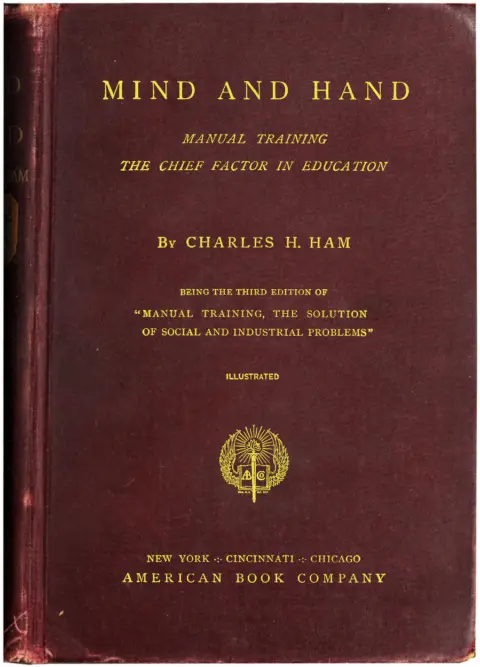
"Mind and Hand: Manual Training the Chief Factor in Education" by Charles H. Ham is an educational treatise written in the late 19th century. The book advocates for an educational reform that emphasizes the integration of manual training with intellectual development, positioning these skills as fundamental to a well-rounded education. Ham argues that the combination of mind and hands-on experience creates a more effective learning environment, fostering not only intellectual growth but also moral and practical skills in students. The beginning of the text discusses Ham's vision of the "Ideal School," a transformative educational institution that prioritizes practical training and labor alongside traditional learning. Describing the school as a place that dignifies labor and combines knowledge with hands-on work, he draws inspiration from historical educational theorists. He emphasizes the significance of tools as critical instruments in education, lamenting their absence in conventional schools, and challenges the status quo of education that often neglects practical skills. In his view, true education goes beyond theory to actively engage students in the physical world, blending learning with creativity and practical applications.
Introduction adapted from the source catalogue; source summaries may be automatically generated.
Free to read · English · 138,003 words · No account needed
MAKE TIME FOR A GOOD BOOK
On by default. Untick to stop anonymous reading totals. Each page counts after 10 seconds in view. How this works.
Anonymous counting is on unless you have switched it off.
Suffrage, love of country in the United States is a due appreciation of the right of, 323; in the universality of the right of, lies the power of correcting all social evils, 324; destined to preservation forever in the United States, 324; attempt to limit, in New York accounted for by the prevalence of European ideas, 324; the right of, can be taken from the American people only by force, 324; standard of, lowered by ignorance and depravity, 325; when better informed it will be more honest, 325; with increased intelligence it will gain the power to grapple with social abuses, 325.
Superstition, how it arose through ignorance and selfishness, 249.
Sweden, five hundred slöjd schools in, in 1882, 368; supports a school for the training of teachers of slöjd schools at Nääs, 369.
Syria, the founders, smiths, and all the artisans of, were slaves, 56.
Tacitus, his account of the execution of four hundred slaves for the murder of one man, 265; his lament at the decline of public virtue, 267; is silent on the subject of the infamy of slavery, and on the shame of degrading labor, 272.
Tancred the Crusader pays for King Arthur’s sword Excalibar “four great ships and fifteen galleys,” 71.
Tarquins, the banishment of the, 264.
Telegraph, the, influence of, upon the destinies of mankind, 170.
Telephone, the work of the hand, 156.
Telescope, the work of the hand, 155.
Texas, Agricultural and Mechanical College of, 359.
Theodoric, attempt of, to reconstruct the Roman civilization, 279; the order evoked from chaos by, to chaos soon returned, 280.
Theorem, a, always a question solved, 144.
Things both the subject and occasion of speech, 151; regarded as of less vital importance than abstract ideas, 185; the false, easily detected in--examples, 224; the study of, steadies and balances the mind, 225; the truth revealed only in, 243; ideas are mere vain speculations till embodied in, 243; the habit of expressing ideas in, should be formed in the schools, 245; the truths that are hidden in, 378; the integrity of the mind can be maintained only by the submission of its immature judgments to the verification of, 379; the source of ideas, 379; essential to spiritual development, 384.
Thinking, acting is the complement of, 244.
Thought, must be incarnate in things, or it is dead, 141; is not even present to the thinker until he has set it forth, out of himself, 150; independent, of all mental processes the most difficult--habit, tradition, and reverence for antiquity unite to forbid it, 192.
Thoughts must be expressed to have influence, 244; may be expressed most forcibly in things, 244.
Thucydides arraigns the Greeks as falsifiers and perjurers, 255.
Thurston, Robert H., on the tremendous power wielded by the mechanic,
183.
Your reading position is saved on this browser. Take it to another device with a library code. Reading pages adapt to text, rather than matching a printed edition.
BEHIND THE BOOK
This eBook is for the use of anyone anywhere in the United States and most other parts of the world at no cost and with almost no restrictions whatsoever. You may copy it, give it away or re-use it under the terms of the Project Gutenberg License included with this eBook or online at www.gutenberg.org. If you are not located in the United States, you will have to check the laws of the country where you are located before using this eBook. Read the source licence.
The original source file, including credits and licence, is retained by this library. Request an original-format copy at no charge. Please include the book title and Project Gutenberg identifier #67039.
KEEP YOUR CURIOSITY GOING
Charles G. (Charles Griffith) Ross
Hannah Webster Foster

Emily Lawless
Edwin Hamlin Carr

Charles De Lano Hine
Andrew Ure