
The Writing of News A Handbook with Chapters on Newspaper Correspondence and Copy Reading
Charles G. (Charles Griffith) Ross
THE CLASSIC COLLECTION · 1886
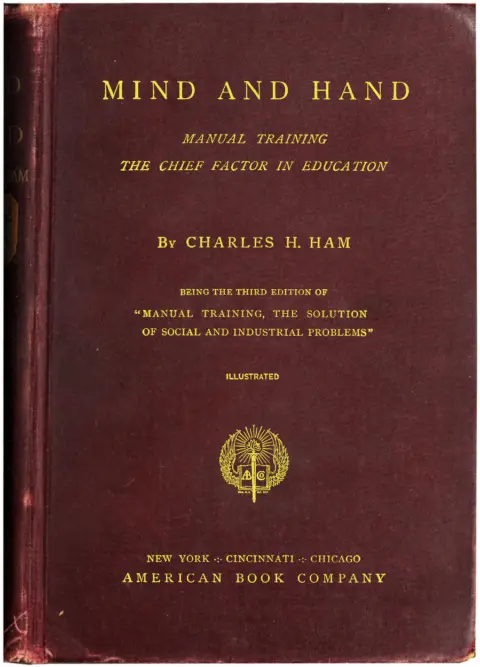
"Mind and Hand: Manual Training the Chief Factor in Education" by Charles H. Ham is an educational treatise written in the late 19th century. The book advocates for an educational reform that emphasizes the integration of manual training with intellectual development, positioning these skills as fundamental to a well-rounded education. Ham argues that the combination of mind and hands-on experience creates a more effective learning environment, fostering not only intellectual growth but also moral and practical skills in students. The beginning of the text discusses Ham's vision of the "Ideal School," a transformative educational institution that prioritizes practical training and labor alongside traditional learning. Describing the school as a place that dignifies labor and combines knowledge with hands-on work, he draws inspiration from historical educational theorists. He emphasizes the significance of tools as critical instruments in education, lamenting their absence in conventional schools, and challenges the status quo of education that often neglects practical skills. In his view, true education goes beyond theory to actively engage students in the physical world, blending learning with creativity and practical applications.
Introduction adapted from the source catalogue; source summaries may be automatically generated.
Free to read · English · 138,003 words · No account needed
MAKE TIME FOR A GOOD BOOK
On by default. Untick to stop anonymous reading totals. Each page counts after 10 seconds in view. How this works.
Anonymous counting is on unless you have switched it off.
Rousseau, the school he described, 2; his opinion that the poor need no education, 124; his theory of the vital importance of early training, 125; his definition of education, 125; his appreciation of the importance of the education of woman, 125, 126; his condemnation of the old system of education, 126; declaration of, that education is nothing but habit, 245.
Runkle, Dr. John D., his declaration that public education should touch practical life in a larger number of points, 202; the founder of manual training in the United States, 333; excerpts from the report of, in 1876, recommending the adoption of manual training by the Massachusetts Institute of Technology, 333, 334; letter of, to the author, containing an exposition of the theory of manual training, with an account of its origin in the mind of, 337, 338; assists in introducing manual training into Girard College, 354.
Ruskin, on finding the truth in things [note], 145; on disciplining the fingers in the laboratory of the goldsmiths [note], 148; on learning by labor what the lips of man could never teach [note], 152; tribute of, to labor [note], 161; on rogues, a manufactured article [note], 237; on how national debts bear upon labor [note], 291; on how standing armies are supported [note], 293.
Russia, arbitrary act of, in 1770, in relation to the export of iron, 115; solves the problem of tool instruction by the laboratory process, 331; manual training introduced into all the technical schools of, 333.
Russia, Emperor of, presents one hundred models of mechanical manipulations to the Massachusetts Institute of Technology, 69; offers John Arnold five thousand dollars for a duplicate of his George III. watch, 86.
San Francisco, Cal., manual training in, 342.
Sankey Canal, the, authorized upon condition that boats plying upon it should be drawn by men only, 179.
Saracens, the friends of education, of science, and art, 282; inventors of cotton-paper, promoters of all the industries, including agriculture, 282, 283; driven from the soil they had made to blossom like the rose, 283; ameliorating influence of, upon the ignorance and superstition of the Middle Ages, 285.
Savage, the, how he is trained, 9; helplessness of, 11; how he is taught to hunt and fish, 176; is taught what he needs to know in his condition, and nothing else, 181; if his education were as unscientific as that of the civilized boy, the race would perish, 215; ninety-nine times in a hundred he traces the footsteps of his enemy in the forest, 215, 216; education of, is scientific, 216; in the practical character of the training of, consists its excellence, 217; mystery which envelops skill of, solved, 219; ignorant, in his primitive state, of all the arts, 278.
Savonarola, the hater of abuses in the Roman Catholic Church, 234; at the death-bed of Lorenzo de Medici, 235; shaking thrones and making proud prelates tremble, 235.
Savory helps to solve the steam-power problem, 15.
Saw-mills, opposition to their introduction in England, 178.
Your reading position is saved on this browser. Take it to another device with a library code. Reading pages adapt to text, rather than matching a printed edition.
BEHIND THE BOOK
This eBook is for the use of anyone anywhere in the United States and most other parts of the world at no cost and with almost no restrictions whatsoever. You may copy it, give it away or re-use it under the terms of the Project Gutenberg License included with this eBook or online at www.gutenberg.org. If you are not located in the United States, you will have to check the laws of the country where you are located before using this eBook. Read the source licence.
The original source file, including credits and licence, is retained by this library. Request an original-format copy at no charge. Please include the book title and Project Gutenberg identifier #67039.
KEEP YOUR CURIOSITY GOING
Charles G. (Charles Griffith) Ross
Hannah Webster Foster

Emily Lawless
Edwin Hamlin Carr

Charles De Lano Hine
Andrew Ure