
The Writing of News A Handbook with Chapters on Newspaper Correspondence and Copy Reading
Charles G. (Charles Griffith) Ross
THE CLASSIC COLLECTION · 1886
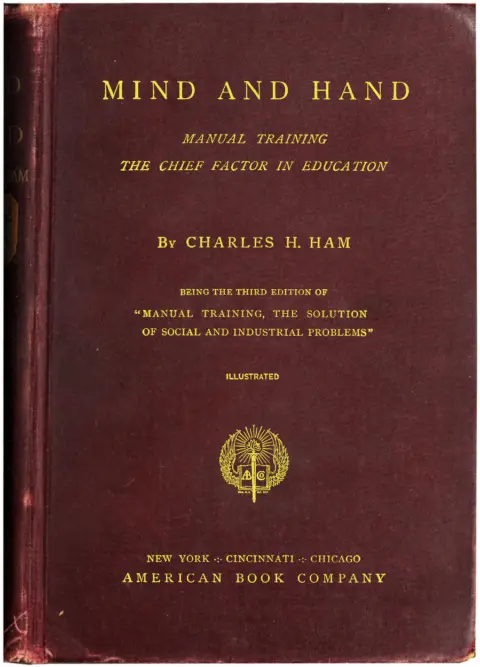
"Mind and Hand: Manual Training the Chief Factor in Education" by Charles H. Ham is an educational treatise written in the late 19th century. The book advocates for an educational reform that emphasizes the integration of manual training with intellectual development, positioning these skills as fundamental to a well-rounded education. Ham argues that the combination of mind and hands-on experience creates a more effective learning environment, fostering not only intellectual growth but also moral and practical skills in students. The beginning of the text discusses Ham's vision of the "Ideal School," a transformative educational institution that prioritizes practical training and labor alongside traditional learning. Describing the school as a place that dignifies labor and combines knowledge with hands-on work, he draws inspiration from historical educational theorists. He emphasizes the significance of tools as critical instruments in education, lamenting their absence in conventional schools, and challenges the status quo of education that often neglects practical skills. In his view, true education goes beyond theory to actively engage students in the physical world, blending learning with creativity and practical applications.
Introduction adapted from the source catalogue; source summaries may be automatically generated.
Free to read · English · 138,003 words · No account needed
MAKE TIME FOR A GOOD BOOK
On by default. Untick to stop anonymous reading totals. Each page counts after 10 seconds in view. How this works.
Anonymous counting is on unless you have switched it off.
Manual training school the child of the kindergarten, 5; destined to unite science and art, 5; its highest text-books tools, 7; must be made part of the public system of education, 112; gain of the pupil of, 122; pupil of, constructs a machine, breathes into it the breath of life, and with it moves mountains, 201; methods of, twenty times more valuable than the unscientific methods of the trade-shop, 219; pupil of, is an investigator, his reasoning opens new fields of thought with every stroke of the chisel, 220; pupil of, gets as much again intellectual benefit from the laboratory as he would if the laboratory equivalent in time were given to book study, 221; laboratory exercises of, a great strain upon the mental constitution, and hence highly educational, 222; pupils of, love it--an incident, 223; method of the, is the expression of ideas in things, 245; realizes the idea of Bacon, Comenius, Pestalozzi, and Froebel, 245.
Massachusetts Institute of Technology, its models of mechanical manipulation presented by the Emperor of Russia, 66; first institution of learning in the United States to adopt manual training, 333; manual training adopted by, in 1876, 334; resolution of thanks for a series of models, presented by the Emperor of Russia, adopted by, 334, 335.
Massachusetts, legislature of, adopts manual training as part of the public school course of, 360.
Maudslay, Henry, his improvement of the lathe made it the king of the machine-tool shop, 33; without his slide-rest Watt’s engine could not have been made, 35; through his slide-rest alone the mechanic is able to make two things exactly alike, 92; slide-rest of, an automaton truer than the human eye, more cunning than the human hand, 200, 201.
Maudsley, Dr. Henry, on the contribution of the muscular sense to mental operations, 147; on the impossibility of thinking without physical expression, 149.
Mechanic, the, who makes a machine that multiplies products is in the front rank of the civilizers of the race, 160; prospects of the skilled, in life, 170; did more to hasten the world’s progress from 1740 to 1840 than all the statesmen of previous ages, 171; splendid career which this age opens to the educated, 182; tremendous power wielded by, 183; has wrought an industrial revolution, 185; works of, reflect honor upon, 187; stands the test of scrutiny better than the merchant, 225; trained in things, 225.
Mechanics, skilled, the use of automatic tools increases rather than diminishes the demand for, 94; of the early time had none of the advantages of the manual training school, 172; their sufferings and misfortunes, 172; no such failure of, as there is of merchants, 227; thoroughness of training of, 239.
Your reading position is saved on this browser. Take it to another device with a library code. Reading pages adapt to text, rather than matching a printed edition.
BEHIND THE BOOK
This eBook is for the use of anyone anywhere in the United States and most other parts of the world at no cost and with almost no restrictions whatsoever. You may copy it, give it away or re-use it under the terms of the Project Gutenberg License included with this eBook or online at www.gutenberg.org. If you are not located in the United States, you will have to check the laws of the country where you are located before using this eBook. Read the source licence.
The original source file, including credits and licence, is retained by this library. Request an original-format copy at no charge. Please include the book title and Project Gutenberg identifier #67039.
KEEP YOUR CURIOSITY GOING
Charles G. (Charles Griffith) Ross
Hannah Webster Foster

Emily Lawless
Edwin Hamlin Carr

Charles De Lano Hine
Andrew Ure