
The Writing of News A Handbook with Chapters on Newspaper Correspondence and Copy Reading
Charles G. (Charles Griffith) Ross
THE CLASSIC COLLECTION · 1886
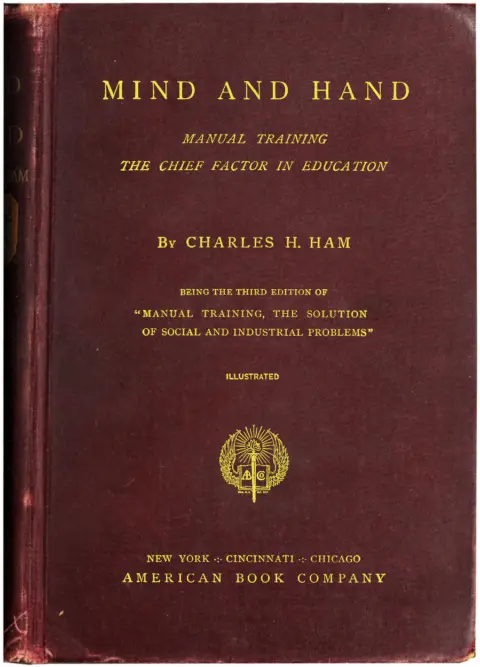
"Mind and Hand: Manual Training the Chief Factor in Education" by Charles H. Ham is an educational treatise written in the late 19th century. The book advocates for an educational reform that emphasizes the integration of manual training with intellectual development, positioning these skills as fundamental to a well-rounded education. Ham argues that the combination of mind and hands-on experience creates a more effective learning environment, fostering not only intellectual growth but also moral and practical skills in students. The beginning of the text discusses Ham's vision of the "Ideal School," a transformative educational institution that prioritizes practical training and labor alongside traditional learning. Describing the school as a place that dignifies labor and combines knowledge with hands-on work, he draws inspiration from historical educational theorists. He emphasizes the significance of tools as critical instruments in education, lamenting their absence in conventional schools, and challenges the status quo of education that often neglects practical skills. In his view, true education goes beyond theory to actively engage students in the physical world, blending learning with creativity and practical applications.
Introduction adapted from the source catalogue; source summaries may be automatically generated.
Free to read · English · 138,003 words · No account needed
MAKE TIME FOR A GOOD BOOK
On by default. Untick to stop anonymous reading totals. Each page counts after 10 seconds in view. How this works.
Anonymous counting is on unless you have switched it off.
SEC. 9. And be it enacted, That no appropriation for the benefit of the colored industrial schools of any county, provided for under this act, shall be paid after the first annual appropriation, unless the average daily attendance at such school or schools shall have been, for the preceding year, at least thirty scholars; and in case said attendance shall fall short of said number, then there shall be paid to the treasurer of the county school commissioners maintaining said school or schools, only at the rate of fifty ($50.00) dollars a scholar, for the daily average annual attendance at the same, to be determined by the report hereinbefore required to be made to the comptroller.
Approved April 7, 1898.”
The report of the state superintendent of public instruction for Michigan, for the year 1897, shows that Kindergartens exist in the public schools of the following cities and towns: Cities of over 4000 population as shown by state census of 1894--Albion, Big Rapids, Cadillac, Calumet, Detroit, Escanaba, Grand Haven, Grand Rapids, Holland, Ionia, Ironwood, Ishpeming, Jackson, Menonimee, Mt. Clemens, Muskegon, Negamee, Niles, St. Joseph, Traverse City, West Bay City, Wyandotte--twenty-two cities of over 4000 population. The twenty-four cities and towns with less than 4000 population as shown by state census of 1894, and having Kindergartens in their public schools, are: Algonac, Alma, Au Sable, Caro, Crystal Falls, Dowagiac, Fremont, Greenville, Hartford, Houghton, Ithaca, Lake Linden, Lake View, Mancelona, Manistique, Montague, Morenci, Nashville, Pentwater, Reed City, Sand Beach, Stanton, Union City, Vassar. Such of these cities and towns as furnished reports will be found in the accompanying tables; from the others no data was received.
Two thoroughly equipped Manual Training schools are projected: one, to be in Pullman, Illinois, is to result from a bequest in the will of the late Mr. George M. Pullman, who left a large sum for its construction, and an annuity of $25,000 for its maintenance; the other school is to be built by the Calumet and Hecla Mining Company, at Calumet, Michigan. Both these schools will be free, and will probably become a part of the public-school system of their respective towns.
The legislature of Massachusetts in 1898 passed an act establishing a trade-school for weavers, to be located at Lowell, Massachusetts, provided the city would raise half the money necessary for its construction, the state to pay the other half. This is the first well-defined movement in this country to establish public trade-schools to teach the trades prevailing in the locality of the school. Europe has many such schools.
Your reading position is saved on this browser. Take it to another device with a library code. Reading pages adapt to text, rather than matching a printed edition.
BEHIND THE BOOK
This eBook is for the use of anyone anywhere in the United States and most other parts of the world at no cost and with almost no restrictions whatsoever. You may copy it, give it away or re-use it under the terms of the Project Gutenberg License included with this eBook or online at www.gutenberg.org. If you are not located in the United States, you will have to check the laws of the country where you are located before using this eBook. Read the source licence.
The original source file, including credits and licence, is retained by this library. Request an original-format copy at no charge. Please include the book title and Project Gutenberg identifier #67039.
KEEP YOUR CURIOSITY GOING
Charles G. (Charles Griffith) Ross
Hannah Webster Foster

Emily Lawless
Edwin Hamlin Carr

Charles De Lano Hine
Andrew Ure