
The Writing of News A Handbook with Chapters on Newspaper Correspondence and Copy Reading
Charles G. (Charles Griffith) Ross
THE CLASSIC COLLECTION · 1886
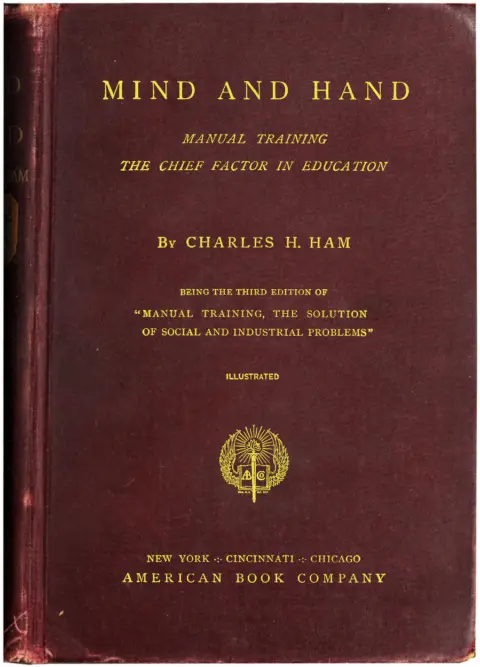
"Mind and Hand: Manual Training the Chief Factor in Education" by Charles H. Ham is an educational treatise written in the late 19th century. The book advocates for an educational reform that emphasizes the integration of manual training with intellectual development, positioning these skills as fundamental to a well-rounded education. Ham argues that the combination of mind and hands-on experience creates a more effective learning environment, fostering not only intellectual growth but also moral and practical skills in students. The beginning of the text discusses Ham's vision of the "Ideal School," a transformative educational institution that prioritizes practical training and labor alongside traditional learning. Describing the school as a place that dignifies labor and combines knowledge with hands-on work, he draws inspiration from historical educational theorists. He emphasizes the significance of tools as critical instruments in education, lamenting their absence in conventional schools, and challenges the status quo of education that often neglects practical skills. In his view, true education goes beyond theory to actively engage students in the physical world, blending learning with creativity and practical applications.
Introduction adapted from the source catalogue; source summaries may be automatically generated.
Free to read · English · 138,003 words · No account needed
MAKE TIME FOR A GOOD BOOK
On by default. Untick to stop anonymous reading totals. Each page counts after 10 seconds in view. How this works.
Anonymous counting is on unless you have switched it off.
“As to the proceedings in courts of law they [the Athenians] have less regard to what is just than to what is profitable to themselves.”--Xenophon’s “Minor Works,” pp. 235-236. London: George Bell & Sons, 1882.
Ibid, pp. 243, 244.
When Mardonius the Persian consulted with the Thebans how to subdue Greece, they said: “Send money to the most powerful men in the cities, and by sending it you will split Greece into parties, and then, with the assistance of those of your party, you may easily subdue those who are not in your interest.”--Herodotus, “Calliope,” IX., § 2. New York: Harper & Brothers, 1882.
Ibid, “Urania,” VIII., §§ 128-134.
„ “Calliope,” IX., § 44.
See also “Plutarch’s Lives [Pericles],” p. 123. New York: Harper &
Brothers, 1850.
Ibid, “Pericles,” p. 118.
„ “Pericles,” p. 115, note.
“Accordingly, as the Athenians state, these men while staying at Delphi, prevailed on the Pythian by money, when any Spartans should come thither to consult the oracle, either on their own account or that of the public, to propose to them to liberate Athens from servitude.”--Herodotus, “Terpsichore,” V., § 63. New York: Harper & Brothers, 1882.
Ibid, “Erato,” VI., §§ 72, 100.
[E22] Euripides makes Andromache say: “O, ye inhabitants of Sparta, most hated of mortals among all men, crafty in counsel, king of liars, concoctors of evil plots, crooked and thinking nothing soundly, but all things tortuously, unjustly are ye prospered in Greece. And what evil is there not in you? Are there not abundant murders? Are ye not given to base gain? Are ye not detected speaking ever one thing with the tongue but thinking another? A murrain seize you!”--“The Tragedies of Euripides [Andromache],” Vol, II., p. 138. New York: Harper & Brothers, 1857.
[E23] “Is it not by reasoning that the soul embraces truths? And does it not reason better than before when it is not encumbered by seeing or hearing, by pain or pleasure? When shut up within itself it bids adieu to the body, and entertains as little correspondence with it as possible; and pursues the knowledge of things without touching them.... Is it not especially upon this occasion that the soul of a philosopher despises and avoids the body and wants to be by itself?... Now, the purgation of the soul, as we were saying just now, is only its separation from the body, its accustoming itself to retire and lock itself up, renouncing all commerce with it as much as possible, and living by itself, whether in this or the other world, without being chained to the body.”--Plato’s “Divine Dialogues,” pp. 180, 181, 182. London: S. Cornish & Co., 1839.
Your reading position is saved on this browser. Take it to another device with a library code. Reading pages adapt to text, rather than matching a printed edition.
BEHIND THE BOOK
This eBook is for the use of anyone anywhere in the United States and most other parts of the world at no cost and with almost no restrictions whatsoever. You may copy it, give it away or re-use it under the terms of the Project Gutenberg License included with this eBook or online at www.gutenberg.org. If you are not located in the United States, you will have to check the laws of the country where you are located before using this eBook. Read the source licence.
The original source file, including credits and licence, is retained by this library. Request an original-format copy at no charge. Please include the book title and Project Gutenberg identifier #67039.
KEEP YOUR CURIOSITY GOING
Charles G. (Charles Griffith) Ross
Hannah Webster Foster

Emily Lawless
Edwin Hamlin Carr

Charles De Lano Hine
Andrew Ure