
The Writing of News A Handbook with Chapters on Newspaper Correspondence and Copy Reading
Charles G. (Charles Griffith) Ross
THE CLASSIC COLLECTION · 1907
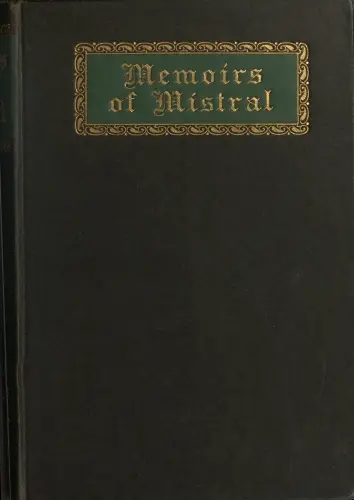
"Memoirs of Mistral" by Frédéric Mistral is a memoir written in the late 19th century. The work provides a vivid account of the author's early life in the province of Provence, capturing the essence of rural life and his formative experiences. The narrative is likely to focus on Mistral's childhood memories, including his family, education, and the natural landscapes that shaped his identity as a poet. The opening portion of the memoir introduces Frédéric Mistral’s childhood in the village of Maillane, nestled at the foot of the Alpilles mountains. He shares details of his family's way of life as yeoman farmers, emphasizing the harmony between their traditions and the landscape. Key figures in his early life, such as his parents, are vividly described; particularly his father, a hardworking patriarch with deep roots in Provençal traditions. Mistral paints a nostalgic picture of his innocent adventures, interactions with local characters, and fond memories tied to nature and familial bonds, establishing a strong sense of place and identity that resonates throughout the memoir.
Introduction adapted from the source catalogue; source summaries may be automatically generated.
Free to read · English · 69,531 words · No account needed
MAKE TIME FOR A GOOD BOOK
On by default. Untick to stop anonymous reading totals. Each page counts after 10 seconds in view. How this works.
Anonymous counting is on unless you have switched it off.
“Folks told, too, of a black horse or mule, some said it was a huge sow, which appeared to the young rakes as they came out of the public-house. One night at Avignon a lot of good-for-nothings on the spree saw a black horse suddenly come out of the Camband Sewer.
“‘Oh, look!’ says one of them, ‘here’s a fine horse, blest if I don’t mount him,’ and the horse let him get on quietly enough.
“‘Why there’s room for me, too,’ says another, and up he got.
“‘And me, too,’ says a third. He jumped up also, and as one by one they mounted, that horse’s back became longer and longer, till, if you’ll believe it, there were a dozen of those young fools on this same horse! Then a thirteenth cries out:
“‘Lord--Holy Virgin and sainted Joseph, I believe there’s room for another’! But at these words the beast vanished, and our twelve riders found themselves on their feet looking sheepish enough, I can tell you. Lucky for them that the last one had pronounced the names of the saints, for otherwise that evil beast would have carried them straight to the devil.
“And then, O Lord, there were the witch-cats. Why yes, those black cats they called the ‘Mascots,’ for they were said to make money come to the house where they lived. You knew the old Tarlavelle, eh?--she who left such a pile of crowns when she died--well, she had a black cat, and she took care to give it the first helping at every meal. And there was my poor uncle, going to bed one night by the light of the moon, what does he see but a black cat crossing the road. He, thinking no harm, threw a stone at the cat--when, lo and behold, the beast turned round, gave him an evil look, and hissed out, ‘Thou hast hit Robert!’ Strange things! To-day they seem like dreams, nobody ever mentions them--yet there must have been something in it all, or why should every one have been so afraid. Eh, and there were many others,” continued Renaude, “awful strange creatures like the Night-witch, who seated herself on your chest and squeezed the breath out of you. And the Wier-wolf, and the Jack o’ Lantern, and the Fantastic Sprite. Why, just fancy, one day--I might have been eleven years old--I was returning from the catechism class when, passing near a poplar, I heard a laugh coming from the very top of the tree. I looked up, and there was the Fantastic Sprite grinning between the leaves and making me signs to climb up. Why, I wouldn’t have gone up that tree for a hundred onions--I took to my heels and ran as if I’d gone crazy. Oh, I can tell you, when we talked of these things round the hearth at nights not one of us would have gone outside. Poor children, what a fright we were in. But we soon grew up, and then came the time for lovers, and the lads would call to us to come out and walk or dance by the moonlight. At first we refused for fear we might meet the White Hen or the Fantastic Sprite, but when they called us ‘sillies’ to believe such blind grandmother’s tales, and said they’d scare away the hobgoblins--boys of that age have got no sense, and make you laugh with their nonsense even against your will--why, gradually we ceased to think so much of it. For one thing we soon had too much to do. Why, I had eleven children, who all turned out well, thank God, besides others I looked after. When one is not rich and has all those brats to do for, one’s hands are pretty full, I can tell you.”
Your reading position is saved on this browser. Take it to another device with a library code. Reading pages adapt to text, rather than matching a printed edition.
BEHIND THE BOOK
This eBook is for the use of anyone anywhere in the United States and most other parts of the world at no cost and with almost no restrictions whatsoever. You may copy it, give it away or re-use it under the terms of the Project Gutenberg License included with this eBook or online at www.gutenberg.org. If you are not located in the United States, you will have to check the laws of the country where you are located before using this eBook. Read the source licence.
The original source file, including credits and licence, is retained by this library. Request an original-format copy at no charge. Please include the book title and Project Gutenberg identifier #56040.
KEEP YOUR CURIOSITY GOING
Charles G. (Charles Griffith) Ross
Hannah Webster Foster

Emily Lawless
Edwin Hamlin Carr

Charles De Lano Hine
Andrew Ure