
The Writing of News A Handbook with Chapters on Newspaper Correspondence and Copy Reading
Charles G. (Charles Griffith) Ross
THE CLASSIC COLLECTION · 1907
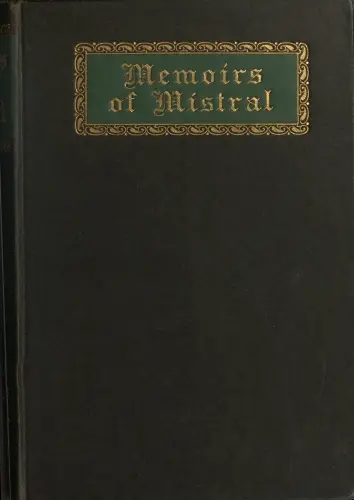
"Memoirs of Mistral" by Frédéric Mistral is a memoir written in the late 19th century. The work provides a vivid account of the author's early life in the province of Provence, capturing the essence of rural life and his formative experiences. The narrative is likely to focus on Mistral's childhood memories, including his family, education, and the natural landscapes that shaped his identity as a poet. The opening portion of the memoir introduces Frédéric Mistral’s childhood in the village of Maillane, nestled at the foot of the Alpilles mountains. He shares details of his family's way of life as yeoman farmers, emphasizing the harmony between their traditions and the landscape. Key figures in his early life, such as his parents, are vividly described; particularly his father, a hardworking patriarch with deep roots in Provençal traditions. Mistral paints a nostalgic picture of his innocent adventures, interactions with local characters, and fond memories tied to nature and familial bonds, establishing a strong sense of place and identity that resonates throughout the memoir.
Introduction adapted from the source catalogue; source summaries may be automatically generated.
Free to read · English · 69,531 words · No account needed
MAKE TIME FOR A GOOD BOOK
On by default. Untick to stop anonymous reading totals. Each page counts after 10 seconds in view. How this works.
Anonymous counting is on unless you have switched it off.
“Oh,” said he, “how happy one feels! how beautiful it is! What music!”
After a moment the doorkeeper said:
“When you have gaped enough, you will go out, for I have no more time to
waste.”
“Don’t you worry,” said Jarjaye. “If you have anything to do, go about your business. I will go out when I will go out. I am not the least in a hurry.”
“But that was not our agreement!”
“My goodness, holy man, you seem very distressed! It would be different if there were not plenty of room. But thank God, there is no squash!”
“But I ask you to go, for if the good God were to pass by----”
“Oh! you arrange that as you can. I have always heard, that he who finds himself well off, had better stay. I am here--so I stay.”
Saint Peter frowned and stamped. He went to find St. Yves.
“Yves,” he said, “You are a barrister--you must give me an opinion.”
“Two if you like,” replied Saint Yves.
“I am in a nice fix! This is my dilemma,” and he related all. “Now what
ought I to do?”
“You require,” said Saint Yves, “a good solicitor, and must then cite by bailiff the said Jarjaye to appear before God.”
They went to look for a good solicitor, but no one had ever seen such a person in Paradise. They asked for a bailiff--still more impossible to find. Saint Peter was at his wits’ end.
Just then Saint Luke passed by.
“Peter, you look very melancholy! Has our Lord been giving you another
rebuke?”
“Oh, my dear fellow, don’t talk of it--I am in the devil of a fix, do you see. A certain Jarjaye has got into Paradise by a trick, and I don’t know how to get him out.”
“Where does he come from, this Jarjaye?”
“From Tarascon.”
“A Tarasconais?” cried Saint Luke. “Oh! what an innocent you are! There is nothing, nothing easier than to make him go out. Being, as you know, a friend of cattle, the patron of cattle-drovers, I am often in the Camargue, Arles, Beaucaire, Nîmes, Tarascon, and I know that people. I have studied their peculiarities, and how to manage them. Come--you shall see.”
At that moment there went by a flight of cherubs.
“Little ones!” called Saint Luke, “here, here!”
The cherubs descended.
“Go quietly outside Paradise--and when you get in front of the door, run past crying out: ‘The oxen--the oxen!’”
So the cherubs went outside Paradise and when they were in front of the door they rushed past crying, “Oxen, oxen! Oh see, see the cattle-drover!”
Jarjaye turned round, amazed.
Your reading position is saved on this browser. Take it to another device with a library code. Reading pages adapt to text, rather than matching a printed edition.
BEHIND THE BOOK
This eBook is for the use of anyone anywhere in the United States and most other parts of the world at no cost and with almost no restrictions whatsoever. You may copy it, give it away or re-use it under the terms of the Project Gutenberg License included with this eBook or online at www.gutenberg.org. If you are not located in the United States, you will have to check the laws of the country where you are located before using this eBook. Read the source licence.
The original source file, including credits and licence, is retained by this library. Request an original-format copy at no charge. Please include the book title and Project Gutenberg identifier #56040.
KEEP YOUR CURIOSITY GOING
Charles G. (Charles Griffith) Ross
Hannah Webster Foster

Emily Lawless
Edwin Hamlin Carr

Charles De Lano Hine
Andrew Ure