THE CLASSIC COLLECTION✦An outlaw’s diary: the CommuneCLASSIC FREE BOOKS
An outlaw’s diary: the Commune
Cécile Tormay
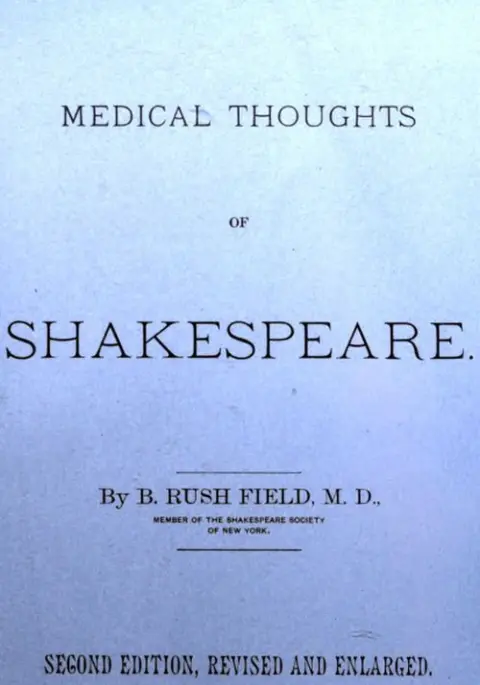
THE CLASSIC COLLECTION · 1884
"Medical Thoughts of Shakespeare" by Benjamin Rush Field is a scholarly publication written in the late 19th century. The work explores the intersection of medicine and the literary genius of Shakespeare, analyzing various medical references and characters within his plays. It aims to highlight Shakespeare's understanding of medical practices and terminology through various citations from his works, providing insights into the medical knowledge of his time. At the start of the text, the author introduces the revised second edition, noting the expansion of content and the addition of new topics related to medicine, surgery, and pharmacology. The opening includes a preface that acknowledges the book's reception and outlines the chapters to follow, suggesting an organized analytical approach. Field begins discussing Shakespeare's portrayal of physicians in his plays and quotes lines showcasing the playwright’s grasp of medical concepts, setting the stage for a detailed investigation into Shakespeare’s medical insights throughout the ensuing chapters.
Introduction adapted from the source catalogue; source summaries may be automatically generated.
Free to read · English · 25,133 words · No account needed
MAKE TIME FOR A GOOD BOOK
On by default. Untick to stop anonymous reading totals. Each page counts after 10 seconds in view. How this works.
Anonymous counting is on unless you have switched it off.
She said, no shepherd sought her side,
No hunter’s hand her snood untied,
Yet ne’er again to braid her hair
The virgin snood did Alice wear;
Gone was her maiden glee and sport,
Her maiden girdle all too short.
Nor sought she, from that fatal night,
Or holy church or blessed rite,
But lock’d her secret in her breast,
And died in travail unconfess’d.
Scott—Lady of the Lake, Canto III., Verse V.
My princely father then had wars in France; And by true computation of the time, Found that the issue was not his begot. Richard III., Act III., Sc. V.
Worse than a slavish wipe, or birth hour’s blot: For marks descried in men’s nativity Are nature’s faults, not their own infamy. Lucrece.
A few quotations on abortion, and some others that are intimately
related to obstetrics, remain.
If ever he have child, abortive be it, Prodigious, and untimely brought to light, Whose ugly and unnatural aspect May fright the hopeful mother at the view. Richard III., Act I., Sc. II.
Why should I joy in any abortive birth? Love’s Labour’s Lost, Act I., Sc. I.
Truth is truth: large length of seas and shores Between my father and my mother lay,— And I have heard my father speak * * * That this, my mother’s son, was none of his; And, if he were, he came into the world Full fourteen weeks before the course of time. King John, Act I., Sc. I.
Shakespeare has interwoven some of his family history here, and made the advent of Philip, the Bastard, correspond exactly to the untimely birth of his eldest daughter Susanna, who appeared only five and a half months after his marriage—“full fourteen weeks before the course of time.” Later on in the play we find the following:
Your brother is legitimate,
Your father’s wife did after wedlock bear him.
—thus furnishing proof of legitimacy in such cases.
She is, something before her time, deliver’d. * * * A daughter; and a goodly babe, Lusty, and like to live. Winter’s Tale, Act II., Sc. II.
O pray God, the fruit of her womb miscarry. Henry IV—2d, Act V., Sc. IV.
She had also snatch’d a moment since her marriage To bear a son and heir—and one miscarriage. Byron—Don Juan, Canto XIV., Verse LVI.
Macduff was from his mother’s womb
Untimely ripp’d.
Macbeth, Act V., Sc. VIII.
Some griefs are med’cinable; that is, one of them, For it doth physic love. Cymbeline, Act III., Sc. II.
Your reading position is saved on this browser. Take it to another device with a library code. Reading pages adapt to text, rather than matching a printed edition.
BEHIND THE BOOK
This eBook is for the use of anyone anywhere in the United States and most other parts of the world at no cost and with almost no restrictions whatsoever. You may copy it, give it away or re-use it under the terms of the Project Gutenberg License included with this eBook or online at www.gutenberg.org. If you are not located in the United States, you will have to check the laws of the country where you are located before using this eBook. Read the source licence.
The original source file, including credits and licence, is retained by this library. Request an original-format copy at no charge. Please include the book title and Project Gutenberg identifier #61366.
KEEP YOUR CURIOSITY GOING
Cécile Tormay

Moritz Busch
John L. Ransom
Frances Wright
Cécile Tormay

Mabel Potter Daggett