
The Writing of News A Handbook with Chapters on Newspaper Correspondence and Copy Reading
Charles G. (Charles Griffith) Ross
THE CLASSIC COLLECTION · 1894
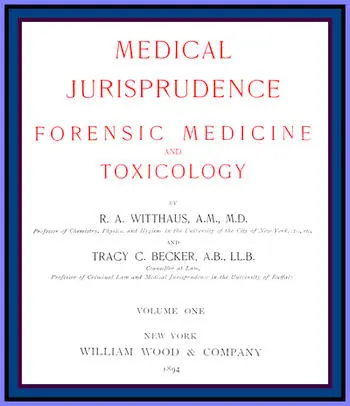
"Medical Jurisprudence, Forensic Medicine and Toxicology. Vol. 1" by R. A. Witthaus et al. is a scientific publication written in the late 19th century. This comprehensive work serves as a fundamental reference for the intersection of medicine and law, particularly focusing on how medical knowledge applies in legal contexts. The book explores various aspects of medical jurisprudence, forensic medicine, and toxicology, aimed at practitioners in both legal and medical fields, as well as scholars interested in legal medicine’s historical and practical significance. The opening of the volume sets the stage by delineating the key topics—medical jurisprudence, forensic medicine, and toxicology. It discusses the historical development of these fields, illustrating the evolution of the legal relationships between medical practitioners and the law. The introduction emphasizes the necessity for legal definitions regarding medical practice, the rights and duties of physicians, and the importance of providing expert testimony in legal cases. This section serves not only as an academic foundation but also as a practical guide for understanding the statutory landscape governing medical practice and its implications for both physicians and patients.
Introduction adapted from the source catalogue; source summaries may be automatically generated.
Free to read · English · 310,507 words · No account needed
MAKE TIME FOR A GOOD BOOK
On by default. Untick to stop anonymous reading totals. Each page counts after 10 seconds in view. How this works.
Anonymous counting is on unless you have switched it off.
[15] What the contents of these depositions were and by whom made is unknown, as the papers referred to by the orator are not given. In the Attic courts the testimony was taken at a preliminary trial, and referred to at the trial by the orator.
[16] “Oratores Attici,” C. Müller, Paris, 1877, i., 20.
[17] “Oratores Attici,” C. Müller, ed. Didot, Paris, 1877, i., 200-203.
[18] In a doubtful fragment of Lysias the expression “as physicians andmidwives declare” (ὡσπερ οὶ ἰατροὶ καὶ αὶ μαῑαι ἁπερηναντο) is used in connection with the question whether a fœtus has life and may be murdered. Cf. “Orat. Attici,” Müller and Hunziker, Paris, Didot, 1858, ii., 257.
[19] “Jul. Cæs.,” 82.
[20] “Hist. Nat.,” xi., 71.
[21] “Hist. Nat.,” vii., 4.
[22] A. Gellius: “Noct. Att.,” 1. 3, c. 16: “requisitis veterum philosophorum et medicorum sententiis.” The word “veterum” seems to indicate that the emperor consulted books, not living physicians.
[23] “Medici non sunt proprie testes, sed majis est judicium quam
testimonium.”
[24] For accounts of the medico-legal provisions of the Justinian enactments, see: G. A. v. d. Pfordten, “Beiträge z. Gesch. d. ger. Med. aus d. Justin. Rechtssam.,” Würzburg, 1838: M. F. Eller, Bull. Med. Leg. Soc. N. Y., 1879, i., 226-237; and Friedreich, Blt. f. ger. Anthr., Nürnberg, 1850, I., iii., 1-64; 1862, xiii., 188-215.
[25] See Mende: “Handb. d. ger. Med.,” Leipzig. 1819, i., 83-87.
[26] “Etablissements et Coûtumes, Assises et Arrêts de l’Echiquier de Normandie au xiii. Siècle,” A. J. Marnier, Par., 1839: “veue d’homme en langueur, veue de méfaits, veue d’homme occis et veue de femme despucelée.”
[27] “Ut peritorum judicio medicorum talis percussio asseveretur non fuisse letalis,” Mende, “Handb. d. ger. Med.,” i., 91.
[28] Hensschel, in “Janus,” Breslau, 1847, ii., 135.
[29] Assises de Jérusalem,” Beugnot, Paris, 1841-43, quoted by Ortolan,
l.c., infra.
[30] Ortolan: “Débuts d. l. Méd. lég.,” Ann. d’Hyg., Par., 1872, 2 s.,
xxxviii., 361.
[31] “Registre Criminel du Châtelet de Paris,” Par., 1861, i., 255.
[32] Ibid., i., 313.
[33] Ibid., i., 375, 409.
[34] “Quæst. Medico-legales,” t. ii., lib. vi., tit. ii.: vol. ii., pp. 33-49, ed. Venet., fol., 1737.
[35] See also “Reg. Crim. Chât. de Paris.,” i., 204, ii., 429; Desmaze: “Hist. Méd. Lég.,” 11-20, 33-41.
[36] Isensee: “Gesch. d. Med.,” i., 216.
[37] “Constitutio criminalis Carolina.” The first edition was printed at Mayence, 1533, fol., by J. Schöffer. See also Kopp, “Jahrb. d. Staatsarznk.,” Frankf., 1808, i., 183.
[38] “Con. cr. Car.,” art. 147.
[39] Ibid., art. 149.
[40] Ibid., arts. 35, 36, 131, 133; “Bambergische Halssgerichts-Ordenung.” Bamb., 1507, art. 44.
[41] “Con. cr. Car.,” art. 37.
[42] Ibid., art. 134.
[43] Ibid., arts. 135, 179, 219.
[44] “Non per quoslibet, nec per insipidos et imperitos, sed tantum per peritos ac doctos medicos aut chirurgos,” p. 245.
[45] “Praxis Rerum Criminalium,” Antw., 1554 (the dedicatory epistle is dated 1551), pp. 245-252, 223-228.
Your reading position is saved on this browser. Take it to another device with a library code. Reading pages adapt to text, rather than matching a printed edition.
BEHIND THE BOOK
This eBook is for the use of anyone anywhere in the United States and most other parts of the world at no cost and with almost no restrictions whatsoever. You may copy it, give it away or re-use it under the terms of the Project Gutenberg License included with this eBook or online at www.gutenberg.org. If you are not located in the United States, you will have to check the laws of the country where you are located before using this eBook. Read the source licence.
The original source file, including credits and licence, is retained by this library. Request an original-format copy at no charge. Please include the book title and Project Gutenberg identifier #49027.
KEEP YOUR CURIOSITY GOING
Charles G. (Charles Griffith) Ross
Hannah Webster Foster

Emily Lawless
Edwin Hamlin Carr

Charles De Lano Hine
Andrew Ure