
The Writing of News A Handbook with Chapters on Newspaper Correspondence and Copy Reading
Charles G. (Charles Griffith) Ross
THE CLASSIC COLLECTION · 1894
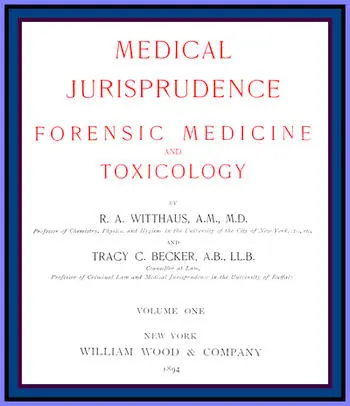
"Medical Jurisprudence, Forensic Medicine and Toxicology. Vol. 1" by R. A. Witthaus et al. is a scientific publication written in the late 19th century. This comprehensive work serves as a fundamental reference for the intersection of medicine and law, particularly focusing on how medical knowledge applies in legal contexts. The book explores various aspects of medical jurisprudence, forensic medicine, and toxicology, aimed at practitioners in both legal and medical fields, as well as scholars interested in legal medicine’s historical and practical significance. The opening of the volume sets the stage by delineating the key topics—medical jurisprudence, forensic medicine, and toxicology. It discusses the historical development of these fields, illustrating the evolution of the legal relationships between medical practitioners and the law. The introduction emphasizes the necessity for legal definitions regarding medical practice, the rights and duties of physicians, and the importance of providing expert testimony in legal cases. This section serves not only as an academic foundation but also as a practical guide for understanding the statutory landscape governing medical practice and its implications for both physicians and patients.
Introduction adapted from the source catalogue; source summaries may be automatically generated.
Free to read · English · 310,507 words · No account needed
MAKE TIME FOR A GOOD BOOK
On by default. Untick to stop anonymous reading totals. Each page counts after 10 seconds in view. How this works.
Anonymous counting is on unless you have switched it off.
47. Terrier: Prog. Méd., 1887, vi., pp. 211-214.—Two men, age 29 and 25, insane. Attempted suicide by hanging. Both resuscitated.
48. Nobeling: Aertz. Intellig.-bl., 1884, xxxi., p. 213.—Two suicides by hanging; men, ages 24 and 40.
49. Ritter: Allg. Wien,. med. Zeit., 1886, xxxi., p. 375.—Soldier, found hanging. Cut down in ten minutes. Artificial respiration applied; fifteen minutes later, an effort at respiration; face changing from blue to white and then to red; pulse small, irregular; still unconscious; mark of ligature distinct; a few hours later had a maniacal seizure; gave morphia hypodermically and he slept; was also aphonic. Gradually recovered and returned to duty.
50. Strassmann: Viert. f. ger. Med., 1888, xlviii., pp. 379-381.—Three cases of suicidal hanging in men, ages 27, 37, and 40. The last was found kneeling.
51. Balta: Pest. Med. Chir. Presse, 1892, xxviii., p. 1244.—Man, age 45-50; hanging; suicide. Thyroid cartilage and hyoid bone broken.
52. Hackel: Op. cit., p. 35.—Man, found hanging to a beam by a sheet. Had previously tried to choke himself with his hands.
53. Ibid.—Two cases of suicidal hanging where the cord made no mark. In the first the body hung free; in the second the body was partly supported. In the first there was no rubbing of the skin; in the second the body was soon cut down.
54. Freund: Wien. klin. Woch., 1893, vi., pp. 118-121.—Man, found hanging; cut down, but could not be resuscitated. Ligature between hyoid bone and larynx, then crossed over itself about middle line of neck, passed up along each side of face, knotted above the head, then thrown over a beam, and on the other side the loop was caught between his legs.
55. Hoffman: Op. cit., p. 525, illustrated.—Case communicated by Dr. Rosen, of Odessa. Man, age 21, and woman, age 17, hung themselves by same ligature thrown over an open door, one of them on each side. They had previously tried other means of suicide without success (see Fig. 24).
56. Ibid., p. 530.—Man found hanging by handkerchief to branch of tree but sitting on the ground. Mark of handkerchief superficial and pale. When the necroscopy was made the mark had disappeared. Also a similar suicide where there was no mark at all.
57. Ibid., p. 541.—Man found hanging to a window. Another man cut the cord and the suspended one fell into a cellar, fracturing his skull.
58. Ibid.—Man found hanging; cut down; the fall caused rupture of
liver.
59. Ibid., p. 539.—Drunkard hung himself; there was evidence that he had previously injured himself during his drunkenness.
60. Ibid.—Boy hung himself because he had been punished by the schoolmaster. There were marks on his back and lower limbs from the punishment.
See also Taylor, “Medical Jurisprudence,” pp. 451-452; Tidy, “Medical Jurisprudence,” incomplete hanging, Cases 33 to 36 and 62; Hofmann, “Lehrbuch,” p. 538.
Your reading position is saved on this browser. Take it to another device with a library code. Reading pages adapt to text, rather than matching a printed edition.
BEHIND THE BOOK
This eBook is for the use of anyone anywhere in the United States and most other parts of the world at no cost and with almost no restrictions whatsoever. You may copy it, give it away or re-use it under the terms of the Project Gutenberg License included with this eBook or online at www.gutenberg.org. If you are not located in the United States, you will have to check the laws of the country where you are located before using this eBook. Read the source licence.
The original source file, including credits and licence, is retained by this library. Request an original-format copy at no charge. Please include the book title and Project Gutenberg identifier #49027.
KEEP YOUR CURIOSITY GOING
Charles G. (Charles Griffith) Ross
Hannah Webster Foster

Emily Lawless
Edwin Hamlin Carr

Charles De Lano Hine
Andrew Ure