
The Writing of News A Handbook with Chapters on Newspaper Correspondence and Copy Reading
Charles G. (Charles Griffith) Ross
THE CLASSIC COLLECTION · 1894
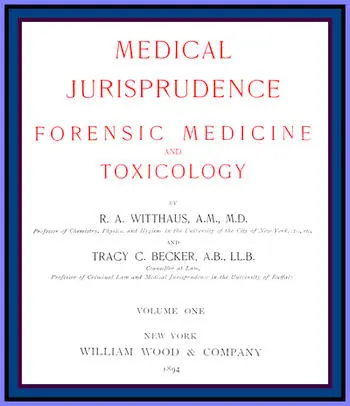
"Medical Jurisprudence, Forensic Medicine and Toxicology. Vol. 1" by R. A. Witthaus et al. is a scientific publication written in the late 19th century. This comprehensive work serves as a fundamental reference for the intersection of medicine and law, particularly focusing on how medical knowledge applies in legal contexts. The book explores various aspects of medical jurisprudence, forensic medicine, and toxicology, aimed at practitioners in both legal and medical fields, as well as scholars interested in legal medicine’s historical and practical significance. The opening of the volume sets the stage by delineating the key topics—medical jurisprudence, forensic medicine, and toxicology. It discusses the historical development of these fields, illustrating the evolution of the legal relationships between medical practitioners and the law. The introduction emphasizes the necessity for legal definitions regarding medical practice, the rights and duties of physicians, and the importance of providing expert testimony in legal cases. This section serves not only as an academic foundation but also as a practical guide for understanding the statutory landscape governing medical practice and its implications for both physicians and patients.
Introduction adapted from the source catalogue; source summaries may be automatically generated.
Free to read · English · 310,507 words · No account needed
MAKE TIME FOR A GOOD BOOK
On by default. Untick to stop anonymous reading totals. Each page counts after 10 seconds in view. How this works.
Anonymous counting is on unless you have switched it off.
[1] The distinction made in the text and in the title of this work is not new. It was recognized by the father of medico-legal science, Zacchias, in his two prefaces, one to the “lector medicus,” the other to the “lector legumperitus” (“Quæst. Med. Leg.,” Ed. Venet., 1727, fol.). In a note to the introduction of the “Medical Jurisprudence” of Dr. Paris and Mr. Fonblanque (the first work produced by joint authorship of a physician and a lawyer, in 1823) is the following (p. i.): “Some authors have objected to the term Medical Jurisprudence as implying a knowledge of the laws relating to medical topics, rather than an acquaintance with the medical science necessary for the elucidation of legal subjects. As it is our peculiar object to unite the sciences and to show their mutual relevance, the title becomes most applicable to this, although it may have been improperly affixed to former works.” The title of one of two existing French works in whose authorship a lawyer is associated is: “Traité de Médecine légale, de Jurisprudence médicale et de Toxicologie,” par Le Grand du Saulle, Geo. Berryer et Gab. Pouchet, 2d ed., 8vo, Paris, 1886.
[2] “Bibl. Hist.,” I., ii., 77; Miot’s transl., Paris, 1834, i., 157.
[3] L. c., I., ii., 82; transl., i., 165.
[4] L. c., I., ii., 75, 76; transl., i., 152.
[5] The “Papyros Ebers,” in the University of Leipzig, the most ancient medical text known, was written about 1550 B.C., and is probably one of the books referred to by Diodorus. It contains no statement bearing upon our subject. It is, however, simply a collection of descriptions of remedies, and their uses, including the incantations to be used with them. (See “Papyros Ebers,” H. Joachim, Berlin. 1890.) The same is true of the Berlin and Leyden papyri. The Bibl. Nat. (Tf. 2) possesses a Chinese manuscript on legal medicine. The catalogue does not, however, state to what period it belongs.
[6] For an account of early Indian medicine, see Th. A. Wise, “Review of the Hist. of Med.,” Lond., 1867, i., 272 et passim; “Hindu System of Medicine,” 1845, by the same author; Haeser, “Lehrb. d. Gesch. d. Med.,” 3. ed., i., 5-40.
[7] Hippocr.: “De Superfœtatione,” ed. Littré, viii., 472.
[8] Hippocr.: “De Septimestri partu;” ibid., “De Octimestri partu,” ed. Littré, viii., 432, 436, 452.
[9] “Aphorismi,” vi., 18, 24; “De Morbis,” ed. Littré, vi., 144.
[10] Petit, S.: “Leges Atticæ,” Lugd. Bat., 1742, lib. iii., tit. 8.
[11] “Od.,” iv., 229; xvii., 384.
[12] For an excellent account of Attic criminal procedure, see Kennedy, C. R.: “Demosthenes’ Orations,” ed. Bohn, iii., 326-372.
[13] “Var. Hist.,” iii., 38.
[14] Kennedy’s transl., ed. Bohn, v., 95.
Your reading position is saved on this browser. Take it to another device with a library code. Reading pages adapt to text, rather than matching a printed edition.
BEHIND THE BOOK
This eBook is for the use of anyone anywhere in the United States and most other parts of the world at no cost and with almost no restrictions whatsoever. You may copy it, give it away or re-use it under the terms of the Project Gutenberg License included with this eBook or online at www.gutenberg.org. If you are not located in the United States, you will have to check the laws of the country where you are located before using this eBook. Read the source licence.
The original source file, including credits and licence, is retained by this library. Request an original-format copy at no charge. Please include the book title and Project Gutenberg identifier #49027.
KEEP YOUR CURIOSITY GOING
Charles G. (Charles Griffith) Ross
Hannah Webster Foster

Emily Lawless
Edwin Hamlin Carr

Charles De Lano Hine
Andrew Ure