THE CLASSIC COLLECTION✦An outlaw’s diary: the CommuneCLASSIC FREE BOOKS
An outlaw’s diary: the Commune
Cécile Tormay
THE CLASSIC COLLECTION · 1920
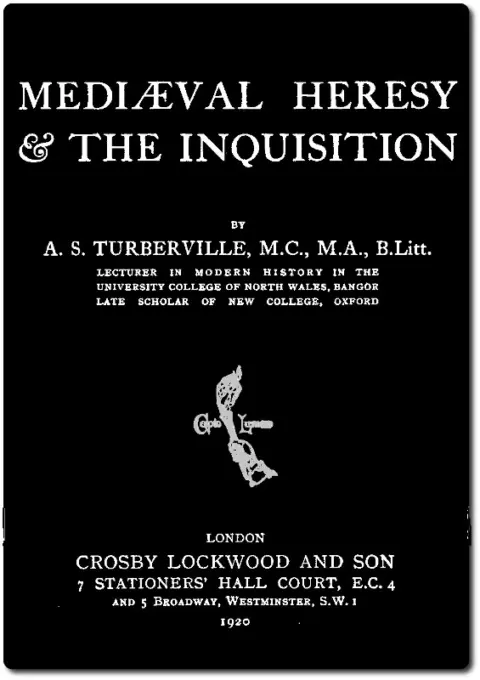
"Mediæval Heresy & the Inquisition" by Arthur Stanley Turberville is a historical account written in the early 20th century. The work explores the complex relationship between various heretical movements that emerged in the Middle Ages and the Church's response to them through the Inquisition. With a focus primarily on the origins of heresy and the nature of ecclesiastical power, it seeks to provide insight into the doctrinal conflicts and social conditions that fueled these movements. The opening of the book sets the stage by describing the historical context of the Middle Ages, establishing a nuanced perspective on what is often referred to as the "Ages of Faith." Turberville asserts that this title does not reflect the whole truth, as various heresies arose from psychological, social, and intellectual tensions within society. He delves into the concept of the "Civitas Dei," emphasizing the intertwined relationship of church and state, and addresses the roots of heresy stemming from clerical abuses and public dissatisfaction. By laying this groundwork, the author suggests that the Inquisition's emergence was a societal response to the perceived threats posed by heretical teachings, highlighting the complexities of faith and authority during this turbulent period.
Introduction adapted from the source catalogue; source summaries may be automatically generated.
Free to read · English · 89,610 words · No account needed
MAKE TIME FOR A GOOD BOOK
On by default. Untick to stop anonymous reading totals. Each page counts after 10 seconds in view. How this works.
Anonymous counting is on unless you have switched it off.
[331] Summa, 2, 2, qu. 11, arts. 3 and 4. ‘Multo enim gravius corrumpere fidem, per quam est animae vita, quam falsare pecuniam, per quam temporali vitae subvenitur. Unde si falsarii pecuniae vel alii malefactores statim per saeculares principes juste morti traduntur, multo magis haeretici statim ex quo de haeresi convincuntur, possunt non solum excommunicari, sed et juste occidi.’ Vacandard (p. 176) answers: ‘Such reasoning is not very convincing. Why should not the life-imprisonment of the heretic safeguard the faithful as well as his death? Will you answer that this penalty is too trivial to prevent the faithful from falling into heresy? If that be so, why not at once condemn all heretics to death, even when repentant? That would terrorize the wavering ones all the more. But St. Thomas evidently was not thinking of the logical consequences of his reasoning. His one aim was to defend the criminal code in vogue at the time. That is his only excuse. For we must admit that rarely has his reasoning been so faulty and so weak as in his thesis upon the coercive power of the Church and the punishment of heresy.’ St. Thomas’s logic is sounder than his apologist’s, if his humanity is less! It is not St. Thomas’s logic that is at fault, but the standpoint of mediæval Christianity, which it is vain to seek to harmonize with modern humanitarianism.
[332] St. John, xv, 6. Vacandard, p. 177. ‘To regard our Saviour as the precursor or rather the author of the criminal code of the Inquisition evidences, one must admit, a very peculiar temper of mind.’ So judged, again by modern humanitarianism.
[333] Tanon, pp. 52-3. To be carefully distinguished from Arnaud of Citeaux, Archbishop of Narbonne, the former papal legate in Languedoc.
[334] Vaissete & Devic, op. cit., vol. iv, p. 118. ‘Clamor validus et insinuatio luctuosa fidelium subditorum, processus suos inquisitionis negotio a captionibus, quaestionibus, et excogitatis tormentis incipiens personas quas pro libito asserit haeretica labe notatas, abnegare Christum ... vi vel motu tormentorum fateri compellit.’
[335] See Douais, Documents, vol. ii, pp. 303-27, for particulars of
this commission.
[336] The bull, Multorum querela, incorporated in the decrees of this Council. See Frédéricq, Corpus, vol. i, No. 170.
[337] Practica, p. 188.
[338] Tanon, p. 116.
[339] See Tanon, p. 119. Also the case of the Sieur de Partenay, the most powerful noble of Poitou. Lea, vol. ii, p. 124.
[340] Lea, vol. ii, p. 130.
[341] Lea, vol. ii, pp. 130-2.
[342] Ibid., p. 140.
[343] Lea, vol. ii. p. 341.
[344] Lea, vol. ii, p. 221. For Peter Martyr, see Ludovico à Paramo,
pp. 108-9.
[345] Lea, vol. ii, p. 236.
Your reading position is saved on this browser. Take it to another device with a library code. Reading pages adapt to text, rather than matching a printed edition.
BEHIND THE BOOK
This eBook is for the use of anyone anywhere in the United States and most other parts of the world at no cost and with almost no restrictions whatsoever. You may copy it, give it away or re-use it under the terms of the Project Gutenberg License included with this eBook or online at www.gutenberg.org. If you are not located in the United States, you will have to check the laws of the country where you are located before using this eBook. Read the source licence.
The original source file, including credits and licence, is retained by this library. Request an original-format copy at no charge. Please include the book title and Project Gutenberg identifier #46149.
KEEP YOUR CURIOSITY GOING
Cécile Tormay

Moritz Busch
John L. Ransom
Frances Wright
Cécile Tormay

Mabel Potter Daggett