THE CLASSIC COLLECTION✦An outlaw’s diary: the CommuneCLASSIC FREE BOOKS
An outlaw’s diary: the Commune
Cécile Tormay
THE CLASSIC COLLECTION · 1920
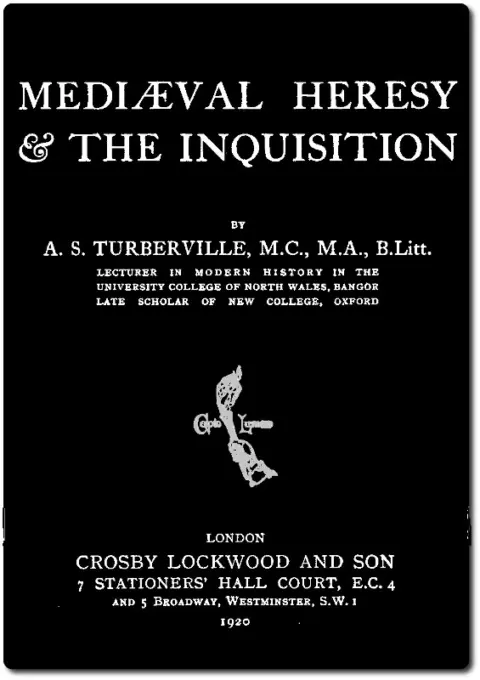
"Mediæval Heresy & the Inquisition" by Arthur Stanley Turberville is a historical account written in the early 20th century. The work explores the complex relationship between various heretical movements that emerged in the Middle Ages and the Church's response to them through the Inquisition. With a focus primarily on the origins of heresy and the nature of ecclesiastical power, it seeks to provide insight into the doctrinal conflicts and social conditions that fueled these movements. The opening of the book sets the stage by describing the historical context of the Middle Ages, establishing a nuanced perspective on what is often referred to as the "Ages of Faith." Turberville asserts that this title does not reflect the whole truth, as various heresies arose from psychological, social, and intellectual tensions within society. He delves into the concept of the "Civitas Dei," emphasizing the intertwined relationship of church and state, and addresses the roots of heresy stemming from clerical abuses and public dissatisfaction. By laying this groundwork, the author suggests that the Inquisition's emergence was a societal response to the perceived threats posed by heretical teachings, highlighting the complexities of faith and authority during this turbulent period.
Introduction adapted from the source catalogue; source summaries may be automatically generated.
Free to read · English · 89,610 words · No account needed
MAKE TIME FOR A GOOD BOOK
On by default. Untick to stop anonymous reading totals. Each page counts after 10 seconds in view. How this works.
Anonymous counting is on unless you have switched it off.
[81] By the middle of the thirteenth century the University of Paris was in possession of practically all the Commentaries of Averrhoës, ibid. See also Renan, pp. 201-2, ‘Un des phénomènes les plus singuliers de l’histoire littéraire du moyen âge, c’est l’activité du commerce intellectuel et la rapidité avec laquelle les livres se repandaient d’un bout à l’autre de l’Europe.’
[82] Mandonnet, pp. lxix et seq.
[83] ‘Nec libri Aristotelis de naturali philosophia nec commenta legantur Parisiis publice et secreto, et hoc sub pena excommunicationis inhibemus.’ This, and the subsequent prohibition of 1215 referred of course only to Paris. See Directorium on the errors of Aristotle and his Arabian commentators, pt. ii, question iv, pp. 253-5. See Hauréau, op. cit., vol. ii, pp. 83-107. On action of Gregory IX, ibid., pp. 108-19.
[84] The tract was written against Averrhoës, not the Averrhoïsts. When, however, it was incorporated in his Summa Theologica, Albertus Magnus made mention of the fact that Averrhoïsm had made considerable progress and boasted a number of advocates. Mandonnet, p. lxxiii.
[85] Ibid., pp. xcvii-ix.
[86] See Fr. Rogeri Bacon Opera quaedam hactenus inedita (ed. J. S. Brewer, 1859), p. 429. There are several contemporary poems on the troubles in the University of Paris, especially on the part played by William de Saint-Amour, in Rutebeuf, Œuvres Complètes (Paris, 1874), vol. i, pp. 178-213.
[87] See Mandonnet, p. cx.
[88] Salimbene, op. cit., p. 108. ‘Isti boni homines semper de scientia gloriantur, et dicunt quod in ordine eorum fons sapientiae invenitur.’
[89] Registrum epistolarum fratris Johannis Peckham (Rolls series, ed. C. T. Martin, London, 1882-5), vol. iii, p. 842. See also A. Little, The Grey Friars in Oxford (1892), pp. 72-5.
[90] See Alberti Magni De Quindecim Problematicis in appendix to
Mandonnet, pp. 13-36.
[91] See Mandonnet, p. cxxvi.
[92] In appendix to Mandonnet, pp. 69-83, 83-115 respectively.
[93] In his tract Contra praecipuos viros in philosophia Albertum et Thomam. On Siger and St. Thomas, see Hauréau, vol. iii, pp. 131-7.
[94] See, passim, De Wulf, op. cit., pp. 379-85; Mandonnet, pp.
cxxviii-ccvi.
[95] De Wulf, p. 384; Mandonnet, p. ccxxi.
[96] The tractate, De Erroribus Philosophorum, is attributed to him. It is printed in appendix to Mandonnet, pp. 2-11.
[97] Ibid., p. clxxvii.
[98] Mandonnet, p. ccvi.
[99] Ibid., p. ccxxvi.
[100] Ibid., pp. ccxxviii et seq.
[101] Ibid., pp. cclxiv et seq.
[102] Mandonnet, pp. cclxx et seq. Mandonnet sees a reference to Siger and Boëthius in the words of Peckham: ‘Nam eam (opinionem) credimus non a religiosis personis, sed saecularibus quibusdam duxisse originem, cuius duo praecipui defensores vel forsitan inventores miserabiliter dicuntur conclusisse dies suos in partibus transalpinis, cum tamen non essent de illis partibus oriundi.’—Registrum, vol. iii, p. 842.
Your reading position is saved on this browser. Take it to another device with a library code. Reading pages adapt to text, rather than matching a printed edition.
BEHIND THE BOOK
This eBook is for the use of anyone anywhere in the United States and most other parts of the world at no cost and with almost no restrictions whatsoever. You may copy it, give it away or re-use it under the terms of the Project Gutenberg License included with this eBook or online at www.gutenberg.org. If you are not located in the United States, you will have to check the laws of the country where you are located before using this eBook. Read the source licence.
The original source file, including credits and licence, is retained by this library. Request an original-format copy at no charge. Please include the book title and Project Gutenberg identifier #46149.
KEEP YOUR CURIOSITY GOING
Cécile Tormay

Moritz Busch
John L. Ransom
Frances Wright
Cécile Tormay

Mabel Potter Daggett