THE CLASSIC COLLECTION✦An outlaw’s diary: the CommuneCLASSIC FREE BOOKS
An outlaw’s diary: the Commune
Cécile Tormay
THE CLASSIC COLLECTION · 1920
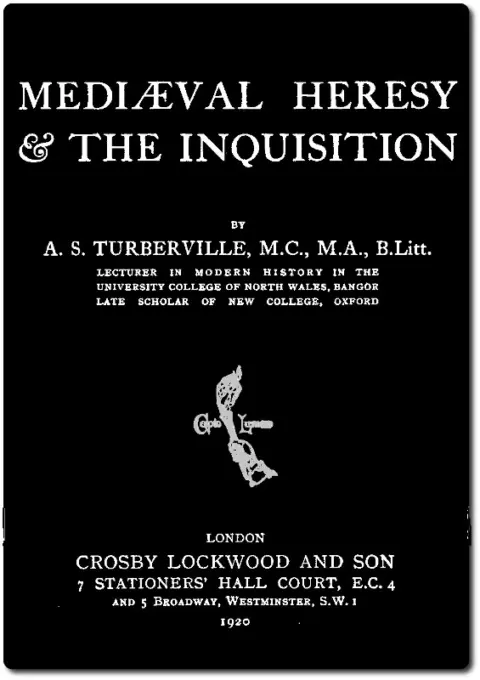
"Mediæval Heresy & the Inquisition" by Arthur Stanley Turberville is a historical account written in the early 20th century. The work explores the complex relationship between various heretical movements that emerged in the Middle Ages and the Church's response to them through the Inquisition. With a focus primarily on the origins of heresy and the nature of ecclesiastical power, it seeks to provide insight into the doctrinal conflicts and social conditions that fueled these movements. The opening of the book sets the stage by describing the historical context of the Middle Ages, establishing a nuanced perspective on what is often referred to as the "Ages of Faith." Turberville asserts that this title does not reflect the whole truth, as various heresies arose from psychological, social, and intellectual tensions within society. He delves into the concept of the "Civitas Dei," emphasizing the intertwined relationship of church and state, and addresses the roots of heresy stemming from clerical abuses and public dissatisfaction. By laying this groundwork, the author suggests that the Inquisition's emergence was a societal response to the perceived threats posed by heretical teachings, highlighting the complexities of faith and authority during this turbulent period.
Introduction adapted from the source catalogue; source summaries may be automatically generated.
Free to read · English · 89,610 words · No account needed
MAKE TIME FOR A GOOD BOOK
On by default. Untick to stop anonymous reading totals. Each page counts after 10 seconds in view. How this works.
Anonymous counting is on unless you have switched it off.
[67] Ibid., vol. ii, pp. 100-1.
[68] Ibid., vol. iii, p. 35. See also p. 31: ‘ ... yperbolice loquendo, qua locutione solet frequenter uti scriptura ad exprimendum eius magnam quantitatem seu multitudinem, congrue dici possit per omnes christianitatis provincias jam esse diffusa.’ From a sermon preached before Clement VI, descanting upon the seriousness and extent of the attraction of the Flagellant mania for the ignorant crowd.
[69] These acrobatic performances were of course of a convulsive nature and were by contemporaries ascribed to demoniac possession. But the idea of dancing and leaping as a form of religious devotion suggests the very charming story, Our Lady’s Tumbler, which has been rewritten by Anatole France and is included in Aucassin et Nicolette and other Mediæval Romances in Everyman’s Library.
[70] On the Scholastic Philosophy generally, see Taylor, The Mediæval Mind, vol. ii, book vii, passim; M. de Wulf, History of Mediæval Philosophy (tr. P. Coffey, London, 1909), pp. 240-410 (passim); B. Hauréau, Histoire de la Philosophie Scolastique (Paris, 1880).
[71] Taylor, op. cit., vol. ii, pp. 358-64.
[72] P. Mandonnet, Siger de Brabant et l’Averroïsme latin au XIIIe Siècle (Fribourg, 1899), pp. xxiii-xxvi; C. Douais, Essai sur l’organisation des études dans l’ordre des Frères-Prêcheurs (Paris, 1884), pp. 62 et seq.
[73] For Arabian Philosophy see the following: T. J. De Boer, History of Philosophy in Islam (tr. E. R. Jones, 1903); De Wulf, op. cit., pp. 225-39; Hauréau, Histoire de la Philosophie Scolastique, vol. ii, pp. 15-53; Carra de Vaux, Avicenne (Paris, 1900), Gazali (Paris, 1902); S. Munk, Mélanges de la philosophie juive et arabe (Paris, 1859), pt. iii, especially pp. 352-83, 418-58.
[74] Alfarabi’s work belonged to the first half of the tenth century.
[75] Avicenna, 980-1036.
[76] Ghazali, 1059-1111.
[77] Ibn Roschd, or Averrhoës, was born in 1126 at Cordova; was entrusted by the Caliph, Abu Jacub Jusuf, with the task of making an analysis of Aristotle; in 1182 became physician at the court; but in 1195 was deprived of his office by the succeeding Caliph, Jacub Almansur, presumably owing to a fit of orthodoxy on the Caliph’s part, and banished from Cordova. He died in Morocco in 1198.
[78] See Renan, Averroës et l’Averroïsme, pp. 107 et seq.
[79] See Renan, op. cit., pp. 133-53 (passim); J. Owen, Skeptics of the Italian Renaissance (1893), pp. 67-72.
[80] Renan, op. cit., pp. 209 et seq., p. 291; De Wulf, op. cit.,
p. 248.
Your reading position is saved on this browser. Take it to another device with a library code. Reading pages adapt to text, rather than matching a printed edition.
BEHIND THE BOOK
This eBook is for the use of anyone anywhere in the United States and most other parts of the world at no cost and with almost no restrictions whatsoever. You may copy it, give it away or re-use it under the terms of the Project Gutenberg License included with this eBook or online at www.gutenberg.org. If you are not located in the United States, you will have to check the laws of the country where you are located before using this eBook. Read the source licence.
The original source file, including credits and licence, is retained by this library. Request an original-format copy at no charge. Please include the book title and Project Gutenberg identifier #46149.
KEEP YOUR CURIOSITY GOING
Cécile Tormay

Moritz Busch
John L. Ransom
Frances Wright
Cécile Tormay

Mabel Potter Daggett