THE CLASSIC COLLECTION✦An outlaw’s diary: the CommuneCLASSIC FREE BOOKS
An outlaw’s diary: the Commune
Cécile Tormay
THE CLASSIC COLLECTION · 1920
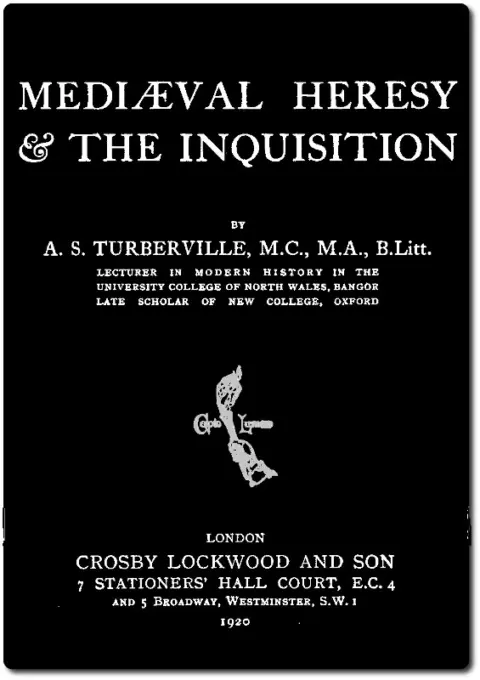
"Mediæval Heresy & the Inquisition" by Arthur Stanley Turberville is a historical account written in the early 20th century. The work explores the complex relationship between various heretical movements that emerged in the Middle Ages and the Church's response to them through the Inquisition. With a focus primarily on the origins of heresy and the nature of ecclesiastical power, it seeks to provide insight into the doctrinal conflicts and social conditions that fueled these movements. The opening of the book sets the stage by describing the historical context of the Middle Ages, establishing a nuanced perspective on what is often referred to as the "Ages of Faith." Turberville asserts that this title does not reflect the whole truth, as various heresies arose from psychological, social, and intellectual tensions within society. He delves into the concept of the "Civitas Dei," emphasizing the intertwined relationship of church and state, and addresses the roots of heresy stemming from clerical abuses and public dissatisfaction. By laying this groundwork, the author suggests that the Inquisition's emergence was a societal response to the perceived threats posed by heretical teachings, highlighting the complexities of faith and authority during this turbulent period.
Introduction adapted from the source catalogue; source summaries may be automatically generated.
Free to read · English · 89,610 words · No account needed
MAKE TIME FOR A GOOD BOOK
On by default. Untick to stop anonymous reading totals. Each page counts after 10 seconds in view. How this works.
Anonymous counting is on unless you have switched it off.
[38] Döllinger, vol. ii, pp. 25, 44. Catholic churches were the dwellings of evil spirits. Satan’s first home on earth had been the temple of Jerusalem, ibid., p. 45. Whenever one of their children by some chance was baptized in a Catholic church, they washed off the taint with dirty water.
[39] See Vacandard, pp. 73-6. Also Douais, Documents, vol. ii, p. 94. ‘Audivit dictum Petrum Garcia(m) dicentem quod non erat missa celebrata in ecclesia usque ad tempus beati Sylvestri; nec ecclesia habuerat possessiones usque ad illud tempus; et quod ecclesia deficiet citra xx annos; et quod missa nostra nihil valet; et quod omnes praedicatores crucis sunt homicide; et quod crux quam illi praedicatores dant nihil aliud est nisi parum de pella super humerum; idem cordula cum qua ligantur capilli.’
[40] Douais, Documents, vol. ii, pp. 250-1, 263, 291, where the ceremony is described in confessions before inquisitors.
[41] Douais, Documents, vol. ii, p. 100. ‘Dixit etiam idem Petrus quod si teneret illum Deum qui de mille hominibus ab eo factis unum salvaret et omnes alios damnaret, ipsum dirumperet et dilaceraret unguibus et dentibus tanquam perfidum et reputaret ipsum esse falsum et perfidum, et spueret in faciem ejus, addens “de gutta cadet ipse.”’ Such language, which is typical of many Catharan utterances, is simply that of a saeva indignatio, aroused by the ascription to the Deity of the cruelty and injustice which conscience reprobates in human beings.
[42] Eymeric, Directorium, part ii, question xiv, p. 196. ‘Quod melius est satisfieri libidini, quocunque actu turpi, quam carnis stimulis fatigari: sed est (ut dicunt, & ipsi faciunt) in tenebris licitum, quemlibet cum qualibet indistincte carnaliter commisceri, quandocunque & quotiescunque carnalibus desideriis stimulentur.’ Cf. Schmidt, p. 151 n., on the Cathari of Orleans in 1012.
[43] Vacandard, p. 80.
[44] Lea, vol. iii, p. 10.
[45] Paradiso, xii, 139-41.
[46] On Joachim’s writings, the problem of The Everlasting Gospel and Joachitism generally, see J. J. Döllinger, Prophecy and the Prophetic Spirit in the Christian Era (tr. A. Plummer, 1873), ch. vii; E. Renan, Nouvelles Études d’histoire religieuse (Paris, 1884; English ed., 1886); the Essay on Joachim in Franciscan Essays (1912), by E. G. Gardner, pp. 50-70; also E. Gebhart, L’Italie mystique; la renaissance religieuse au moyen âge (1908), esp. pp. 49-84, 183-253. The whole story of the Spiritual Franciscans, so far as it affected Italy, is told in this admirable work.
[47] J. à Royas, De Haereticis, eorum que impia intentione et credulitate, cum quinquaginta analyticis assertionibus, quibus universae fidei causae facile definiri valeant, in F. Zilettus, Tractatus Universi Juris (Venice, 1633), vol. xi, pt. ii, p. 211. The fact of the submission of his works in 1200 is disputed, Franciscan Essays, p. 56.
Your reading position is saved on this browser. Take it to another device with a library code. Reading pages adapt to text, rather than matching a printed edition.
BEHIND THE BOOK
This eBook is for the use of anyone anywhere in the United States and most other parts of the world at no cost and with almost no restrictions whatsoever. You may copy it, give it away or re-use it under the terms of the Project Gutenberg License included with this eBook or online at www.gutenberg.org. If you are not located in the United States, you will have to check the laws of the country where you are located before using this eBook. Read the source licence.
The original source file, including credits and licence, is retained by this library. Request an original-format copy at no charge. Please include the book title and Project Gutenberg identifier #46149.
KEEP YOUR CURIOSITY GOING
Cécile Tormay

Moritz Busch
John L. Ransom
Frances Wright
Cécile Tormay

Mabel Potter Daggett