THE CLASSIC COLLECTION✦An outlaw’s diary: the CommuneCLASSIC FREE BOOKS
An outlaw’s diary: the Commune
Cécile Tormay
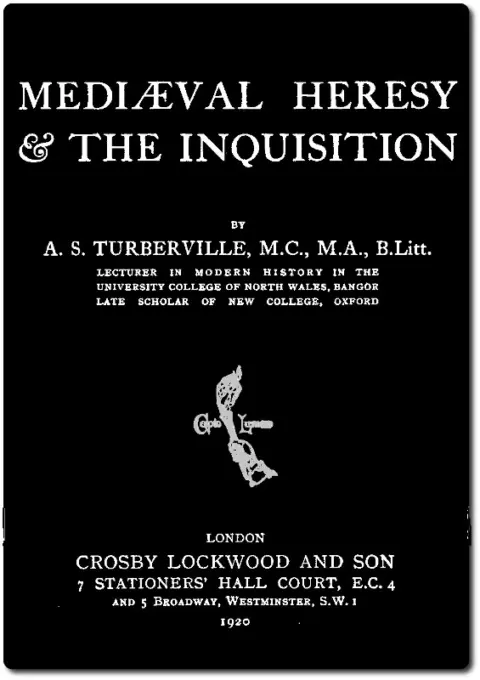
THE CLASSIC COLLECTION · 1920
"Mediæval Heresy & the Inquisition" by Arthur Stanley Turberville is a historical account written in the early 20th century. The work explores the complex relationship between various heretical movements that emerged in the Middle Ages and the Church's response to them through the Inquisition. With a focus primarily on the origins of heresy and the nature of ecclesiastical power, it seeks to provide insight into the doctrinal conflicts and social conditions that fueled these movements. The opening of the book sets the stage by describing the historical context of the Middle Ages, establishing a nuanced perspective on what is often referred to as the "Ages of Faith." Turberville asserts that this title does not reflect the whole truth, as various heresies arose from psychological, social, and intellectual tensions within society. He delves into the concept of the "Civitas Dei," emphasizing the intertwined relationship of church and state, and addresses the roots of heresy stemming from clerical abuses and public dissatisfaction. By laying this groundwork, the author suggests that the Inquisition's emergence was a societal response to the perceived threats posed by heretical teachings, highlighting the complexities of faith and authority during this turbulent period.
Introduction adapted from the source catalogue; source summaries may be automatically generated.
Free to read · English · 89,610 words · No account needed
MAKE TIME FOR A GOOD BOOK
On by default. Untick to stop anonymous reading totals. Each page counts after 10 seconds in view. How this works.
Anonymous counting is on unless you have switched it off.
[13] See Döllinger, vol. ii, pp. 306-11, for list of eighty-nine errors alleged against the Waldenses.
[14] Bernard Gui, Practica Inquisitionis haereticae pravitatis (ed. C. Douais, Paris, 1886), p. 134. ‘Item, circa sacramentum vere penitentie et clavis ecclesie perniciosius aberrantes, tenent et docent se habere potestatem a Deo, sicut sancti apostoli habuerunt, audiendi confessiones peccatorum sibi volentium confiteri, et absolvendi, et penitentias injungendi; confessiones talium audiant et injungant sibi confitentibus penitentias pro peccatis, quamvis non sunt clerici, nec sacerdotales per aliquem episcopum Romane ecclesie ordinati, nec sunt layci simpliciter; talemque potestatem nec confitentur se habere a Romana ecclesia, sed pocius diffitentur, et revera nec a Deo nec ab ejus ecclesia ipsam habent, cum sint extra ecclesiam et ab ipsa ecclesia jam precisi, extra quam non est vera penitentia neque salus.’ Cf. ibid., pp. 244 et seq.
[15] Quoted in Lea, vol. i, p. 85.
[16] Peter de Pilichdorff, quoted in Melia, p. 25.
[17] Quoted in Lea, vol. i, p. 85.
[18] See Schmidt, vol. i, pp. 7-24.
[19] The Paulicians had originally, in the seventh century, in Armenia, been anti-Manichæan. They became definitely Manichæan in the ninth. The French bougre-heretic means Bulgar. For Catharan doctrines and manners of life generally, see Bernard Gui, Practica, pp. 235 et seq.; for its theology see Döllinger, vol. i, pp. 34-50; vol. ii (Documents), pp. 282-96. The errors of the Cathari are summarised in Nicolas Eymeric, Directorium Inquisitorum (Rome, 1585), part ii, question xiii, pp. 290-2.
[20] See Schmidt, vol. ii, pp. 9, 11, 16.
[21] Ibid., pp. 21-2; also C. Douais, Documents pour servir à l’histoire de l’Inquisition dans le Languedoc (Paris, 1900), vol. ii, pp. 95-6. Examination of a Catharan, Pierre Garcia. Garcia said, ‘quod erat unus Deus benignus qui creavit incorruptibilia et permansura, et alius Deus erat malignus qui creavit corruptibilia et transitoria.’
[22] Ibid., p. 91. ‘Lex Moysi non erat nisi umbra et vanitas.’ Cf. Döllinger, vol. i, p. 40.
[23] Schmidt, vol. ii, pp. 37-68.
[24] Ibid., p. 73.
[25] Ibid., p. 36.
[26] Schmidt, vol. ii, pp. 38-9.
[27] Ibid., p. 40, and Douais, Documents, vol. ii, p. 40;
Döllinger, vol. ii, p. 155.
[28] Schmidt, vol. ii, pp. 39-40; Döllinger, vol. ii, p. 34.
[29] Schmidt, ibid., pp. 44-8.
[30] S. Matt., x. 37.
[31] See Schmidt, vol. ii, p. 82.
[32] Döllinger, vol. ii, pp. 3, 83-4.
[33] Ibid., p. 4; Schmidt, vol. ii, p. 84.
[34] Schmidt, ibid.
[35] Döllinger, vol. ii, pp. 30-4, 56. This was a survival of the Marcionite heresy. The continuity of the same fundamental types of heresy which had vexed the early Church into the Middle Ages is remarkable.
[36] Döllinger, vol. ii, pp. 30 et seq., 56; mainly from Acta inquisitionis Carcassonensis contra Albigenses, 1308-9.
[37] Ibid., vol. ii, p. 33. See also E. Vacandard, The Inquisition, a Critical and Historical Study of the Coercive Powers of the Church (trans. by B. L. Conway, 1908), pp. 90-4.
Your reading position is saved on this browser. Take it to another device with a library code. Reading pages adapt to text, rather than matching a printed edition.
BEHIND THE BOOK
This eBook is for the use of anyone anywhere in the United States and most other parts of the world at no cost and with almost no restrictions whatsoever. You may copy it, give it away or re-use it under the terms of the Project Gutenberg License included with this eBook or online at www.gutenberg.org. If you are not located in the United States, you will have to check the laws of the country where you are located before using this eBook. Read the source licence.
The original source file, including credits and licence, is retained by this library. Request an original-format copy at no charge. Please include the book title and Project Gutenberg identifier #46149.
KEEP YOUR CURIOSITY GOING
Cécile Tormay

Moritz Busch
John L. Ransom
Frances Wright
Cécile Tormay

Mabel Potter Daggett