THE CLASSIC COLLECTION✦The hermit of Turkey HollowCLASSIC FREE BOOKS
The hermit of Turkey Hollow
Arthur Cheney Train
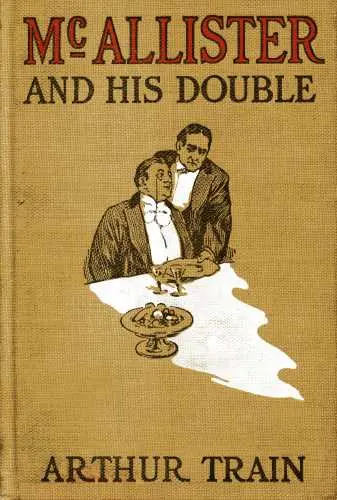
THE CLASSIC COLLECTION · 1905
"McAllister and His Double" by Arthur Cheney Train is a novel written in the early 20th century. The story centers around the main character, McAllister, a clubman who faces an unexpected and tumultuous Christmas when he becomes mistaken for a criminal named Fatty Welch. The narrative explores themes of identity, social class, and fate in a comically embroiled twist of events. The opening of the book introduces McAllister as a somewhat disgruntled clubman who is stuck at his club during the Christmas season, longing for company and feeling irritated by the festive atmosphere surrounding him. His evening takes a dramatic turn when he finds himself in a runaway cab with a dangerous criminal and is soon arrested, believing he is merely a victim of circumstance. McAllister grapples with being mistakenly identified as a notorious thief, leading to a series of unfortunate yet humorous encounters with the police and his former valet, Wilkins. This sets the stage for an engaging exploration of mistaken identity and the chaos that ensues as McAllister seeks to clear his name, discovering both the absurdity of his situation and the inherent struggles of those living on the fringes of society.
Introduction adapted from the source catalogue; source summaries may be automatically generated.
Free to read · English · 63,595 words · No account needed
MAKE TIME FOR A GOOD BOOK
On by default. Untick to stop anonymous reading totals. Each page counts after 10 seconds in view. How this works.
Anonymous counting is on unless you have switched it off.
"Yes, Miss Higgins got yer telegram," answered Deacon Brewer, as they drove slowly along the river in the dusty heat of the early July morning. "Ef she hadn't I reckon she'd 'a' gone nigh crazy."
They were in an open two-seated buck-board. McAllister, holding Abby in his lap, occupied the front seat with the Deacon, while Wilkins sat behind with the valise and the pasteboard box.
"It was a tiresome delay and really a very fortunate escape," responded McAllister. "Abby behaved beautifully."
"She's a good child," said the Deacon. "Her mother was a fine woman, and she's goin' to be just like her."
"Are we nearly home?" asked the little girl, rubbing her eyes.
"'Most," answered the Deacon. "Are ye hungry?"
"I got her some bread and milk at a farm-house," explained McAllister, "but none of us have had any breakfast yet."
"Wall, I reckon Miss Higgins'll be prepared for ye," said the Deacon. "She's a liberal woman an' a smart woman, but all the same, the farm's going to be sold for taxes next week."
Abby had fallen asleep, but the clubman started and looked anxiously at her at this piece of intelligence.
"She don't know nuthin' about it," said the farmer. "Miss Higgins can't run a hard-scrabble farm, nor no one can and make a livin' out'n it. It ain't worth five dollars an acre."
"What will she do?" asked the clubman.
"Darn ef I know," responded the other. "She kin help around some, I guess. Deacon Giddings has a powerful lot of company. 'N any woman kin sew. She kin make out, I reckon."
"But the child?" whispered McAllister.
"Her Uncle Moses'll hev to take her," answered the Deacon.
"Jiminy!" ejaculated the clubman, recalling the little girl's description of her uncle's wife. "She won't like that."
"Beggars can't be choosers," said the Deacon dryly.
A turn in the road brought them within view of a small, low farm-house, with good-sized barn, lying in a field between the woods and the river, here about a quarter of a mile in width. The pines grew close to the road upon the left, but upon the other side the land had been well cleared to the Penobscot's bank. Huge piles of stones, ten or twelve feet long, five or so broad, and four or five feet high, were monuments to the energy and industry of some former owner.
"Gosh, how Henery worked to clear this farm!" remarked the Deacon. "He hove stone for twenty years, an' then died. Look at them trees!"
He pointed dramatically to a large orchard containing row upon row of
young apple-trees.
Your reading position is saved on this browser. Take it to another device with a library code. Reading pages adapt to text, rather than matching a printed edition.
Arthur Cheney Train
Arthur Cheney Train
Arthur Cheney Train
Arthur Cheney Train
BEHIND THE BOOK
This eBook is for the use of anyone anywhere in the United States and most other parts of the world at no cost and with almost no restrictions whatsoever. You may copy it, give it away or re-use it under the terms of the Project Gutenberg License included with this eBook or online at www.gutenberg.org. If you are not located in the United States, you will have to check the laws of the country where you are located before using this eBook. Read the source licence.
The original source file, including credits and licence, is retained by this library. Request an original-format copy at no charge. Please include the book title and Project Gutenberg identifier #34597.
KEEP YOUR CURIOSITY GOING
Coulson Kernahan

Maurice Baring
Frances Wright
Cécile Tormay

Frederic Jesup Stimson

W. H. P. (William Henry Pope) Jarvis