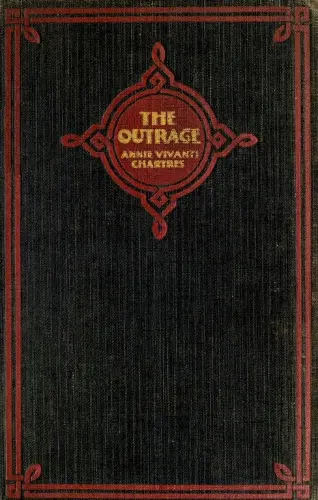
The Outrage
Annie Vivanti
THE CLASSIC COLLECTION · 1915
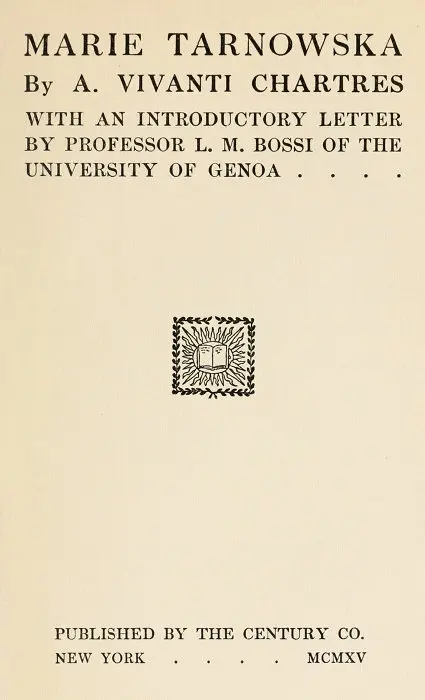
"Marie Tarnowska" by Annie Vivanti is a novel written in the early 20th century. The story is centered around the tragic life of Marie Nicolaevna Tarnowska, a Russian noblewoman embroiled in a sensational murder trial that raises questions about guilt, morality, and societal judgments. The narrative navigates through themes of love, crime, and the psychological and physical conditions affecting women, particularly in the context of societal expectations and personal trauma. The opening of the novel introduces the backstory of Count Paul Kamarowsky's murder and sets the stage for the trial that reveals a web of passion, betrayal, and tragedy surrounding Marie. It describes the events leading up to Kamarowsky's death and the subsequent arrest and sentencing of Marie and her accomplices. Through the lens of a doctor familiar with the case, we learn about Marie's troubled past and the health issues that plagued her family, hinting at deeper societal critiques about the treatment of women and notions of criminality. The narrative style is introspective, inviting readers to empathize with Marie's plight while reflecting on her emotional and mental turmoil as she transitions from the corridors of aristocracy to the confines of a prison cell.
Introduction adapted from the source catalogue; source summaries may be automatically generated.
Free to read · English · 58,096 words · No account needed
MAKE TIME FOR A GOOD BOOK
On by default. Untick to stop anonymous reading totals. Each page counts after 10 seconds in view. How this works.
Anonymous counting is on unless you have switched it off.
Although Tioka and I both recovered, this alarming incident had its consequences on my life. It caused me to leave my old home, and from the moment of that departure I never saw my dear mother again.
With the passing of her mild and tender presence all that still was pure and holy vanished out of my life.
I was already on the brink of perdition. Freed from the restraint of that gentle hand, whose light touch even from afar had still controlled my heart, I plunged forward to destruction.
The inheritance was divided, and my share was dissipated I know not how. I returned to Moscow, and found myself ever more and more in need of money.
I lived luxuriously, I dressed gorgeously, and traveled from one place to another--yet I had nothing of my own except an income of four thousand rubles a year, which were scarcely paid to me before they were swallowed up in the gulf of my debts. I asked Prilukoff for money, and he gave it to me.
But there came a day when, on my asking him for five thousand rubles, he turned upon me abruptly.
"I have not got them," he said. "At least," he added, "not unless I
steal them."
"How dreadful," I exclaimed in terror. "How can you say such a thing?" Then I laughed, feeling sure that he had spoken in jest.
"Get them from Kamarowsky," said Prilukoff, curtly.
I started with indignation. From Kamarowsky! Never, never, as long as I lived. I had seen him frequently during the last few days; he and his charming little son, Grania, still in their deep mourning and with pale, sad faces, used to come and see me, and talk to me with many tears about their dear one who was gone. It would have been horrible, it would have been indecorous, to ask Kamarowsky for money.
"I did not say you were to ask him for it," retorted Prilukoff.
"What then?"
"Telephone and invite him to dine with you to-morrow."
"Well? And then?"
"Then we shall see."
As he insisted I complied reluctantly.
Kamarowsky accepted the invitation with touching gratitude, and a large basket of roses preceded his arrival.
Prilukoff, who was still hanging about in my boudoir, but declared that he would not stay to dinner, sniffed the roses with a cynical smile:
"Flowers! Flowers! Nothing but flowers! Nous allons changer tout
cela."
The door bell rang, announcing the arrival of my visitor.
"What am I to do with him now he is here?" I asked Prilukoff uneasily.
"What shall I say?"
"Do nothing and say nothing. And mind you don't open any letter in his
presence."
Your reading position is saved on this browser. Take it to another device with a library code. Reading pages adapt to text, rather than matching a printed edition.
Annie Vivanti
Annie Vivanti
BEHIND THE BOOK
This eBook is for the use of anyone anywhere in the United States and most other parts of the world at no cost and with almost no restrictions whatsoever. You may copy it, give it away or re-use it under the terms of the Project Gutenberg License included with this eBook or online at www.gutenberg.org. If you are not located in the United States, you will have to check the laws of the country where you are located before using this eBook. Read the source licence.
The original source file, including credits and licence, is retained by this library. Request an original-format copy at no charge. Please include the book title and Project Gutenberg identifier #43058.
KEEP YOUR CURIOSITY GOING
Coulson Kernahan

Maurice Baring
Frances Wright
Cécile Tormay

Frederic Jesup Stimson

W. H. P. (William Henry Pope) Jarvis