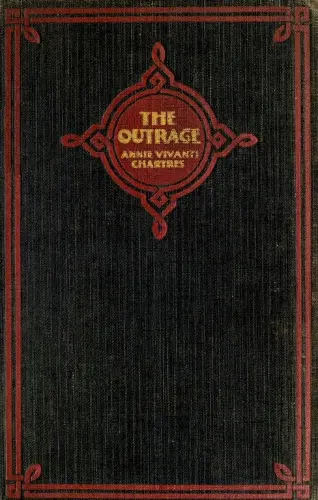
The Outrage
Annie Vivanti
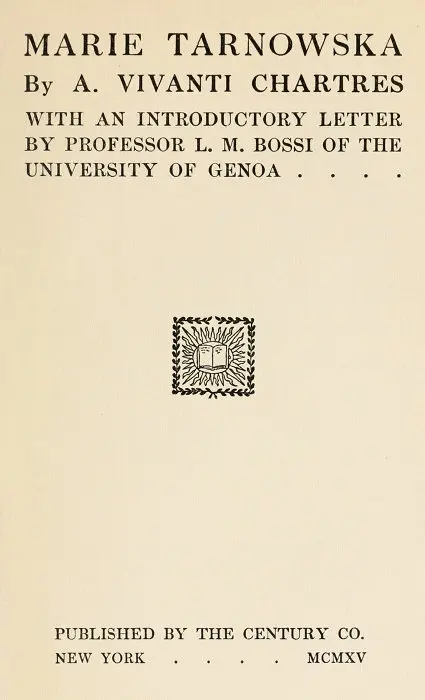
THE CLASSIC COLLECTION · 1915
"Marie Tarnowska" by Annie Vivanti is a novel written in the early 20th century. The story is centered around the tragic life of Marie Nicolaevna Tarnowska, a Russian noblewoman embroiled in a sensational murder trial that raises questions about guilt, morality, and societal judgments. The narrative navigates through themes of love, crime, and the psychological and physical conditions affecting women, particularly in the context of societal expectations and personal trauma. The opening of the novel introduces the backstory of Count Paul Kamarowsky's murder and sets the stage for the trial that reveals a web of passion, betrayal, and tragedy surrounding Marie. It describes the events leading up to Kamarowsky's death and the subsequent arrest and sentencing of Marie and her accomplices. Through the lens of a doctor familiar with the case, we learn about Marie's troubled past and the health issues that plagued her family, hinting at deeper societal critiques about the treatment of women and notions of criminality. The narrative style is introspective, inviting readers to empathize with Marie's plight while reflecting on her emotional and mental turmoil as she transitions from the corridors of aristocracy to the confines of a prison cell.
Introduction adapted from the source catalogue; source summaries may be automatically generated.
Free to read · English · 58,096 words · No account needed
MAKE TIME FOR A GOOD BOOK
On by default. Untick to stop anonymous reading totals. Each page counts after 10 seconds in view. How this works.
Anonymous counting is on unless you have switched it off.
"Elise, I cannot bear to see myself in this ugly black dress any longer. Write to Schanz and tell him to send me some new gowns. I want a dark green tailor-made costume, and a pearl-gray voile."
"Yes, my lady. But, begging your ladyship's pardon, Schanz says that he
would like to be paid."
"Well, let us pay him then."
"Yes, my lady. But, begging your ladyship's pardon, his bill is
twenty-five thousand rubles."
"Well, let him have them."
"I am sorry, my lady, but we have not got twenty-five thousand rubles."
It was true. We had not got twenty-five thousand rubles.
"Elise, Tioka wants to be amused. He would like a toy railway."
"Yes, my lady."
"Mind," cried Tioka, "it must be like the one we saw yesterday, with all those stations and canals, and a Brooklyn bridge."
"Yes, Master Tioka."
"Well, Elise, what are you waiting for?"
"Begging your ladyship's pardon, it costs eighty rubles."
"Well?"
"We have not got them."
True enough; we had not got eighty rubles.
"Elise, I have no more perfumes. Go and get me a bottle of Coty's
Origant."
"Yes, my lady. But--"
"But what?"
"It costs twelve rubles."
"Well?"
"We have not got them."
And indeed we had not got twelve rubles.
I thought it very sad not to have twenty-five thousand rubles, nor even twelve rubles, when I required them.
I resolved to telegraph to my mother.
Feeling sad and perplexed, I went to the telegraph office and sat down at a table to write my message:
"Mother, dear, we are unhappy and forlorn; Tioka and I want to come home and stay with you always. Please send us at once--"
I was meditating on what sum to mention, when I felt the touch of a hand upon my shoulder. Startled, I turned, and raised my eyes. Before me stood a man--dark, rather tall, with a brown mustache and pendulous cheeks. Surely I knew him! Where had I seen that face before? Suddenly there flashed into my mind the recollection of a crowded, brilliantly lighted restaurant. I saw Vassili, amid much laughter, counting the dark-eyed tziganes to see if one of them were missing--Prilukoff! "The Scorpion!" It was he who stood before me.
"Countess Tarnowska! Who would have dreamt of finding you here!" he exclaimed. "What are you doing in Moscow?"
"I--I do not know," I stammered. I had in fact not infrequently asked myself what I was doing in Moscow.
Your reading position is saved on this browser. Take it to another device with a library code. Reading pages adapt to text, rather than matching a printed edition.
Annie Vivanti
Annie Vivanti
BEHIND THE BOOK
This eBook is for the use of anyone anywhere in the United States and most other parts of the world at no cost and with almost no restrictions whatsoever. You may copy it, give it away or re-use it under the terms of the Project Gutenberg License included with this eBook or online at www.gutenberg.org. If you are not located in the United States, you will have to check the laws of the country where you are located before using this eBook. Read the source licence.
The original source file, including credits and licence, is retained by this library. Request an original-format copy at no charge. Please include the book title and Project Gutenberg identifier #43058.
KEEP YOUR CURIOSITY GOING
Coulson Kernahan

Maurice Baring
Frances Wright
Cécile Tormay

Frederic Jesup Stimson

W. H. P. (William Henry Pope) Jarvis