THE CLASSIC COLLECTION✦An outlaw’s diary: the CommuneCLASSIC FREE BOOKS
An outlaw’s diary: the Commune
Cécile Tormay
THE CLASSIC COLLECTION · 1889
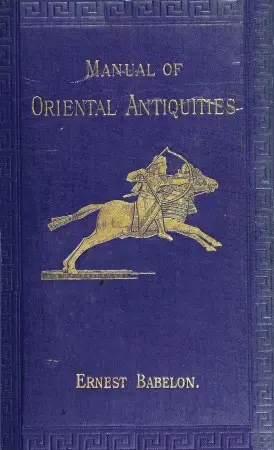
"Manual of Oriental Antiquities" by Ernest Babelon is a scholarly work focusing on historical and artistic analyses of ancient Eastern civilizations, drafted in the early 20th century. It comprehensively covers the architecture, sculpture, and various arts of cultures such as Chaldæa, Assyria, Persia, and others until reaching the influence of Greek civilization. The book aims to unravel the connections and unique characteristics of these rich cultures while highlighting recent archaeological discoveries. The opening of this manual introduces readers to the rich tapestry of ancient civilizations in the Near East, excluding Egypt, that once thrived long before the influence of Greece and Rome. Babelon emphasizes the artistic genius of these civilizations, declaring that what we call “Persian art” or “Jewish art” fundamentally draws from Chaldæo-Assyrian and Egyptian roots. The text reveals exciting archaeological findings from sites such as Tello, which have contributed significantly to our understanding of ancient architecture and sculpture, laying the groundwork for a broader discussion of art forms, materials, and techniques used by these remarkable societies.
Introduction adapted from the source catalogue; source summaries may be automatically generated.
Free to read · English · 81,642 words · No account needed
MAKE TIME FOR A GOOD BOOK
On by default. Untick to stop anonymous reading totals. Each page counts after 10 seconds in view. How this works.
Anonymous counting is on unless you have switched it off.
[28] Heuzey, Un palais chaldéen, p. 91.
[29] History of Art in Assyria and Chaldæa, vol. i., p. 228 f. [Eng
Ed.]
[30] Lenormant and Babelon, Hist. Anc. de l’Orient, vol. iv., p. 411.
[31] xvi., 1, 5.
[32] Lenormant and Babelon, Hist. anc. de l’Orient, v. iv., p. 412.
[33] What Aristotle really says is: “It is not a wall that makes a city, for the Peloponnese might be enclosed within a wall. Babylon, perhaps, is a city of such sort, and so is any other, the walls of which enclose a nation rather than a city. They say that when Babylon had been taken for three days part of the inhabitants were unaware of the fact.”--Pol. i. 3.
[34] Exp. en Mésopotamie, t. i., p. 194 ff.
[35] Cun. Inscr. and the O.T., vol. i., p. 79.
[36] Heuzey, Un Palais Chaldéen, p. 81.
[37] Menant, Remarques sur les portraits des rois assyro-chaldéens,
1882.
[38] Layard, Monuments of Nineveh, vol. i., pl. 26, and passim.
[39] Perrot and Chipiez, History of Art in Chaldæa and Assyria, vol.
i., p. 257.
[40] Herod. ii. 106
[41] Perrot and Chipiez, History of Art in Chaldæa and Assyria, vol.
ii., p. 294 ff.
[42] Cf. Ezekiel xxiii. 14.
[43] L. Heuzey, Les Figurines de terre cuite du Musée du Louvre, p.
1.
[44] Nineveh and Babylon, p. 358.
[45] Heuzey, op. cit., p. 2.
[46] History of Art in Chaldæa and Assyria, vol. ii., p. 217.
[47] Perrot and Chipiez, History of Art, vol. ii., p. 143.
[48] Perrot and Chipiez, op. cit., vol. ii., p. 319 ff.
[49] Wrongly called Sennacherib by M. Babelon.
[50] E. Müntz, La Tapisserie, p. 22.
[51] See especially J. Menant, La Glyptique Orientale, t. ii.
[52] For the recent discoveries at Susa and discussion of Elamite remains, see Chapter IX. of this volume.
[53] Heuzey, in the Revue politique et littéraire, 1886, p. 661.
[54] L’art antique de la Perse, t. i., p. 8.
[55] L’art antique de la Perse, t. ii., p. 37.
[56] Dieulafoy, op. cit., t. ii., p. 80.
[57] Pendentives are generally held to have been introduced into architecture several centuries after our era, and to have first appeared in a perfect form in the Church of St. Sophia at Constantinople, the dome of which, as Procopius says (De Ædificiis, Bk. I., c. i.) seems to hang by a golden chain from the sky.
[58] Revue politique et littéraire, 1886, p. 661.
[59] Op. cit., t. iii., p. 186.
[60] Lenormant and Babelon, Hist. anc. de l’Orient, t. vi., p. 18, f.
[61] The existence of a supreme god, Ilu, among the Assyrian deities is not proved, though assumed by M. Babelon, who supposes that the winged figure on the Assyrian bas-reliefs is Ilu.
[62] Coste and Flandin, La Perse ancienne, pl. 164.
[63] Dieulafoy, L’art antique de la Perse, t. iv., p. 79.
[64] Compare Flandin and Coste, Perse ancienne, pl. 152.
Your reading position is saved on this browser. Take it to another device with a library code. Reading pages adapt to text, rather than matching a printed edition.
BEHIND THE BOOK
This eBook is for the use of anyone anywhere in the United States and most other parts of the world at no cost and with almost no restrictions whatsoever. You may copy it, give it away or re-use it under the terms of the Project Gutenberg License included with this eBook or online at www.gutenberg.org. If you are not located in the United States, you will have to check the laws of the country where you are located before using this eBook. Read the source licence.
The original source file, including credits and licence, is retained by this library. Request an original-format copy at no charge. Please include the book title and Project Gutenberg identifier #50626.
KEEP YOUR CURIOSITY GOING
Cécile Tormay

Moritz Busch
John L. Ransom
Frances Wright
Cécile Tormay

Mabel Potter Daggett