THE CLASSIC COLLECTION✦An outlaw’s diary: the CommuneCLASSIC FREE BOOKS
An outlaw’s diary: the Commune
Cécile Tormay
THE CLASSIC COLLECTION · 1889
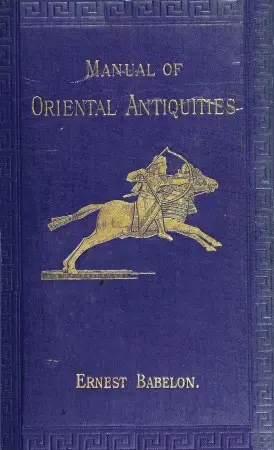
"Manual of Oriental Antiquities" by Ernest Babelon is a scholarly work focusing on historical and artistic analyses of ancient Eastern civilizations, drafted in the early 20th century. It comprehensively covers the architecture, sculpture, and various arts of cultures such as Chaldæa, Assyria, Persia, and others until reaching the influence of Greek civilization. The book aims to unravel the connections and unique characteristics of these rich cultures while highlighting recent archaeological discoveries. The opening of this manual introduces readers to the rich tapestry of ancient civilizations in the Near East, excluding Egypt, that once thrived long before the influence of Greece and Rome. Babelon emphasizes the artistic genius of these civilizations, declaring that what we call “Persian art” or “Jewish art” fundamentally draws from Chaldæo-Assyrian and Egyptian roots. The text reveals exciting archaeological findings from sites such as Tello, which have contributed significantly to our understanding of ancient architecture and sculpture, laying the groundwork for a broader discussion of art forms, materials, and techniques used by these remarkable societies.
Introduction adapted from the source catalogue; source summaries may be automatically generated.
Free to read · English · 81,642 words · No account needed
MAKE TIME FOR A GOOD BOOK
On by default. Untick to stop anonymous reading totals. Each page counts after 10 seconds in view. How this works.
Anonymous counting is on unless you have switched it off.
Uruk, 2, 48, 309.
Utica, 252.
Vandals, seizure of treasures of Jewish temple by, 227.
Vases,--
Assyrian, 122, 123.
Chaldæan, 39.
Elamite, 304, 307, 335.
Vault,--
at Tello, 14.
at Mugheir, 14.
at Babylon in time of Strabo, 15.
at Khorsabad, 55, 57, 58, 59.
in drain at Nimroud, 57.
in Persia, 158, 159.
Veil in Jewish Temple, 224.
Vermilion, use of, in Assyrian art, 116, 119.
Vogüé, M. de, 205.
on platform of Jewish Temple, 208.
on Herod’s restoration, 211.
on Golden Gate, 217 (note).
on altar of burnt offerings, 221.
on chambers attached to Temple, 222.
on appearance of Temple, 222, 223.
on cherubim, 225.
on columns before Temple, 227.
Voussoirs, 55, 58, 59.
“Vulture Stela,” 24-6, 321.
Walls,--
of Chaldæan palace, 12, 13.
of Assyrian palace, 54-6.
of Babylon, 79, 80.
of Nineveh, 81.
of Khorsabad, 79.
of Jewish Temple, 212-14.
of Jerusalem, 232.
of Banias, 246.
of Carthage, 247.
of Eryx, 247.
of Elam, 314.
Warka, 2, 9, 18, 40, 63, 114.
Weapons,--
Chaldæan, 37, 38.
Assyrian, 129, 137.
Windows of Persian palaces, 152.
Women, treatment of, in Assyrian art, 101.
Wood,--
want of, in Chaldæa, 4.
use of, in Assyria, 60, 134-7.
Woodwork, carved, 134-7.
Wuswas, 9, 10, 114.
Xanthus, 177.
Xerxes, 148, 150, 152, 154, 164.
Zacharias, tomb of, 234.
Zaghouan, 249.
Zarpanit, the goddess, 78.
Zerubbabel, 210, 214.
Zikkurat,--
in Chaldæa, 15, 16.
in Assyria, 72-6.
in Persia, 174.
in Elam, 314.
Printed and bound by Hazell, Watson & Viney, Ld., London and Aylesbury,
England.
[1] The authority of a syllabary and a bilingual text enables us to correct the pronunciation of this name to Lagas. See Pinches in Babylonian and Oriental Record, vol. iii., p. 24. [Translator’s note.]
[2] Genesis xi. 3.
[3] Nahum iii. 14.
[4] Herodotus i. 179.
[5] Journal of the Royal Asiatic Society, vol. xv., p. 406.
[6] Travels and Researches in Chaldæa and Susiana, p. 175.
[7] Découvertes en Chaldée, p. 62.
[8] See Heuzey, Un palais chaldéen, pp. 37-58.
[9] E. de Sarzec, Découvertes en Chaldée, pp. 34, 35.
[10] See, however, Garstang, The Third Egyptian Dynasty, Constable, 1904, pp. 28-29, plates, v., xiv.
[11] Strabo xvi. I, 5.
[12] E. de Sarzec, op. cit., p. 37.
[13] E. de Sarzec, op. cit., p. 59.
[14] Loftus, Travels and Researches, pp. 187-189.
[15] E. de Sarzec, op. cit., p. 60.
[16] M. Babelon’s statement that the cylinder of Sagasaltias was found by modern explorers with that of Nabonidus is unfortunately inaccurate. Only the records of Nabonidus were discovered. See Taylor, Journal of the Royal Asiatic Society, vol. xv.
[17] Heuzey, Gazette Arch., 1884, p. 195.
[18] E. de Sarzec, Découvertes, p. 61.
[19] L. Heuzey, Un palais chaldéen, pp. 59-117.
[20] See the translation which I have given of it in Lenormant and Babelon, Histoire ancienne de l’Orient, vol. v., p. 84.
[21] Perrot and Chipiez, op. cit., vol. ii., p. 192 f. [Eng. ed.]
[22] Perrot and Chipiez, op. cit., vol. ii., p. 195, fig. 106.
[23] E. de Sarzec, Découvertes, p. 61.
[24] Revue archéologique, 1883 (3e série, t. ii.) pl. xx.
[25] Les figurines antiques du Musée du Louvre, p. 1 ff.
[26] Revue archéol., mai-juin, 1887.
[27] See especially J. Menant, La Glyptique orientale, t. i., and L. de Clercq, Catalogue de sa collection, fasc. 1-3.
Your reading position is saved on this browser. Take it to another device with a library code. Reading pages adapt to text, rather than matching a printed edition.
BEHIND THE BOOK
This eBook is for the use of anyone anywhere in the United States and most other parts of the world at no cost and with almost no restrictions whatsoever. You may copy it, give it away or re-use it under the terms of the Project Gutenberg License included with this eBook or online at www.gutenberg.org. If you are not located in the United States, you will have to check the laws of the country where you are located before using this eBook. Read the source licence.
The original source file, including credits and licence, is retained by this library. Request an original-format copy at no charge. Please include the book title and Project Gutenberg identifier #50626.
KEEP YOUR CURIOSITY GOING
Cécile Tormay

Moritz Busch
John L. Ransom
Frances Wright
Cécile Tormay

Mabel Potter Daggett