THE CLASSIC COLLECTION✦An outlaw’s diary: the CommuneCLASSIC FREE BOOKS
An outlaw’s diary: the Commune
Cécile Tormay
THE CLASSIC COLLECTION · 1889
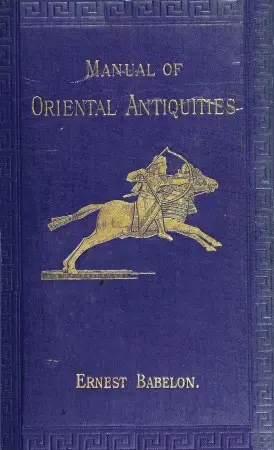
"Manual of Oriental Antiquities" by Ernest Babelon is a scholarly work focusing on historical and artistic analyses of ancient Eastern civilizations, drafted in the early 20th century. It comprehensively covers the architecture, sculpture, and various arts of cultures such as Chaldæa, Assyria, Persia, and others until reaching the influence of Greek civilization. The book aims to unravel the connections and unique characteristics of these rich cultures while highlighting recent archaeological discoveries. The opening of this manual introduces readers to the rich tapestry of ancient civilizations in the Near East, excluding Egypt, that once thrived long before the influence of Greece and Rome. Babelon emphasizes the artistic genius of these civilizations, declaring that what we call “Persian art” or “Jewish art” fundamentally draws from Chaldæo-Assyrian and Egyptian roots. The text reveals exciting archaeological findings from sites such as Tello, which have contributed significantly to our understanding of ancient architecture and sculpture, laying the groundwork for a broader discussion of art forms, materials, and techniques used by these remarkable societies.
Introduction adapted from the source catalogue; source summaries may be automatically generated.
Free to read · English · 81,642 words · No account needed
MAKE TIME FOR A GOOD BOOK
On by default. Untick to stop anonymous reading totals. Each page counts after 10 seconds in view. How this works.
Anonymous counting is on unless you have switched it off.
[65] See especially W. Wright, The Empire of the Hittites, 8vo, 2nd ed., London, 1886; Perrot and Chipiez, Hist. de l’art dans l’antiquité, t. iv., pp. 483 to 812; O. Hirschfeld, Die Felsen-reliefs in Kleinasien und das Volk der Hittiter (Abhandlungen der Berliner Akademie, 1886).
[66] Perrot and Chipiez, op. cit., t. iv., p. 547.
[67] Perrot and Chipiez, op. cit., t. iv., p. 549.
[68] There is some doubt whether this figure is Hittite at all. It may be of Babylonian origin. (See Perrot and Chipiez, Hist., t. iv., 550 f.) The boots are so slightly turned up at the points that they are more like those worn by Babylonian kings than the characteristic boots of the Hittites. The stela was brought from the castle of Birejik, not from the site of Carchemish, as M. Babelon states.
[69] Perrot and Chipiez, op. cit., t. iv., p. 534.
[70] Perrot and Chipiez, op. cit., t. iv., p. 559.
[71] Perrot and Guillaume, Exploration archéol. de la Galatie, etc.,
pl. lxv.
[72] Hist. de l’art dans l’antiquité, t. iv. p. 667.
[73] Perrot and Chipiez, op. cit., t. iv., p. 697.
[74] Perrot and Chipiez, op cit., t. iv., p. 713.
[75] Perrot and Chipiez, op. cit., t. iv., p. 750.
[76] S. Reinach, Rev. Archéol., 1885 (3 se. t. v.), p. 54, ff.
[77] Gazette archéol., 1887 (t. xiii. p. 60).
[78] From Wilson and Warren, The Recovery of Jerusalem, p. 298
(1871).
[79] M. de Vogüé, Le Temple de Jérusalem, p. 3.
[80] M. de Vogüé, Le Temple de Jérusalem, pp. 21 and 22.
[81] This name is at present given to a building which has nothing in common with this door of the Temple.--M. de Vogüé, Le Temple de Jérusalem, p. 12, note.
[82] A, Ophel.--B, Bridge.--C,
Tyropœon.--D, Causeway.--E, Tower of Baris
or Antonia.--F, Portico.--G, Court of the
Gentiles.--H, Court of the women.--K, Court
of Israel.--L, Altar of burnt-offerings.--M,
Court of the priests.--N, Solomon’s porch. O,
Moat called Birket Israîl. PP, Double gate and triple
gate.--Q, Golden gate.--R, Kedron valley.
[83] M. de Vogüé, Le Temple, p. 56.
[84] M. de Vogüé, Le Temple, p. 37.
[85] M. de Vogüé, Le Temple, p. 58.
[86] 1 Kings vii. 49-50.
[87] Procopius, De Bello Vandalico, ii., chap. 9; Theophanes, Chronographia, p. 168, and Georg. Cedrenus, Hist. Comp., p. 606 (Ed. Bonn, 1833)
[88] M. de Vogüé, Le Temple, p. 34; Perrot and Chipiez, op. cit.,
t. iv. p. 315 ff.
[89] Perrot and Chipiez, op. cit., t. iv., p. 463.
[90] Renan, Mission de Phénicie pl. 10
[91] See Perrot and Chipiez, History of Art in Phœnicia and its Dependencies, vol. i., p. 193 [Eng. Ed.].
[92] Renan, Mission de Phénicie, p. 411.
[93] Perrot and Chipiez, History of Art in Phœnicia, vol. ii., p. 12.
[94] See Perrot and Chipiez, History of Art in Phœnicia, etc., vol.
ii., p. 123
Your reading position is saved on this browser. Take it to another device with a library code. Reading pages adapt to text, rather than matching a printed edition.
BEHIND THE BOOK
This eBook is for the use of anyone anywhere in the United States and most other parts of the world at no cost and with almost no restrictions whatsoever. You may copy it, give it away or re-use it under the terms of the Project Gutenberg License included with this eBook or online at www.gutenberg.org. If you are not located in the United States, you will have to check the laws of the country where you are located before using this eBook. Read the source licence.
The original source file, including credits and licence, is retained by this library. Request an original-format copy at no charge. Please include the book title and Project Gutenberg identifier #50626.
KEEP YOUR CURIOSITY GOING
Cécile Tormay

Moritz Busch
John L. Ransom
Frances Wright
Cécile Tormay

Mabel Potter Daggett