
Last letters from the living dead man
David Patterson (Spirit) Hatch
THE CLASSIC COLLECTION · 1900
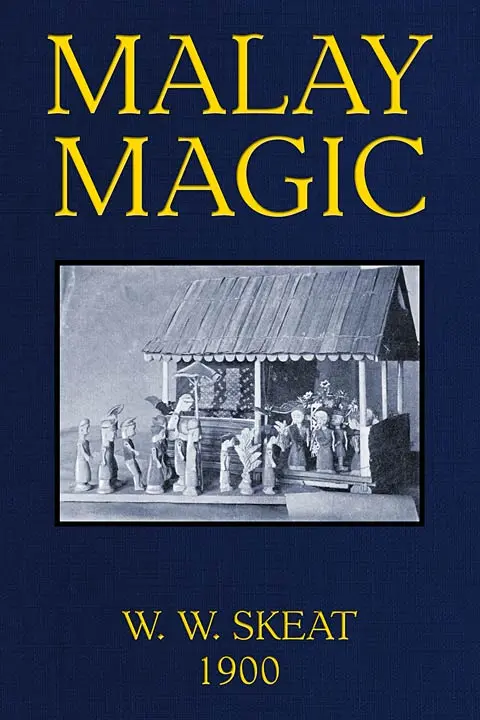
"Malay Magic" by Walter William Skeat is an introductory work on folklore and popular religion written in the late 19th century. It explores the rich tapestry of beliefs, customs, and magical practices of the Malays in the Malay Peninsula, drawing upon a variety of sources, including personal observations, native manuscripts, and published works. The book aims to document and analyze the traditional beliefs and practices that are integral to Malay culture, highlighting the complexity of their folklore intertwined with influences from Indian, Arab, and indigenous sources. The opening of the book sets the stage for a comprehensive exploration of Malay folklore, establishing the author's intent to create a representative account of Malay beliefs and magical practices. Skeat introduces the key themes such as creation myths, the understanding of nature, and the relationships between humans and the supernatural world. He reflects on the significance of various folkloric beliefs, such as the creation of the world and the role of magic in everyday life, and emphasizes the importance of these elements in understanding the Malay identity and culture. As he begins to unfold these narratives, the reader is invited into the intricate world of Malay magic, laying the foundation for the detailed studies that follow.
Introduction adapted from the source catalogue; source summaries may be automatically generated.
Free to read · English · 226,518 words · No account needed
MAKE TIME FOR A GOOD BOOK
On by default. Untick to stop anonymous reading totals. Each page counts after 10 seconds in view. How this works.
Anonymous counting is on unless you have switched it off.
[881] Di-lilit akar: v. 1. chelar (chelah?) bakar.
[882] Di-petok: v. 1. di-chetok, with same meaning.
[883] Vide note on last charm.
[884] Wak-wak, v. l. sengkuak, d.s.b. which apparently could only mean (acc. to Klinkert) extension of the roof over the kitchen rack. Another reading is ruwak-ruwak, in which case it would mean a "heron on the kitchen rack." This latter seems to make the best sense.
[885] Juara means (1) the umpire or manager of a cock-fight, and (2) a master of ceremonies (v. Klinkert, s. v.).
[886] Qu. mari.
[887] The following various readings are found in another version:--
[888] Jintala.
[889] Binasa.
[890] S'ri menyalak.
[891] Menyalak kadalam hutan.
[892] Chelaka besar sudah datang.
[893] Rumah sudah.
[894] Sudah datang.
[895] Sadikit tidak.
[896] Di tepi.
[897] Menchabut rumput petang pagi.
[898] Di-kata.
[899] Modal liput sudah rugi.
[900] Berpalut.
[901] Bukan buatan.
[902] Sadikit tidak tanggong.
[903] Terbang.
[904] Singgah.
[905] Raja.
[906] Chelaka.
[907] Or badak (rhinoceros), as the case may be.
[908] Hum is probably a form of the Buddhist OM; though the form which the latter takes in Malay magic is usually "Ong" or "Hong."
[909] Tongkat: the tongue is commonly said tongkatkan mulut (to prop open the mouth) when the tip of it is pressed against the roof of the mouth. I therefore venture to read tongkat mulut for tongkat, because the context shows that this is what is meant, the tongue being (not inaptly) compared in shape to a crocodile. Tongkat can hardly be used here in the sense of a "staff"; even if mulut is not actually read, it must still be understood.
[910] Pengri was explained to me as the indentation above the chin, but I have never met the word elsewhere.
[911] Here the speaker addresses the tiger direct.
[912] Bergrak-lah must be taken with handak.
[913] Pasih or fasih was the word given me; unless a mistake for something else, it must mean cunning or savage (quære fasik).
[914] Pinta-pinta = perminta'an, request.
[915] Ari bekari: so pronounced by 'Che Indut and other Langat Malays. Bekari is in no dictionary that I could find, and I only came upon begari by accident in Klinkert, who only gave, however, a cross-reference to pegari, which form he does not give in its right place. I found begari, however, in Pijnappel, q.v. s.v. He explains it as meaning "to appear," "to come to light." A similar phrase occurs in cclxvi, infra.
[916] v.l. Membalun.
[917] Uru-uru: the only sense given by Klinkert is that of a kind of rattle used to decoy fish--made of a cocoa-nut shell, and some Chinese copper coins. But in this context it looks most like a double rhyme to guru.
[918] Qu. di-tapakan, i.e. by footsteps.
Your reading position is saved on this browser. Take it to another device with a library code. Reading pages adapt to text, rather than matching a printed edition.
BEHIND THE BOOK
This eBook is for the use of anyone anywhere in the United States and most other parts of the world at no cost and with almost no restrictions whatsoever. You may copy it, give it away or re-use it under the terms of the Project Gutenberg License included with this eBook or online at www.gutenberg.org. If you are not located in the United States, you will have to check the laws of the country where you are located before using this eBook. Read the source licence.
The original source file, including credits and licence, is retained by this library. Request an original-format copy at no charge. Please include the book title and Project Gutenberg identifier #47873.
KEEP YOUR CURIOSITY GOING
David Patterson (Spirit) Hatch

David Patterson (Spirit) Hatch

David Patterson (Spirit) Hatch

Maurice Baring
Francis Greenleaf Allinson & Anne C. E. (Anne Crosby Emery) Allinson

Edwin Abbott Abbott