
Last letters from the living dead man
David Patterson (Spirit) Hatch
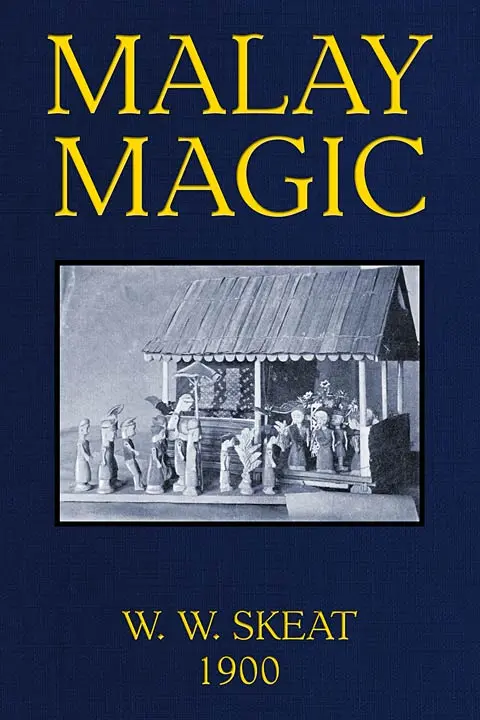
THE CLASSIC COLLECTION · 1900
"Malay Magic" by Walter William Skeat is an introductory work on folklore and popular religion written in the late 19th century. It explores the rich tapestry of beliefs, customs, and magical practices of the Malays in the Malay Peninsula, drawing upon a variety of sources, including personal observations, native manuscripts, and published works. The book aims to document and analyze the traditional beliefs and practices that are integral to Malay culture, highlighting the complexity of their folklore intertwined with influences from Indian, Arab, and indigenous sources. The opening of the book sets the stage for a comprehensive exploration of Malay folklore, establishing the author's intent to create a representative account of Malay beliefs and magical practices. Skeat introduces the key themes such as creation myths, the understanding of nature, and the relationships between humans and the supernatural world. He reflects on the significance of various folkloric beliefs, such as the creation of the world and the role of magic in everyday life, and emphasizes the importance of these elements in understanding the Malay identity and culture. As he begins to unfold these narratives, the reader is invited into the intricate world of Malay magic, laying the foundation for the detailed studies that follow.
Introduction adapted from the source catalogue; source summaries may be automatically generated.
Free to read · English · 226,518 words · No account needed
MAKE TIME FOR A GOOD BOOK
On by default. Untick to stop anonymous reading totals. Each page counts after 10 seconds in view. How this works.
Anonymous counting is on unless you have switched it off.
Clifford, Hugh. In Court and Kampong. London, 1897.
Studies in Brown Humanity. London, 1898.
Clifford, Hugh, and Swettenham, Frank A. A Dictionary of the Malay Language, parts i.-iii. letters A-Ch. Taiping, Perak, 1894-1897.
Crawfurd, John. History of the Indian Archipelago, 3 vols. Edinburgh,
1820.
A Grammar and Dictionary of the Malay Language, 2 vols. London, 1852.
A Descriptive Dictionary of the Indian Islands and Adjacent
Countries. London, 1856.
Denys, N. B. A Descriptive Dictionary of British Malaya. London, 1894.
Frazer, J. G. The Golden Bough, 2 vols. London, 1890.
Hughes, Thomas P. A Dictionary of Islam, 2nd ed. London, 1896.
Journal of the Indian Archipelago, 12 vols. Singapore, 1847-1862.
[Abbreviated reference, J.I.A.]
Journal of the Straits Branch of the Royal Asiatic Society, 32
Nos. Singapore, 1878-1899.
[Abbreviated reference, J.R.A.S., S.B.]
Klinkert, H. C. Nieuw Maleisch-Nederlandsch Woordenboek. Leiden, 1893.
Leyden, John. Malay Annals. London, 1821.
Marsden, William. The History of Sumatra, 2nd ed. London, 1784.
Third ed. London, 1811.
Maxwell, W. E. A Manual of the Malay Language, 2nd ed. London, 1888.
Miscellaneous Papers relating to Indo-China and the Indian Archipelago, two series of 2 vols each. London, 1886, 1887.
Newbold, T. J. Political and Statistical Account of the British Settlements in the Straits of Malacca, 2 vols. London, 1839.
Notes and Queries issued with the Journal of the Straits Branch of the Royal Asiatic Society, 4 Nos. Singapore, 1885-1887.
Publications of the Straits Branch of the Royal Asiatic Society,
3 Nos. Singapore, 1895-1896.
Selangor Journal, 5 vols. Kuala Lumpur, 1892-1897.
Swettenham, Frank A. Malay Sketches. London, 1895.
Tylor, E. B. Primitive Culture, 2 vols. London, 1871.
Wall, H. von de. Maleisch-Nederlandsch Woordenboek uitgegeven door H. N. van der Tuuk, 2 vols. Batavia, 1877, 1880.
Yule, Henry, and Burnell, A. C. Hobson Jobson, being a Glossary of Anglo-Indian Colloquial Words and Phrases. London, 1886.
[1] Newbold, British Settlements in the Straits of Malacca,
vol. ii. pp. 360, 361.
[2] Vide Vishnu Purana, vol. ii. p. 109; trans. by Wilson.
[3] The full Malay text of this introduction will be found in the
Appendix.
[4] Lit. "A cube." The cube-like building in the centre of the Mosque at Makkah (Mecca), which contains the Hajaru 'l-Aswad, or black stone.--Hughes, Dict. of Islam, s.v. Ka`bah.
[5] Sakatimuna (or "Sicatimuna") is the name of an enormous serpent, said to have ravaged the country of Menangkabau in Sumatra about the beginning of the 12th century.--Newbold, op. cit. vol. ii. p. 199 n. It is also given as "Icktimani" by Leyden in his trans. of the Malay Annals.
[6] For the parting asunder of the snake, vide the note on page 11 infra, which gives what may be the origin of this myth as it is known to the Malays.
Your reading position is saved on this browser. Take it to another device with a library code. Reading pages adapt to text, rather than matching a printed edition.
BEHIND THE BOOK
This eBook is for the use of anyone anywhere in the United States and most other parts of the world at no cost and with almost no restrictions whatsoever. You may copy it, give it away or re-use it under the terms of the Project Gutenberg License included with this eBook or online at www.gutenberg.org. If you are not located in the United States, you will have to check the laws of the country where you are located before using this eBook. Read the source licence.
The original source file, including credits and licence, is retained by this library. Request an original-format copy at no charge. Please include the book title and Project Gutenberg identifier #47873.
KEEP YOUR CURIOSITY GOING
David Patterson (Spirit) Hatch

David Patterson (Spirit) Hatch

David Patterson (Spirit) Hatch

Maurice Baring
Francis Greenleaf Allinson & Anne C. E. (Anne Crosby Emery) Allinson

Edwin Abbott Abbott