
Last letters from the living dead man
David Patterson (Spirit) Hatch
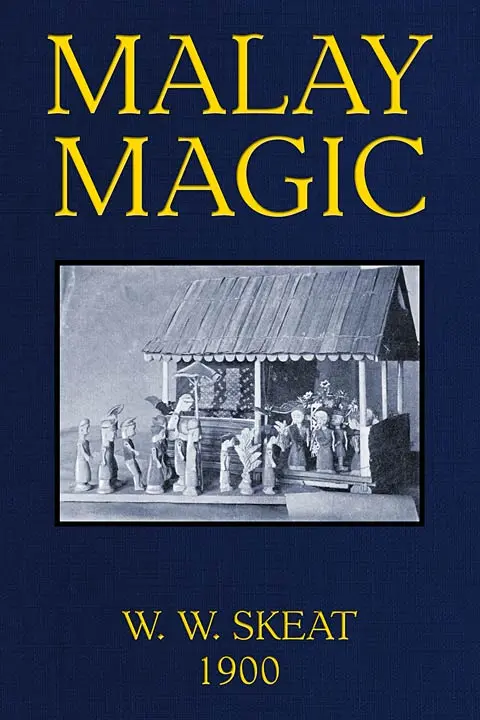
THE CLASSIC COLLECTION · 1900
"Malay Magic" by Walter William Skeat is an introductory work on folklore and popular religion written in the late 19th century. It explores the rich tapestry of beliefs, customs, and magical practices of the Malays in the Malay Peninsula, drawing upon a variety of sources, including personal observations, native manuscripts, and published works. The book aims to document and analyze the traditional beliefs and practices that are integral to Malay culture, highlighting the complexity of their folklore intertwined with influences from Indian, Arab, and indigenous sources. The opening of the book sets the stage for a comprehensive exploration of Malay folklore, establishing the author's intent to create a representative account of Malay beliefs and magical practices. Skeat introduces the key themes such as creation myths, the understanding of nature, and the relationships between humans and the supernatural world. He reflects on the significance of various folkloric beliefs, such as the creation of the world and the role of magic in everyday life, and emphasizes the importance of these elements in understanding the Malay identity and culture. As he begins to unfold these narratives, the reader is invited into the intricate world of Malay magic, laying the foundation for the detailed studies that follow.
Introduction adapted from the source catalogue; source summaries may be automatically generated.
Free to read · English · 226,518 words · No account needed
MAKE TIME FOR A GOOD BOOK
On by default. Untick to stop anonymous reading totals. Each page counts after 10 seconds in view. How this works.
Anonymous counting is on unless you have switched it off.
[753] A number of these diagrams, all of which are in the author's possession, are shown in the illustrations to this section. They seem to be closely connected with the system of "magic squares," which has probably come to Europe from the East.
[754] Or Kutika.
[755] "The original Javanese week, like that of the Mexicans, consists of five days, and its principal use, like that of the same people, is to determine the markets or fairs held in the principal villages or districts. This arbitrary period has probably no better foundation than the relation of the numbers to that of the fingers of the hand. The names of the days of this week are as follows:--Laggi, Pahing, Pon, Wagi, Kliwon.... The Javanese consider the names of the days of their native week to have a mystical relation to colours, and to the divisions of the horizon.
"According to this whimsical interpretation, the first means white, and the east; the second, red, and the south; the third, yellow, and the west; the fourth, black and the north; the fifth, mixed colour, and focus, or centre. It is highly probable that, like the week of the continental nations of Asia and Europe, the days were named after the national gods. In an ancient manuscript found in Java, which will be afterwards referred to, the week of five days is represented by five human figures, two of which are female and three male."--Crawfurd, Hist. of the Indian Archipelago, vol. i. pp. 289, 290.
[756] Communicated by Sir George Birdwood of the India Office.
But in Bali S'ri is the wife of Vishnu, or more usually of Shiva. "As goddess of the rice-fields she is called S'rî ... and has temples on the sawahs [rice-fields], and on the roads between them."--Misc. Papers relating to Indo-China, etc., Second Series, vol. ii. p. 105.
She is frequently mentioned in Malay invocations connected with rice-planting; vide p. 89, supra, and App. cix.
[757] Cf. such words in Malay as panchawarna or pancharona (lit. of five colours), panchalogam (lit. of five metals), which are of Indian origin, with the Indian pancharangi, panchatantra, etc.
[758] Or does this mean "black or red"? But red is Brahma's colour, and for Kala one would a priori expect black to be appropriate.
[759] See App. ccxliii. for an extract from a treatise on these
subjects.
[760] Both this table and that of the Katika Lima have been reversed in translating from the originals, which, being in the Arabic character, run from right to left.
[761] See App. ccxliv. for an extract from a short treatise on this
subject.
[762] The table is given in App. ccxlv.
[763] Vide p. 554, infra.
[764] Newbold, op. cit. vol. ii. p. 354.
[765] Ibid. p. 358.
Your reading position is saved on this browser. Take it to another device with a library code. Reading pages adapt to text, rather than matching a printed edition.
BEHIND THE BOOK
This eBook is for the use of anyone anywhere in the United States and most other parts of the world at no cost and with almost no restrictions whatsoever. You may copy it, give it away or re-use it under the terms of the Project Gutenberg License included with this eBook or online at www.gutenberg.org. If you are not located in the United States, you will have to check the laws of the country where you are located before using this eBook. Read the source licence.
The original source file, including credits and licence, is retained by this library. Request an original-format copy at no charge. Please include the book title and Project Gutenberg identifier #47873.
KEEP YOUR CURIOSITY GOING
David Patterson (Spirit) Hatch

David Patterson (Spirit) Hatch

David Patterson (Spirit) Hatch

Maurice Baring
Francis Greenleaf Allinson & Anne C. E. (Anne Crosby Emery) Allinson

Edwin Abbott Abbott