
Last letters from the living dead man
David Patterson (Spirit) Hatch
THE CLASSIC COLLECTION · 1900
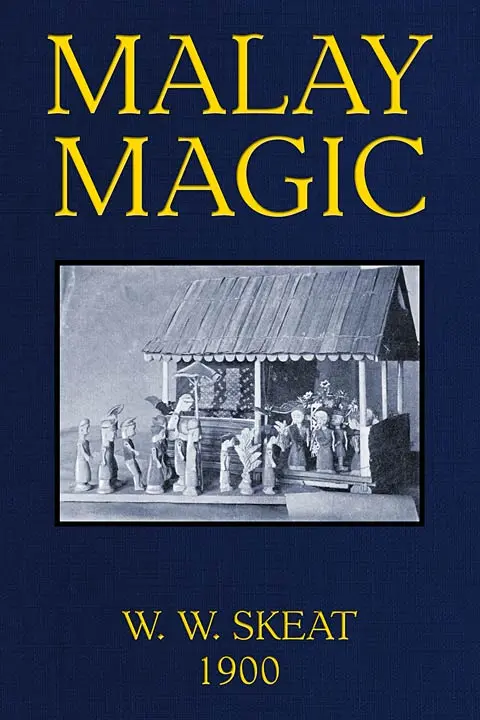
"Malay Magic" by Walter William Skeat is an introductory work on folklore and popular religion written in the late 19th century. It explores the rich tapestry of beliefs, customs, and magical practices of the Malays in the Malay Peninsula, drawing upon a variety of sources, including personal observations, native manuscripts, and published works. The book aims to document and analyze the traditional beliefs and practices that are integral to Malay culture, highlighting the complexity of their folklore intertwined with influences from Indian, Arab, and indigenous sources. The opening of the book sets the stage for a comprehensive exploration of Malay folklore, establishing the author's intent to create a representative account of Malay beliefs and magical practices. Skeat introduces the key themes such as creation myths, the understanding of nature, and the relationships between humans and the supernatural world. He reflects on the significance of various folkloric beliefs, such as the creation of the world and the role of magic in everyday life, and emphasizes the importance of these elements in understanding the Malay identity and culture. As he begins to unfold these narratives, the reader is invited into the intricate world of Malay magic, laying the foundation for the detailed studies that follow.
Introduction adapted from the source catalogue; source summaries may be automatically generated.
Free to read · English · 226,518 words · No account needed
MAKE TIME FOR A GOOD BOOK
On by default. Untick to stop anonymous reading totals. Each page counts after 10 seconds in view. How this works.
Anonymous counting is on unless you have switched it off.
[183] The Bota, Gargasi, and Raksasa (not raksaksa) are giants.
[184] The Nenek Kabayan does not appear to be a ghost at all; it may, however, possibly be a rare synonym for some well-known character in Malay folklore (such as the wife of the Man in the Moon). It is not so explained in the best Dutch dictionaries, however, but simply as the village messenger (dorpsbode) who sells flowers and carries lovers' messages.
[185] The Himbasan I have not yet identified.
[186] The Sawan (i.e. Hantu Sawan) is the demon or devil which is
believed to cause convulsions.
[187] The Hantu (orang) mati di-bunoh is the ghost of a murdered man.
[188] The Bajang is a familiar spirit (vide pp. 320-325, infra).
[189] The Hantu katagoran, sempak-kan, and puput-kan I have not been able to identify, and as the two last possess the verbal suffix it is clear that each is the name of a state or process and not of a ghost or demon. In fact, v. d. Wall gives (under sampok), kesampokan, which he explains as meaning "door een' boozen geest getroffen zijn," to be attacked or possessed by an evil spirit, which is doubtless the correcter form of the word. So with puput-kan, which is also a verbal form meaning (acc. to v. d. W.) "to blow (tr.)," to "sound a wind instrument." It would seem that `Abdullah's list of "ghosts" is not very systematically drawn up.
[190] The `efrit is a spirit of Arabian origin.
[191] The Jemalang (Jembalang) is a Malay earth-spirit.
[192] Terkena is a past participial form used of people who are thought to be "struck by" or "affected by" one of the foregoing demons.
[193] Ubat guna is a love-philtre.
[194] Gagah (usually penggagah) is the art of making one's self bold
or courageous.
[195] Penundok, the art of making one's enemy yield (tundok).
[196] Pengasih, the art of making one's self beloved by another.
[197] Kebal (pengebal) the art of making one's self invulnerable.
[198] Kasaktian, the art of acquiring magic powers.
[199] Tuju (penuju), the art called "sending."
[200] `Alimun, the art of making one's self invisible.
[201] Penderas, the art of making one's self swift-footed.
[202] Perahuh (a misprint for peruah = peruang?) that of keeping water at a distance from one's face when diving, and also, it is said, of walking on the water without sinking below the ankles.
[203] Chucha is, I believe, a love charm.
[204] Pelali, is the art of numbing or deadening pain.
[205] Perangsang, the art of exciting or whetting the temper of the
dogs when hunting.
[206] Hik. Abdullah, p. 143. [Maxwell in J.R.A.S., S.B., No. ii N. and
Q., No. 4, sec. 98.]
[207] Newbold, op. cit. vol.ii. p. 191.
Your reading position is saved on this browser. Take it to another device with a library code. Reading pages adapt to text, rather than matching a printed edition.
BEHIND THE BOOK
This eBook is for the use of anyone anywhere in the United States and most other parts of the world at no cost and with almost no restrictions whatsoever. You may copy it, give it away or re-use it under the terms of the Project Gutenberg License included with this eBook or online at www.gutenberg.org. If you are not located in the United States, you will have to check the laws of the country where you are located before using this eBook. Read the source licence.
The original source file, including credits and licence, is retained by this library. Request an original-format copy at no charge. Please include the book title and Project Gutenberg identifier #47873.
KEEP YOUR CURIOSITY GOING
David Patterson (Spirit) Hatch

David Patterson (Spirit) Hatch

David Patterson (Spirit) Hatch

Maurice Baring
Francis Greenleaf Allinson & Anne C. E. (Anne Crosby Emery) Allinson

Edwin Abbott Abbott