
Last letters from the living dead man
David Patterson (Spirit) Hatch
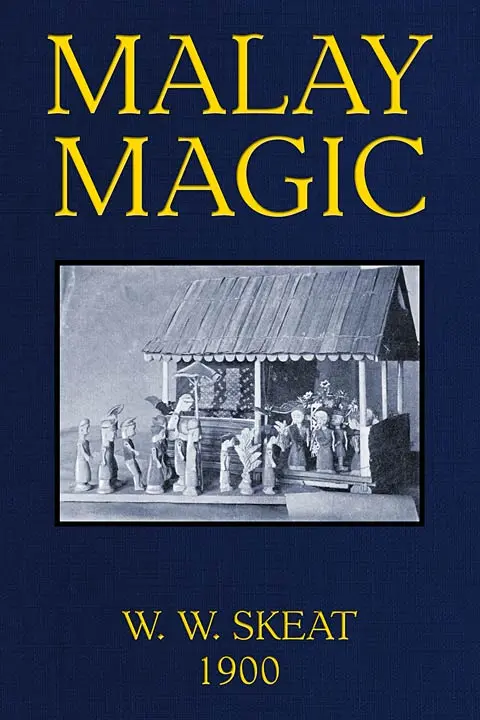
THE CLASSIC COLLECTION · 1900
"Malay Magic" by Walter William Skeat is an introductory work on folklore and popular religion written in the late 19th century. It explores the rich tapestry of beliefs, customs, and magical practices of the Malays in the Malay Peninsula, drawing upon a variety of sources, including personal observations, native manuscripts, and published works. The book aims to document and analyze the traditional beliefs and practices that are integral to Malay culture, highlighting the complexity of their folklore intertwined with influences from Indian, Arab, and indigenous sources. The opening of the book sets the stage for a comprehensive exploration of Malay folklore, establishing the author's intent to create a representative account of Malay beliefs and magical practices. Skeat introduces the key themes such as creation myths, the understanding of nature, and the relationships between humans and the supernatural world. He reflects on the significance of various folkloric beliefs, such as the creation of the world and the role of magic in everyday life, and emphasizes the importance of these elements in understanding the Malay identity and culture. As he begins to unfold these narratives, the reader is invited into the intricate world of Malay magic, laying the foundation for the detailed studies that follow.
Introduction adapted from the source catalogue; source summaries may be automatically generated.
Free to read · English · 226,518 words · No account needed
MAKE TIME FOR A GOOD BOOK
On by default. Untick to stop anonymous reading totals. Each page counts after 10 seconds in view. How this works.
Anonymous counting is on unless you have switched it off.
"The Jin Kafir, or bad genii, are invariably deformed, their heads being always out of their proper position; in short, they are Othello's
Men whose heads
Do grow beneath their shoulders.
Their commonest name, 'Jin isi-isi didalam Dunia' (the Genii who Fill the World), is owing to the fact that their enormous numbers fill the whole atmosphere from earth to sky. Like the good Genii, they cannot die before the great day of judgment, but (unlike them) they are dumb.
"Great as their numbers are they are continually increasing, as they are suffered by God to get children after their kind. They are imps of mischief, and their whole time is spent in works of malice. Sometimes when there has been a long drought and a heavy shower of rain is poured down upon the earth by the angels at the bidding of God to cool the parched verdure, they will assemble their legions, bringing with them invisible cocoa-nut shells, one for each drop of rain. In these they catch each rain-drop as it falls, and herbs and trees alike wither for lack of moisture. Then the angels being wroth, cast thunderbolts upon them out of heaven, and these malicious elves take shelter in tall trees, which the thunderbolts blast in their fall. At another time they will climb one upon the other's shoulders until they reach the sky, when the topmost elf kicks a neighbouring angel, and then they all fall together with a crash like thunder."
[172] It is probable that the Arabic spirits here mentioned have, as in other cases, taken the place of native (Malay) spirits to whom similar functions were assigned, but whose names are now lost.
[173] There are, besides, one or two partly Arabic expressions which are occasionally used, e.g. Sidang (or Sedang) Saleh, Sidang (or Sedang) Mumin. It is probable that "Sidang" in these cases is a Malay word implying respectability (v. v. d. W. s.v.), so that Sidang Saleh may be translated "Sir Devout," and Sidang Mumin, "Sir Faithful."
[174] Hantu and sheitan are generic terms for evil spirits, the former being the Malay term, the latter Arabic.
[175] The Polong is a familiar spirit.
[176] The Pontianak and Penanggalan are childbirth spirits (vide
pp. 327, 328, infra).
[177] The Jin is the genie of the "Arabian Nights" (vide pp. 93-97,
supra).
[178] The Pelisit or Pelesit, like the Polong, is a familiar spirit
(vide pp. 329-331, infra).
[179] The Mambangs are inferior Malay divinities (vide pp. 88 n.,
91-93, supra).
[180] The Hantu Pemburu is the Spectre Huntsman (vide pp. 113-120, infra), for whom Hantu Rimba is probably a mere synonym.
[181] The Jadi-jadian is the Were-tiger (vide pp. 160-163, infra).
[182] The Bengkus I have not yet been able to identify.
Your reading position is saved on this browser. Take it to another device with a library code. Reading pages adapt to text, rather than matching a printed edition.
BEHIND THE BOOK
This eBook is for the use of anyone anywhere in the United States and most other parts of the world at no cost and with almost no restrictions whatsoever. You may copy it, give it away or re-use it under the terms of the Project Gutenberg License included with this eBook or online at www.gutenberg.org. If you are not located in the United States, you will have to check the laws of the country where you are located before using this eBook. Read the source licence.
The original source file, including credits and licence, is retained by this library. Request an original-format copy at no charge. Please include the book title and Project Gutenberg identifier #47873.
KEEP YOUR CURIOSITY GOING
David Patterson (Spirit) Hatch

David Patterson (Spirit) Hatch

David Patterson (Spirit) Hatch

Maurice Baring
Francis Greenleaf Allinson & Anne C. E. (Anne Crosby Emery) Allinson

Edwin Abbott Abbott