In the Line
Albertus T. (Albertus True) Dudley
THE CLASSIC COLLECTION · 1904
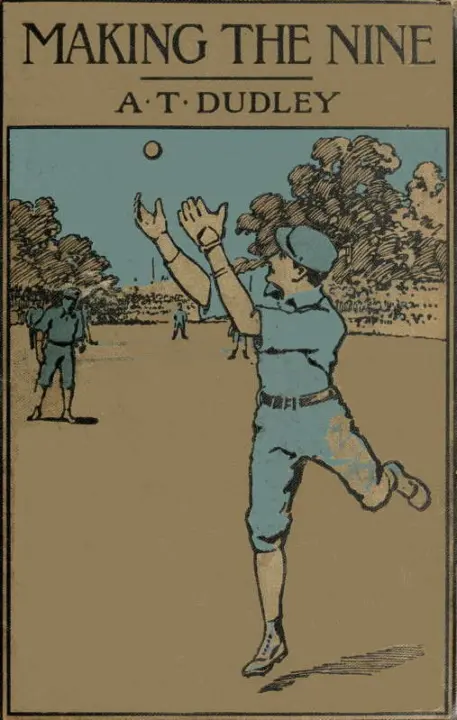
"Making the Nine" by Albertus T. Dudley is a novel written in the early 20th century. The story is set in an American school environment and focuses on the lives of boys navigating their athletic pursuits, particularly baseball. The central character appears to be Philip Poole, a student who is determined to make the baseball team while dealing with the challenges of school life and friendships. The opening portion of the novel introduces us to Philip and his peers, emphasizing their camaraderie and competitive spirit, especially in the context of the school’s athletic events such as football and, later, baseball. As the narrative begins, we witness the playful banter among the boys following a Yale football victory, setting the tone for their lighthearted yet intense rivalry. The dynamics in their relationships are evident as they discuss sports and personal goals, while Melvin, one of the seniors, pushes Phil to try hard for a place on the baseball team despite his initial hesitations. There are themes of ambition, peer influence, and the moral challenges that arise within their tight-knit community, suggesting an exploration of character growth through sportsmanship and friendship.
Introduction adapted from the source catalogue; source summaries may be automatically generated.
Free to read · English · 58,663 words · No account needed
MAKE TIME FOR A GOOD BOOK
On by default. Untick to stop anonymous reading totals. Each page counts after 10 seconds in view. How this works.
Anonymous counting is on unless you have switched it off.
“That’s very true, sir,” remarked Varrell, promptly. The tone drew Melvin’s eyes to the speaker’s face. In reply he got a fierce look that shut him up like an oyster.
“Was that all?” inquired Mr. Moore, glancing at the clock.
“Yes, sir,” replied Varrell, as the boys rose. “We only wanted to tell you about Tompkins.”
“You may be reassured on that point. Neither he nor any other boy is suspected. The thief must have been a professional, but the whole affair is a mystery which we shall probably never solve. Thank you for coming to see me.”
Once outside, the conversation between the two boys waxed warm.
“Dick, you certainly are the limit!”
“What now?” asked Melvin.
“What did you want to lug Bosworth into the conversation for? Don’t you know he’s a particular favorite of Moore’s?”
“No.”
“Well, if you took German, you would. Bosworth’s mother was a German, and he knows German ’most as well as he does English,—makes rushes all the time.”
“I can’t be blamed for not knowing that.”
“Perhaps not, but you need not have connected him with the robbery.”
“I didn’t,” protested Dick; “I just connected him with Eddy.”
“Well, Eddy with the safe and Bosworth with Eddy, it’s all the same,” returned Varrell. “If Grim had been there, you wouldn’t have got out of it so easily. He’d have turned you inside out in no time.”
“But there wasn’t anything more inside me than out,” said Dick,
perplexed.
“No, I’m afraid not,” rejoined Varrell with a sigh. “I say, Dick, who do you really think took that money?”
“I don’t know anything about it. Perhaps a professional, as Moore says.”
Varrell laughed aloud. “And he thinks some rich friend probably gave Bosworth his clothes. I know better. I saw the box in which his last suit came at the express office, and it was from one of the most expensive tailors in Boston. It arrived two days after the safe was broken into, and he paid the bill in cash. What does that suggest to you?”
“Why, that as a deserving poor student he is a fraud.”
“Anything else?”
“No.”
“Supposing I add that the clothes were ordered three weeks ago, before Tommy very unexpectedly cleaned him out.”
Dick still looked puzzled.
“And when Tommy was through with him, he had this suit coming, and probably other bills too, and no money to pay them with, unless he could get some suddenly.”
Melvin stopped and looked blankly at his companion. “Do you really mean that you think Bosworth broke into the safe?”
Varrell nodded.
Your reading position is saved on this browser. Take it to another device with a library code. Reading pages adapt to text, rather than matching a printed edition.
Albertus T. (Albertus True) Dudley
Albertus T. (Albertus True) Dudley
Albertus T. (Albertus True) Dudley
Albertus T. (Albertus True) Dudley
BEHIND THE BOOK
This eBook is for the use of anyone anywhere in the United States and most other parts of the world at no cost and with almost no restrictions whatsoever. You may copy it, give it away or re-use it under the terms of the Project Gutenberg License included with this eBook or online at www.gutenberg.org. If you are not located in the United States, you will have to check the laws of the country where you are located before using this eBook. Read the source licence.
The original source file, including credits and licence, is retained by this library. Request an original-format copy at no charge. Please include the book title and Project Gutenberg identifier #56415.
KEEP YOUR CURIOSITY GOING
Coulson Kernahan

Maurice Baring
Frances Wright
Cécile Tormay

Frederic Jesup Stimson

W. H. P. (William Henry Pope) Jarvis