In the Line
Albertus T. (Albertus True) Dudley
THE CLASSIC COLLECTION · 1904
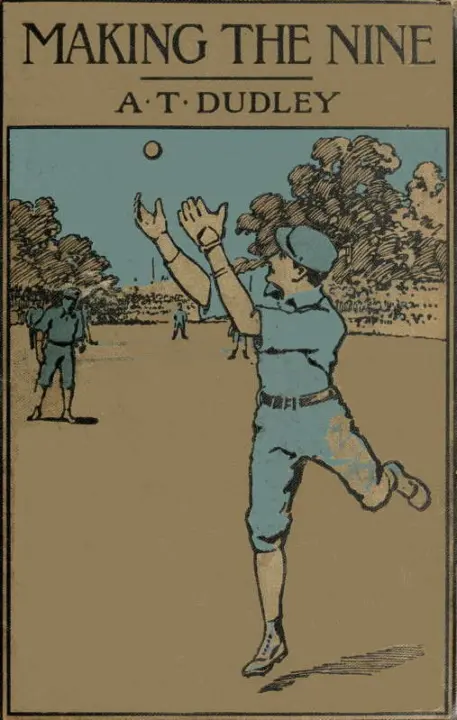
"Making the Nine" by Albertus T. Dudley is a novel written in the early 20th century. The story is set in an American school environment and focuses on the lives of boys navigating their athletic pursuits, particularly baseball. The central character appears to be Philip Poole, a student who is determined to make the baseball team while dealing with the challenges of school life and friendships. The opening portion of the novel introduces us to Philip and his peers, emphasizing their camaraderie and competitive spirit, especially in the context of the school’s athletic events such as football and, later, baseball. As the narrative begins, we witness the playful banter among the boys following a Yale football victory, setting the tone for their lighthearted yet intense rivalry. The dynamics in their relationships are evident as they discuss sports and personal goals, while Melvin, one of the seniors, pushes Phil to try hard for a place on the baseball team despite his initial hesitations. There are themes of ambition, peer influence, and the moral challenges that arise within their tight-knit community, suggesting an exploration of character growth through sportsmanship and friendship.
Introduction adapted from the source catalogue; source summaries may be automatically generated.
Free to read · English · 58,663 words · No account needed
MAKE TIME FOR A GOOD BOOK
On by default. Untick to stop anonymous reading totals. Each page counts after 10 seconds in view. How this works.
Anonymous counting is on unless you have switched it off.
DICKINSON was in his room. He had just returned, also planning for a long pull at his books, the usual evening routine for him. Melvin banged at the door, then jerked it open with little ceremony. Dickinson looked up in mild wonder.
“Hello! I thought you had consecrated your evening to the Muses. What’s up? You look as if you were on the war-path.”
“I am,” answered the visitor, fiercely. His face was set in harsh lines, while his voice, which he vainly strove to control, came forth choked and strained and trembling. “Do you know what makes a professional?”
“Why, I suppose I do,” replied the wondering Dickinson, who was giving less attention to the question than to his friend’s unaccountable agitation.
“Well, what is it?”
“Why, to play for money or your board, or any such compensation.”
“Anything else?”
“Yes, to compete with professionals, or for money prizes, or—”
“Or what?” demanded the questioner.
“Or take part in some kind of an open contest, which the governing boards for some technical reason or other forbid. I never understood about it very well,—in fact, never concerned myself with it. It doesn’t affect us, and it seemed to me quite enough to know the general rules. The genuine amateur doesn’t need rules, anyway. His own instinct for what’s right and fair would keep him straight.”
“Oh, it would!” replied the manager with virulent sarcasm.
“Yes, it would!” retorted Dickinson, catching fire himself at the persistent cross-examination. “What’s got into you, anyway? Why do you come here in this choking, crazy fashion and ask me wild questions? What do you mean?”
Dickinson was standing now, facing his visitor with a challenging look, which warned Melvin that he was beginning wrong. He hesitated a moment, trying to control his voice, and groping for a simple way back to the proper path.
“Well, what is it?” demanded Dickinson, in peremptory tones. “Don’t stand there rolling your eyes. Out with it!”
“It’s about you, Jim,” said Melvin, at last, abandoning any attempt at a wise leading of the conversation, and speaking, as his anger cooled somewhat, with less animosity and more sorrow in his voice. “Did you really run in Indiana last summer with professionals for a money prize?”
For a short minute Dickinson blinked at the questioner in stupefaction. Then with a quick transformation, as memory presented a picture of a past occurrence, the blood came rushing to his cheeks and a fierce light blazed in his eyes.
Your reading position is saved on this browser. Take it to another device with a library code. Reading pages adapt to text, rather than matching a printed edition.
Albertus T. (Albertus True) Dudley
Albertus T. (Albertus True) Dudley
Albertus T. (Albertus True) Dudley
Albertus T. (Albertus True) Dudley
BEHIND THE BOOK
This eBook is for the use of anyone anywhere in the United States and most other parts of the world at no cost and with almost no restrictions whatsoever. You may copy it, give it away or re-use it under the terms of the Project Gutenberg License included with this eBook or online at www.gutenberg.org. If you are not located in the United States, you will have to check the laws of the country where you are located before using this eBook. Read the source licence.
The original source file, including credits and licence, is retained by this library. Request an original-format copy at no charge. Please include the book title and Project Gutenberg identifier #56415.
KEEP YOUR CURIOSITY GOING
Coulson Kernahan

Maurice Baring
Frances Wright
Cécile Tormay

Frederic Jesup Stimson

W. H. P. (William Henry Pope) Jarvis