In the Line
Albertus T. (Albertus True) Dudley
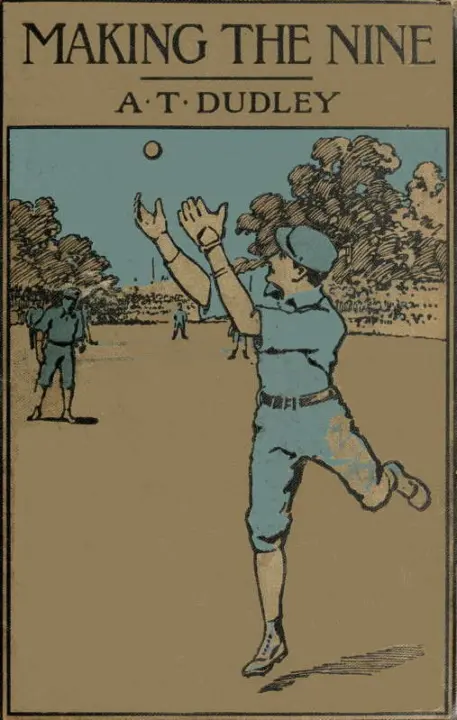
THE CLASSIC COLLECTION · 1904
"Making the Nine" by Albertus T. Dudley is a novel written in the early 20th century. The story is set in an American school environment and focuses on the lives of boys navigating their athletic pursuits, particularly baseball. The central character appears to be Philip Poole, a student who is determined to make the baseball team while dealing with the challenges of school life and friendships. The opening portion of the novel introduces us to Philip and his peers, emphasizing their camaraderie and competitive spirit, especially in the context of the school’s athletic events such as football and, later, baseball. As the narrative begins, we witness the playful banter among the boys following a Yale football victory, setting the tone for their lighthearted yet intense rivalry. The dynamics in their relationships are evident as they discuss sports and personal goals, while Melvin, one of the seniors, pushes Phil to try hard for a place on the baseball team despite his initial hesitations. There are themes of ambition, peer influence, and the moral challenges that arise within their tight-knit community, suggesting an exploration of character growth through sportsmanship and friendship.
Introduction adapted from the source catalogue; source summaries may be automatically generated.
Free to read · English · 58,663 words · No account needed
MAKE TIME FOR A GOOD BOOK
On by default. Untick to stop anonymous reading totals. Each page counts after 10 seconds in view. How this works.
Anonymous counting is on unless you have switched it off.
“WE certainly ought to hear to-night,” said Melvin on Monday, as, with Phil and Dickinson, he hung round the office, waiting for the mail to be distributed. “If the letters arrived Saturday, and the people attended to the matter promptly, the answers might have been mailed Saturday night.”
“More likely they didn’t arrive until Saturday night or this morning,” replied Dickinson, who took a less optimistic view. “Then if the people are like most others when you ask them for a favor, they’ll get round to the thing on Tuesday or later, and the letters may arrive on Thursday or any time during the following week—if indeed they are written at all.”
Nothing for Melvin; nothing for Dickinson; two papers for Varrell;
Dick’s heart sank.
“We have all day to-morrow, and the first mail on Wednesday,” he said at length, as the trio turned gloomily homeward.
A figure passed them on the other side of the lane, hurrying toward the
office.
“Here are a couple of papers for you, Varrell,” called Phil. But Varrell was already past, unresponsive to the hail.
“Throw them at him!” growled Dickinson. “He never hears anything when his back is turned.”
Phil hit the mark, and Varrell stooped for the parcels.
“Not a letter, Wrenn, not a blamed letter for any of us; just these papers for you. I felt like throwing them into the river!”
“I’m glad you didn’t,” replied Varrell, studying the postmark. “I’ll take half a loaf any time, even if you fellows get no bread. Old newspapers are sometimes valuable.”
Tuesday was not a day of profitable study for Melvin. He went to his recitations, but in some he got excused, and in others he blundered most shabbily. His whole attention was given to waiting on the mails. In the morning nothing, in the afternoon nothing, at night a single be-smooched, bescrawled envelope, bearing the postmark “Ralston, Indiana”!
“The jewel at last,” grinned Varrell, as he read the address over Melvin’s shoulder. “Open the case!”
“It isn’t a joking matter,” replied Dick, seriously. “A good deal hangs on this letter.”
“Dirt especially,” said Varrell. “Come, open it up!”
Melvin cut the envelope carefully and brought the following to light:—
This is to sertify that Jim Dickson did not run in the 4th July
Sports as advertysed
Yours resply
Michael Ryan
“Is that all?” asked Varrell.
Melvin examined again. “Everything.”
“I’m afraid he couldn’t pass English A,” said Varrell.
They walked for some minutes in silence, Melvin too much disgusted with his companion’s flippancy to speak.
Your reading position is saved on this browser. Take it to another device with a library code. Reading pages adapt to text, rather than matching a printed edition.
Albertus T. (Albertus True) Dudley
Albertus T. (Albertus True) Dudley
Albertus T. (Albertus True) Dudley
Albertus T. (Albertus True) Dudley
BEHIND THE BOOK
This eBook is for the use of anyone anywhere in the United States and most other parts of the world at no cost and with almost no restrictions whatsoever. You may copy it, give it away or re-use it under the terms of the Project Gutenberg License included with this eBook or online at www.gutenberg.org. If you are not located in the United States, you will have to check the laws of the country where you are located before using this eBook. Read the source licence.
The original source file, including credits and licence, is retained by this library. Request an original-format copy at no charge. Please include the book title and Project Gutenberg identifier #56415.
KEEP YOUR CURIOSITY GOING
Coulson Kernahan

Maurice Baring
Frances Wright
Cécile Tormay

Frederic Jesup Stimson

W. H. P. (William Henry Pope) Jarvis