
Last letters from the living dead man
David Patterson (Spirit) Hatch
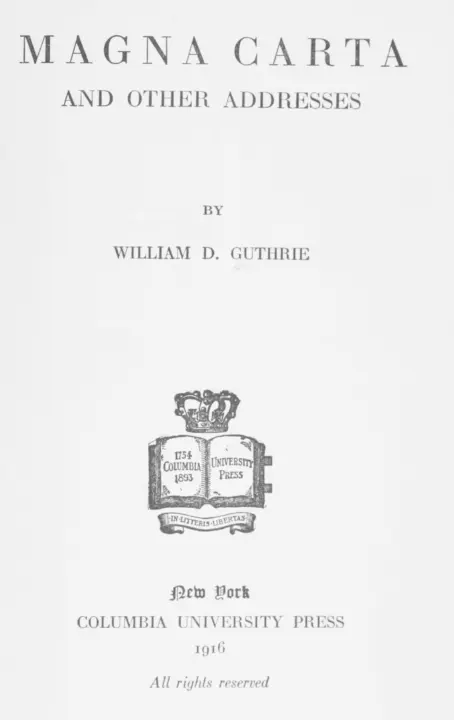
THE CLASSIC COLLECTION · 1916
"Magna Carta and Other Addresses" by William D. Guthrie is a collection of historical and legal addresses written in the early 20th century. The work primarily focuses on foundational documents of American democracy, such as the Magna Carta and the Mayflower Compact, examining their influences on civil liberties and constitutional principles in the United States. The addresses reflect on the significance of these historic milestones in the context of contemporary governance and law. The opening of the book begins with an address commemorating the 700th anniversary of the Magna Carta, delivered at a New York Constitutional Convention. Guthrie highlights the Great Charter's profound legacy in safeguarding individual liberties and establishing the rule of law against tyranny. He discusses how the Magna Carta provided essential principles regarding governance and justice which resonate through subsequent American constitutional developments. The address emphasizes the importance of these historical documents in nurturing a commitment to civil rights, alongside a cautionary note on the need for vigilance in preserving these hard-won freedoms in the face of contemporary legal challenges.
Introduction adapted from the source catalogue; source summaries may be automatically generated.
Free to read · English · 71,269 words · No account needed
MAKE TIME FOR A GOOD BOOK
On by default. Untick to stop anonymous reading totals. Each page counts after 10 seconds in view. How this works.
Anonymous counting is on unless you have switched it off.
Morality, a condition of social welfare and individual
happiness, 250, 252;
taught in Catholic schools, 250, 255.
See Constitutional Morality.
Natural rights, a cardinal principle of Magna Carta, 6.
New York city, tobacco workers in tenements, 49-57;
board of health, 50;
death-rate, 51;
tenement-house conditions, 55-57;
courts, 141, 142;
parochial schools, 254, 257.
New York state, constitution, 12, 19, 23, 24, 49, 258;
Court of Appeals, 50, 57, 65, 80, 138, 139, 141, 145, 146,
154-156, 212;
Bar Association, 75, 131, 140;
conflicts with the federal courts, 87;
practice as to injunctions, 148, 151-152;
population, 204, 234;
religious denominations, 256.
North Carolina vs. Temple, 95.
Officers, Public, responsibility of, 14, 103-106, 111, 114, 226;
fair criticism desirable, 47;
greater permanency of tenure advocated, 143;
their selection important, 221;
in New York, 222-224.
Osborn vs. U.S. Bank, 112-114.
Parliament, and Magna Carta, 3;
its power formerly limited, 7, 8, 10;
its supremacy, 9-11, 17-18, 76-77, 107;
formerly believed to exist to uphold Magna Carta, 10, 25;
its consent to taxation necessary, 16;
parliament of 1265 developed from the commune consilium, 16;
prototype in parliament of Simon de Montfort, 18;
labor laws, 79;
statute on the Petition of Right, 101.
Parties, Political, essential to free government, 206, 238-242; should follow the representative principle, 207; effect of initiative and referendum upon, 207; corruption not cured by primaries, 236, 238; party government, 238-242.
People vs. Koerner, 145.
People vs. Lochner, 57-58, 153.
People vs. Lustig, 145.
People vs. Turley, 143.
Perkins, James Breck, 263, 264.
Persecution, Religious, in 16th and 17th centuries, 33-34;
by Puritans in Massachusetts, 33;
often really political, 33n, 34;
in England, 36-37;
of Catholics in America, 258-259.
Petition of Right, relation to Magna Carta, 15, 23;
procedure under, 99-102.
Phelps, Edward J., 26n.
Pilgrim Fathers, debt of America to, 29, 32, 34, 35;
framed first written constitution, 30;
their tolerance, 32, 33;
their relation to the Puritans, 32, 34;
hated by both Puritans and Cavaliers, 32;
separated Church and State and established religious liberty, 32, 34;
their experiment in communism, 37-39;
established representative government in America, 39;
military preparedness, 41.
See Mayflower Compact.
Plymouth colony, government of, 23, 37, 39;
Governor Bradford's annals of, 30n;
freedom from religious persecution, 33;
absorbed by Massachusetts in 1691, 37.
Poindexter vs. Greenhow, 112.
Police power, exercised by the legislature, 60;
its just exercise not hindered by the courts, 81-82;
very comprehensive, 211.
Precedents, their value in the law, 22;
judges bound by, 46;
danger of establishing, 52.
Primary elections, see Elections.
Progressive party, 183, 204, 211, 217.
Prohibition, Writ of, 107.
Prosecuting attorney, his work, 143, 144, 146.
Prout vs. Starr, 110.
Public service corporations, legislative oppression of, 120;
right of appeal to the courts, 121-126;
regulation necessary, 126.
Puritans, their relation to the Pilgrims, 32, 34;
their views, 32-33;
our debt to them, 34;
their influence in England, 34-35.
Quakers, 33n.
Quo warranto, Writ of, 107.
Railroads, oppressed by legislation, 120, 121, 123.
Recall, a menace to our republican governments, 39, 193,
205-207, 209-211;
agitation for, 47;
applied to judicial decisions, 211.
Referendum, see Initiative.
Religion, growing disrespect for, 201; impracticable to teach it in the public schools, 248; the foundation of our social order, 250-252; should be taught systematically to school children, 252-254, 256; religious denominations in the United States, 255-256. See Liberty and Persecution.
Your reading position is saved on this browser. Take it to another device with a library code. Reading pages adapt to text, rather than matching a printed edition.
BEHIND THE BOOK
This eBook is for the use of anyone anywhere in the United States and most other parts of the world at no cost and with almost no restrictions whatsoever. You may copy it, give it away or re-use it under the terms of the Project Gutenberg License included with this eBook or online at www.gutenberg.org. If you are not located in the United States, you will have to check the laws of the country where you are located before using this eBook. Read the source licence.
The original source file, including credits and licence, is retained by this library. Request an original-format copy at no charge. Please include the book title and Project Gutenberg identifier #64197.
KEEP YOUR CURIOSITY GOING
David Patterson (Spirit) Hatch

David Patterson (Spirit) Hatch

David Patterson (Spirit) Hatch
Cécile Tormay

Moritz Busch
John L. Ransom