
Last letters from the living dead man
David Patterson (Spirit) Hatch
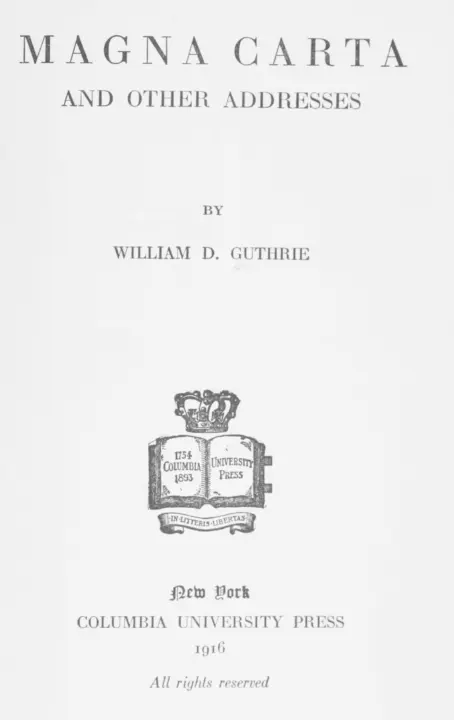
THE CLASSIC COLLECTION · 1916
"Magna Carta and Other Addresses" by William D. Guthrie is a collection of historical and legal addresses written in the early 20th century. The work primarily focuses on foundational documents of American democracy, such as the Magna Carta and the Mayflower Compact, examining their influences on civil liberties and constitutional principles in the United States. The addresses reflect on the significance of these historic milestones in the context of contemporary governance and law. The opening of the book begins with an address commemorating the 700th anniversary of the Magna Carta, delivered at a New York Constitutional Convention. Guthrie highlights the Great Charter's profound legacy in safeguarding individual liberties and establishing the rule of law against tyranny. He discusses how the Magna Carta provided essential principles regarding governance and justice which resonate through subsequent American constitutional developments. The address emphasizes the importance of these historical documents in nurturing a commitment to civil rights, alongside a cautionary note on the need for vigilance in preserving these hard-won freedoms in the face of contemporary legal challenges.
Introduction adapted from the source catalogue; source summaries may be automatically generated.
Free to read · English · 71,269 words · No account needed
MAKE TIME FOR A GOOD BOOK
On by default. Untick to stop anonymous reading totals. Each page counts after 10 seconds in view. How this works.
Anonymous counting is on unless you have switched it off.
Representative government, foundation laid by Magna Carta, 4, 16, 18; synonymous with the republican form of government guaranteed by the Constitution, 31, 39, 75, 76, 227; first established in America by the Pilgrims, 31, 39, 40; a development from democracy, 39; menaced by modern political nostrums, 39, 43, 204-211, 228, 245-246; the form may survive the substance, 46; depends upon the electorate, 206; involved in nominating conventions, 225 sqq.; contribution of English-speaking race, 226.
Republican form of government, see Representative government.
Republican party, campaigns, 178 sqq.;
principles, 217-218;
New York convention of 1914, 234.
Revolution, American, 25, 162, 262-266.
Roman Catholic church, parochial schools, 247-260;
sacrifices for education, 247, 254;
attitude toward public schools, 248-249;
teaches character, good citizenship and morality, 250, 252,
253, 255, 256;
increasing strength in the United States, 256;
formerly persecuted in America, 258-259.
Rome, 6, 27, 44, 168.
Roosevelt, Theodore, 56-67, 121, 153-156, 159-160, 183-189,
209, 213-215.
Root, Elihu, 75, 153, 176, 185, 194.
Separation of powers, see Government.
Shintō, worship of, 27-29.
Ship-Money, Case of, 17.
Short ballot, see Elections.
Sixteenth amendment, 83, 83n.
Socialism, tends to destroy religion, morality and law, 201;
opposition of Socialists to the courts, 211.
See Communism.
Social reform, as class legislation, 43; practical reform can be effected by electing legislators of character and ability, 44; not to be accomplished by exalting the legislature at the expense of the courts, 44, 45, 84, 140; not impeded by the courts or our constitutions, 56, 68-69, 81-82, 135, 137, 155.
Standish, Myles, 33, 41.
State governments, American, reserved powers of the states, 61,
62, 177;
suability of a state, 87 sqq.;
theory of immunity from suit, 98;
prohibitions against, 110;
compelled to obey the federal Constitution, 113;
state officers are suable, 114;
conflicts with the federal courts, 117-128;
right to regulate inheritances, 160, 167-172;
governmental functions, 172;
threatened by primaries, 246.
Strikes, use of injunctions to suppress, 146-152, 212-215; Pullman strike of 1894, 148, 151, 215-216.
Supremacy and Uniformity, Acts of, 32, 36-37.
Supreme Court, Federal, some important decisions, 8, 57, 60, 61,
62, 72, 89, 93, 95, 96, 100, 101, 113, 173;
view of due process of law, 21-22;
attacks upon, 63, 64, 68;
jurisdiction of suits against states, 93 sqq.
See Judiciary.
Taft, William H., 184, 190-193, 217-218.
Tariff, doctrine of protective, 193-201;
non-partisan commissions, 194, 218;
free trade favored by the Democrats, 195, 198;
act of July 4, 1789, 196;
evils of Democratic legislation, 198, 199;
not responsible for the high cost of living, 199.
Taxation, the chief legislative function in the 13th and 14th
centuries, 9, 16;
provisions in Magna Carta, 16;
control of parliament over, 16, 17;
early controversies in England, 16-18;
and representation, 16-17, 162-163;
essentially a legislative function, 17;
inheritance tax, 159-160, 167-173;
income tax, 159, 173-175;
power to tax is the power to destroy, 160;
conflict of state and federal, 160;
should be equal and apportioned, 161;
taxing power liable to abuse, 161;
proportional taxation, 161-163;
federal rule of apportionment, 173-174;
excise tax, 173.
See Graduated taxation.
Tenement case, see Jacobs case.
Throop, Governor, 221.
Truth, indispensable even in political discussions, 69;
trite truths often the most valuable, 202;
eternal, 203.
Turgot, Baron de L'Aulne, 264.
Unconstitutional laws, American doctrine based upon the statute
of 1369, 7, 8, 11;
doctrine formerly recognized in England, 7-10;
English courts may yet annul, 11;
examples, 49, 57, 61, 65, 122, 123, 137, 209;
Hamilton's views, 71-72;
cannot always be annulled by the courts, 170-171.
See Constitutional limitations.
Your reading position is saved on this browser. Take it to another device with a library code. Reading pages adapt to text, rather than matching a printed edition.
BEHIND THE BOOK
This eBook is for the use of anyone anywhere in the United States and most other parts of the world at no cost and with almost no restrictions whatsoever. You may copy it, give it away or re-use it under the terms of the Project Gutenberg License included with this eBook or online at www.gutenberg.org. If you are not located in the United States, you will have to check the laws of the country where you are located before using this eBook. Read the source licence.
The original source file, including credits and licence, is retained by this library. Request an original-format copy at no charge. Please include the book title and Project Gutenberg identifier #64197.
KEEP YOUR CURIOSITY GOING
David Patterson (Spirit) Hatch

David Patterson (Spirit) Hatch

David Patterson (Spirit) Hatch
Cécile Tormay

Moritz Busch
John L. Ransom