
Last letters from the living dead man
David Patterson (Spirit) Hatch
THE CLASSIC COLLECTION · 1916
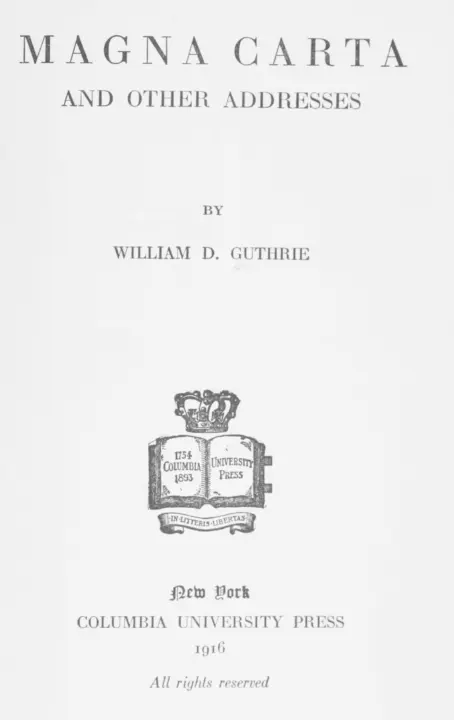
"Magna Carta and Other Addresses" by William D. Guthrie is a collection of historical and legal addresses written in the early 20th century. The work primarily focuses on foundational documents of American democracy, such as the Magna Carta and the Mayflower Compact, examining their influences on civil liberties and constitutional principles in the United States. The addresses reflect on the significance of these historic milestones in the context of contemporary governance and law. The opening of the book begins with an address commemorating the 700th anniversary of the Magna Carta, delivered at a New York Constitutional Convention. Guthrie highlights the Great Charter's profound legacy in safeguarding individual liberties and establishing the rule of law against tyranny. He discusses how the Magna Carta provided essential principles regarding governance and justice which resonate through subsequent American constitutional developments. The address emphasizes the importance of these historical documents in nurturing a commitment to civil rights, alongside a cautionary note on the need for vigilance in preserving these hard-won freedoms in the face of contemporary legal challenges.
Introduction adapted from the source catalogue; source summaries may be automatically generated.
Free to read · English · 71,269 words · No account needed
MAKE TIME FOR A GOOD BOOK
On by default. Untick to stop anonymous reading totals. Each page counts after 10 seconds in view. How this works.
Anonymous counting is on unless you have switched it off.
Liberty, Constitutional, Justice Story on, 25; in the custody of the American people, 26; the Pilgrim Fathers assist at its birth in America, 30.
Liberty, Religious, secured by the New York constitution, 12; idea of, in Magna Carta, 12, 13; established in America by the Pilgrims of Plymouth, 32, 34; our greatest blessing, 34; secured by the courts, 77-78; favored by non-sectarian public schools, 248; fostered in America by Protestants, 251, 259; formerly denied to Catholics in New York, 258; secured temporarily in New York by Governor Dongan, 259.
Lincoln, Abraham, 26, 191, 246.
Lottery case, 46.
Madison, James, 88, 186, 189, 197.
Magna Carta, general treatment, 1-26; marked our greatest political epoch, 1; saved England from despotism, 1; the source of representative government, 1-2, 16, 18; the foundation of liberty and justice, 1, 4; reissues and confirmations, 2, 3, 7, 8, 20, 22; extolled by the royal governor of New York, 2; crystallized and perpetuated English liberties, 2, 3, 5, 21; all Americans enjoy its privileges, 2, 3, 5; granted at Runnymede, June 15, 1215, 3; still on the English statute books, 3; a battle-cry against tyranny, 3, 11; modern criticism of, 3-4, 7, 8, 15, 19; the value of its traditions, 4-5, 26; based upon eternal truths and to endure forever, 5, 21, 203; established the rights of the individual as against the government, 6, 7; long regarded as an unalterable fundamental law, 6-10; limited the power of the king, 11, 12, 24-25; denounced by the Pope, 12; established the supremacy of the law, 14; translated and explained in the churches, 14; guaranteed the writ of habeas corpus, 15; separated legislative and executive power, 16; prevented taxation without the consent of parliament, 16-17; the law of the land, 18-22; jury-trial, 19, 20; supplemented by the statute of 1354, 22-23; justified revolution for cause, 25.
Majorities, Temporary, may yet be restrained in England, 11;
arbitrary action, 40, 124;
their alleged infallibility a dangerous doctrine, 43;
the proposal to free them from all restraints, 43;
their ever-changing opinions and desires as a rule of constitutional
construction, 45-46;
oppressive class legislation, 74, 78-79;
need to be restrained, 75;
exercise of the taxing power, 165;
would overrule the courts, 211.
See Minorities.
Mallet, Monsieur, 262, 266.
Marbury vs. Madison, 8, 72, 100, 124.
Marshall, Chief Justice, his decision in Marbury vs.
Madison, 8-9, 72-73, 100;
on the Constitution, 21;
on the suability of a state, 88;
on the eleventh amendment, 93-94, 95;
on restraining state officers, 113-114;
on civil liberty, 124;
on the duty of judges, 129;
unpopular decisions, 210.
Martial law, as the alternative of injunctions, 151.
Master and servant, three common-law rules changed by
Congress, 62-63, 68;
the common law to be changed by the legislature, not by the courts,
68-69, 134-135, 137-138, 155;
soundness of the common-law rules, 132-134.
See Workmen's Compensation.
Mayflower, 27, 29, 30, 32, 37.
Mayflower Compact, main treatment, 27-41; its interest to Americans, 29, 30, 31, 40; called the first written constitution, 30; text as preserved by Governor Bradford, 30n-31n; its covenant for just and equal laws, 31, 35-37; initiated republican government, 31, 40.
Minorities, English courts may yet have to protect, 11;
their protection entrusted by the founders to the
courts, 25, 43, 75, 76, 78;
secure under representative government, 40;
threatened by the short ballot, 223.
See Judiciary.
Monroe, James, 186, 189, 197.
Your reading position is saved on this browser. Take it to another device with a library code. Reading pages adapt to text, rather than matching a printed edition.
BEHIND THE BOOK
This eBook is for the use of anyone anywhere in the United States and most other parts of the world at no cost and with almost no restrictions whatsoever. You may copy it, give it away or re-use it under the terms of the Project Gutenberg License included with this eBook or online at www.gutenberg.org. If you are not located in the United States, you will have to check the laws of the country where you are located before using this eBook. Read the source licence.
The original source file, including credits and licence, is retained by this library. Request an original-format copy at no charge. Please include the book title and Project Gutenberg identifier #64197.
KEEP YOUR CURIOSITY GOING
David Patterson (Spirit) Hatch

David Patterson (Spirit) Hatch

David Patterson (Spirit) Hatch
Cécile Tormay

Moritz Busch
John L. Ransom