
Last letters from the living dead man
David Patterson (Spirit) Hatch
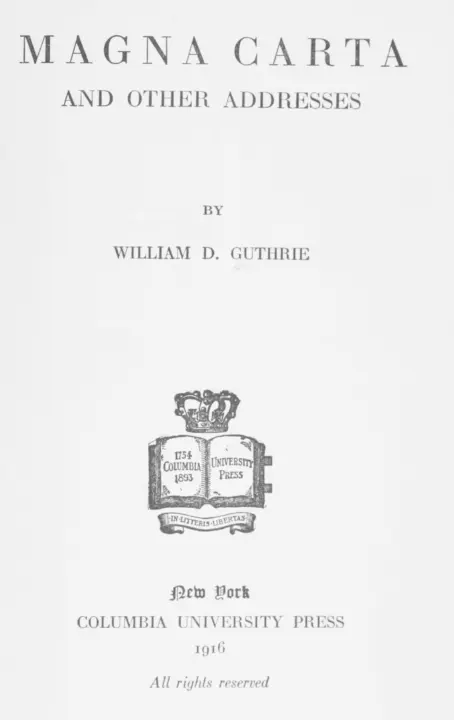
THE CLASSIC COLLECTION · 1916
"Magna Carta and Other Addresses" by William D. Guthrie is a collection of historical and legal addresses written in the early 20th century. The work primarily focuses on foundational documents of American democracy, such as the Magna Carta and the Mayflower Compact, examining their influences on civil liberties and constitutional principles in the United States. The addresses reflect on the significance of these historic milestones in the context of contemporary governance and law. The opening of the book begins with an address commemorating the 700th anniversary of the Magna Carta, delivered at a New York Constitutional Convention. Guthrie highlights the Great Charter's profound legacy in safeguarding individual liberties and establishing the rule of law against tyranny. He discusses how the Magna Carta provided essential principles regarding governance and justice which resonate through subsequent American constitutional developments. The address emphasizes the importance of these historical documents in nurturing a commitment to civil rights, alongside a cautionary note on the need for vigilance in preserving these hard-won freedoms in the face of contemporary legal challenges.
Introduction adapted from the source catalogue; source summaries may be automatically generated.
Free to read · English · 71,269 words · No account needed
MAKE TIME FOR A GOOD BOOK
On by default. Untick to stop anonymous reading totals. Each page counts after 10 seconds in view. How this works.
Anonymous counting is on unless you have switched it off.
Judiciary, Federal, jurisdiction to enjoin state officers, 87,
108-110, 113, 117, 119;
efforts to curtail power of, 88, 125;
jurisdiction limited, 97;
power to annul state laws a necessity, 108, 109, 112, 116, 124-129;
compels the states to obey the Constitution, 113;
power to enjoin criminal prosecutions by the states, 117-119;
causes of dissatisfaction with, 126;
oath of office of judges, 127;
constituted as a bulwark of liberty, 128;
assaults upon, 128, 146-152;
issuance of injunctions in labor disputes, 213-217;
power to punish for contempt, 215-217.
See also Supreme Court.
Jurisprudence, as a science, 13, 52.
Jury-trial, origin in Magna Carta, 15, 19-20;
early history, 19-20;
a right assured by the judicial power, 78;
not in cases of contempt, 215.
Justice, political justice secured by Magna Carta, 1, 4, 13-15; the highest political liberty, 13; uniformity and certainty essential in its administration, 13; social justice, 43, 81-82; delays in its administration, 125, 126, 142-146.
Knisley vs. Pratt, 137, 155.
Labor, competition of foreign workmen, 196, 197, 198;
conditions in 1896, 198-199.
See Master and servant.
Labor laws, in New York, 50, 56, 58, 59, 137, 156.
Labor unions, attitude toward the courts, 131, 140-141;
some labor leaders, 131, 147, 212;
opposition to injunctions, 146-152.
Labourers, Statute of, 79.
Langford vs. United States, 103.
Langton, Stephen, 5, 12.
Law, how to be administered, 13;
wiser than those who administer it, 14;
principle of the supremacy of the law, 14, 103-107, 111, 114;
just and equal laws, 31, 35, 36, 37, 152;
equality before the law, 35, 36, 161;
growing disregard of, 43, 201;
touches every individual, 85.
See Common law, Due process of law, Fundamental laws,
Law of the land, Justice, Judges, and Judiciary.
Lawlessness, manifested in alleged reforms, 43; and in labor organizations, 150, 217; its growth in connection with the spread of socialism, 201.
Law of the land, a phrase wiser than those who wrote it, 5;
the epitome of ancient and forgotten wisdom, 5-6;
guaranteed by Magna Carta, 9, 18, 21, 22;
the equivalent of "due process of law" (q.v.), 18;
meaning, 18, 19, 21, 22;
in American constitutions, 18-19, 23-24;
in the Petition of Right, 23.
Lawyers, see Bar.
Lecky, W.E.H., 164.
Legislation, formerly not a panacea for all ills, 9;
practical reforms needed, 44, 205-206;
alleged social legislation, 49-54, 153, 154;
particular legislation criticized as being arbitrary, crude,
experimental, meddlesome, and oppressive, 52, 80, 82, 120-125,
163, 245;
a rule of construction, 154-155;
necessity for exact language, 208;
great volume of statutes, 204, 208.
See Class legislation and Social legislation.
Legislature, taxation originally its chief function, 9; limitations upon, 43-46, 51, 70, 71, 78, 81, 124; corruption charged by social reformers, 44; abandoning constitutional questions to the courts, 47; duty to apply constitutional principles, 52; supreme in its sphere, 52; power to protect the public health, 59, 60. See Constitutional limitations, Legislation, and Congress.
Leroy-Beaulieu, Pierre Paul, 166.
Liberty, Civil, guaranteed by Magna Carta, 1, 4, 5;
Declaration of Independence, 4, 81;
early charters of the French kings, 5;
writ of habeas corpus its bulwark, 15, 16;
conditions necessary for its perpetuation, 26, 36, 37;
guaranteed by the Constitution, 51, 76;
legislative interference with, 74, 80;
of vital concern to everyone, 84;
guarded by the common law, 98;
its essence, 124;
some political documents, 203;
threatened by temporary majorities (q.v.), 211.
Your reading position is saved on this browser. Take it to another device with a library code. Reading pages adapt to text, rather than matching a printed edition.
BEHIND THE BOOK
This eBook is for the use of anyone anywhere in the United States and most other parts of the world at no cost and with almost no restrictions whatsoever. You may copy it, give it away or re-use it under the terms of the Project Gutenberg License included with this eBook or online at www.gutenberg.org. If you are not located in the United States, you will have to check the laws of the country where you are located before using this eBook. Read the source licence.
The original source file, including credits and licence, is retained by this library. Request an original-format copy at no charge. Please include the book title and Project Gutenberg identifier #64197.
KEEP YOUR CURIOSITY GOING
David Patterson (Spirit) Hatch

David Patterson (Spirit) Hatch

David Patterson (Spirit) Hatch
Cécile Tormay

Moritz Busch
John L. Ransom