
Last letters from the living dead man
David Patterson (Spirit) Hatch
THE CLASSIC COLLECTION · 1916
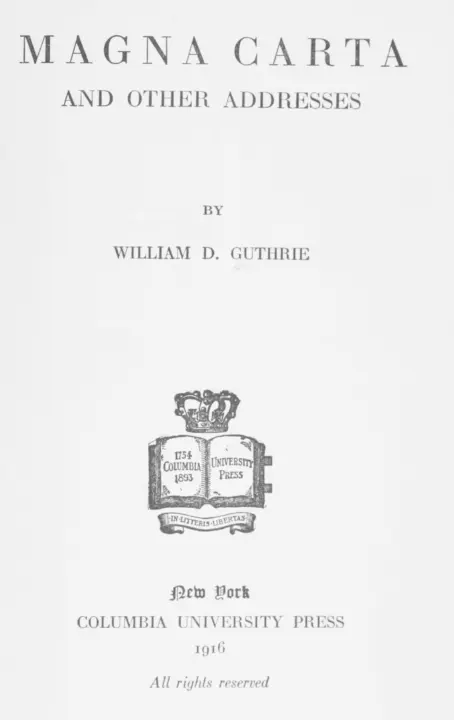
"Magna Carta and Other Addresses" by William D. Guthrie is a collection of historical and legal addresses written in the early 20th century. The work primarily focuses on foundational documents of American democracy, such as the Magna Carta and the Mayflower Compact, examining their influences on civil liberties and constitutional principles in the United States. The addresses reflect on the significance of these historic milestones in the context of contemporary governance and law. The opening of the book begins with an address commemorating the 700th anniversary of the Magna Carta, delivered at a New York Constitutional Convention. Guthrie highlights the Great Charter's profound legacy in safeguarding individual liberties and establishing the rule of law against tyranny. He discusses how the Magna Carta provided essential principles regarding governance and justice which resonate through subsequent American constitutional developments. The address emphasizes the importance of these historical documents in nurturing a commitment to civil rights, alongside a cautionary note on the need for vigilance in preserving these hard-won freedoms in the face of contemporary legal challenges.
Introduction adapted from the source catalogue; source summaries may be automatically generated.
Free to read · English · 71,269 words · No account needed
MAKE TIME FOR A GOOD BOOK
On by default. Untick to stop anonymous reading totals. Each page counts after 10 seconds in view. How this works.
Anonymous counting is on unless you have switched it off.
Graduated taxation, general discussion, 159-177;
exempts the majority and burdens the minority, 160, 163, 166;
a means to break up large fortunes, 160, 169-170;
may amount to confiscation, 163-166;
necessarily arbitrary, 163;
as forced loans in France, 164;
Lecky's views, 164-165;
McCulloch's views, 165-166;
views of Leroy-Beaulieu, 166.
Great Britain, 10, 101.
See England.
Great Charter, see Magna Carta.
Greece, fundamental laws in, 6;
ancestor-worship, 27;
Athenian democracy, 42, 75.
Gunter vs. Atlantic Coast Line, 96.
Habeas corpus, Writ of, the bulwark of personal liberty, 15, 16;
its antecedent in Magna Carta, 15;
in England, 15, 107;
rendered effective by the courts, 77.
Hamilton, Alexander, 71, 74, 88, 161.
Hampden, John, 17, 34.
Hans vs. Louisiana, 95.
Hearn, Lafcadio, 28, 29n.
Henry VIII., 32, 36.
Holden vs. Hardy, 60.
Hunter vs. Wood, 119n.
Impositions, Case of, 17.
Income Tax cases, 173, 175.
Income Tax, 159, 173-175.
Inheritance Tax, 159-160, 167-173.
Initiative and Referendum, a menace to our republican form of
government, 39, 193;
origin in distrust of legislatures, 44;
agitation for, 47, 204;
in Australia, 81;
a scheme of the Progressives, 204-209.
Injunctions, as used to restrain state officers, 87-88, 97, 109-114; to restrain officers of the crown in England, 106-107; to restrain criminal proceedings, 117-119; to prevent the enforcement of unconstitutional state statutes, 120, 125, 127, 128; use in connection with strikes and labor disputes, 146-152, 212-217; New York practice, 148, 151-152.
Inquisition, Writ of, 14, 15.
Institutions, the slower their growth the more enduring they are, 1; English source of American institutions, 98, 266-267; the Roman Catholic church and American institutions, 249-250.
Intestate succession 167-169.
Ives case, 65-69, 153.
Jacobs case, 49-57, 153, 154.
James I., 17, 30n, 31n.
Japan, 27-29, 197.
Jefferson, Thomas, 186, 187, 189, 197, 205.
John, King, 4, 7, 12, 25.
Judges, qualifications, 13, 14, 70, 142, 243-245;
bound by principles, rules and precedents, 46;
not infallible, 47;
duty to enforce the law, 128, 129, 209;
selection and tenure, 139-142, 243-245;
should be defended against unjust criticism, 69-70, 126-128, 157-158.
See Judiciary and Recall.
Judiciary, power to annul unconstitutional laws, 7-9, 25, 42 sqq., 70 sqq., 87 sqq., 109 sqq.; former dependence upon the crown, 10, 17; has no power over legislation in England and France, 11, 76, 77, 107; importance recognized in Magna Carta, 13, 14; defended against unjust criticism, 43 sqq., 130-158, 181, 193, 211-212; government by, 45-46; rules for determining the constitutionality of a statute, 45, 46, 52; charged with having usurped power over legislation, 45, 70, 81; examples of alleged abuse of power, 48-68; cannot control legislative discretion, 52; should avoid judicial legislation, 62, 135; necessity of defending against unfair criticism, 69, 70, 126-128, 158; must enforce the Bill of Rights, 77; control over executive and administrative officers, 103-107, 111, 114; necessity for confidence in, 126-128; the bulwark of liberty, 128, 226; independence of, 141, 142, 226; not responsible for delays, 142-146. See Judges, Constitutional limitations, Injunctions, and Recall.
Your reading position is saved on this browser. Take it to another device with a library code. Reading pages adapt to text, rather than matching a printed edition.
BEHIND THE BOOK
This eBook is for the use of anyone anywhere in the United States and most other parts of the world at no cost and with almost no restrictions whatsoever. You may copy it, give it away or re-use it under the terms of the Project Gutenberg License included with this eBook or online at www.gutenberg.org. If you are not located in the United States, you will have to check the laws of the country where you are located before using this eBook. Read the source licence.
The original source file, including credits and licence, is retained by this library. Request an original-format copy at no charge. Please include the book title and Project Gutenberg identifier #64197.
KEEP YOUR CURIOSITY GOING
David Patterson (Spirit) Hatch

David Patterson (Spirit) Hatch

David Patterson (Spirit) Hatch
Cécile Tormay

Moritz Busch
John L. Ransom